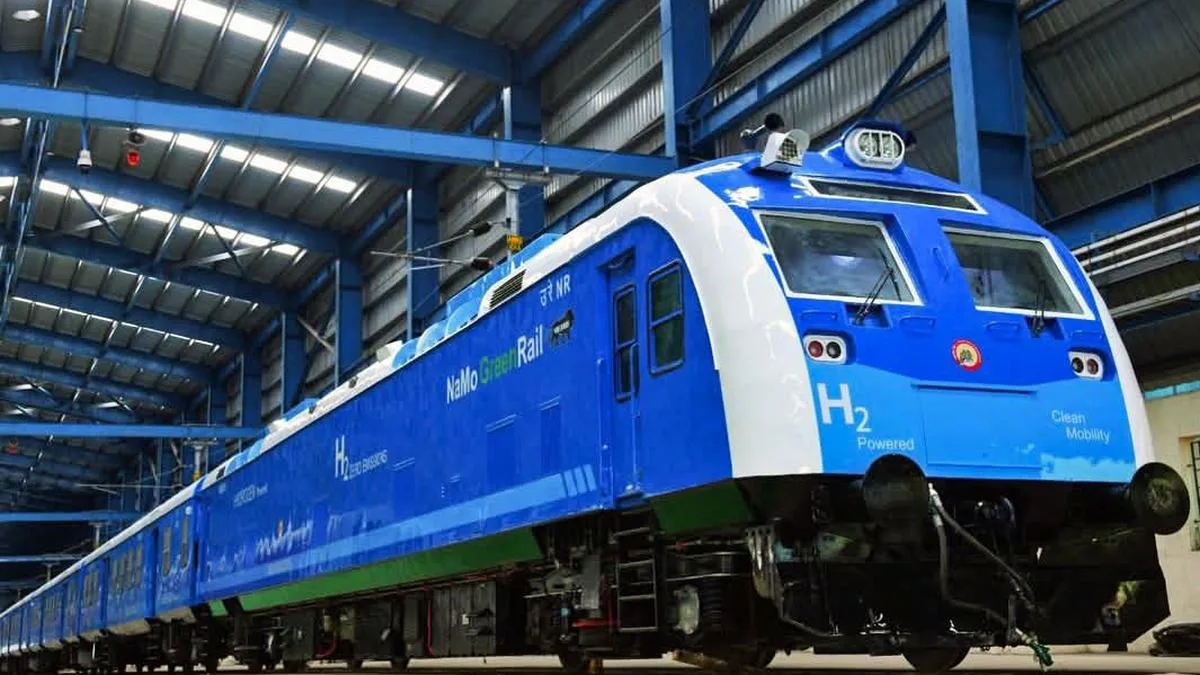
India is set to enter a new era of green mobility today as Prime Minister Narendra Modi will flag off the country’s first hydrogen-powered train, developed using indigenous technology. The train will operate on the Jind-Sonipat route in Haryana and is expected to showcase India’s growing capabilities in clean energy and advanced railway technologies.
The hydrogen-powered train is being launched as part of the government’s broader efforts to promote sustainable transportation and reduce dependence on fossil fuels. With the introduction of the service, India joins a small group of nations that have deployed hydrogen fuel-cell technology in rail operations.
How hydrogen fuel cell technology works
Unlike conventional diesel-powered trains, hydrogen trains generate electricity onboard through a fuel-cell system. Compressed hydrogen stored in onboard cylinders reacts with oxygen from the atmosphere inside fuel cells to produce electricity, which powers the train’s traction motors.
The process produces only water vapour and heat as by-products, making hydrogen trains a zero-emission mode of transport.
The technology eliminates direct carbon emissions during operation and reduces dependence on fossil-fuel-based transportation systems.
India’s first hydrogen train: Key features
According to information released by the Press Information Bureau (PIB), the train has been designed and developed using indigenous technology and is among the most ambitious hydrogen rail projects undertaken globally.
The broad-gauge train consists of 10 coaches, including two Driving Power Cars (DPCs) positioned at either end and eight passenger coaches in between.
It is equipped with a 3,200-horsepower (2,400 kW) hybrid propulsion system that combines a Proton Exchange Membrane Fuel Cell (PEMFC) with lithium iron phosphate (LFP) battery technology.
The train has been designed for a maximum speed of 110 kmph, although commercial operations on the Jind-Sonipat route will initially be limited to 75 kmph.
The train is also fitted with advanced safety systems capable of detecting hydrogen leaks, heat build-up, smoke and fire, ensuring safe passenger operations.
India joins global hydrogen rail network
The launch places India alongside countries that have already experimented with or deployed hydrogen-powered rail services.
Germany: Germany became the first country in the world to operate a commercial fleet of hydrogen-powered passenger trains. The trains replaced diesel services on non-electrified regional routes in Lower Saxony and currently operate on the EVB network connecting towns such as Cuxhaven, Bremerhaven, Bremervörde and Buxtehude.
China: China developed Asia’s first hydrogen-powered urban train and has also deployed hydrogen-powered trams. The country’s hydrogen rail network is centred around Chengdu in Sichuan Province, where hydrogen technology is being integrated into public transport systems.
Japan: Japan has focused on hydrogen rail research through its “Hybari” train project. Developed using Toyota fuel cells and Hitachi battery systems, the train has undergone testing on the Tsurumi and Nanbu Lines in Kanagawa Prefecture near Tokyo.
United States: The United States has adopted hydrogen technology for both passenger and freight rail operations. One of its hydrogen-powered passenger trains set a Guinness World Record by travelling 2,803 kilometres on a single tank of hydrogen during testing. Commercial passenger services are currently operating on California’s Arrow corridor in San Bernardino County.
Step Towards Sustainable Transportation
The launch of India’s first hydrogen-powered train is being viewed as an important step in the country’s clean energy transition and decarbonisation efforts.
Hydrogen is increasingly being explored worldwide as a viable alternative to fossil fuels in sectors where electrification is difficult or expensive. For railways, hydrogen trains offer a cleaner option for routes that are not fully electrified, while also reducing long-term carbon emissions.
Indian Railways has been pursuing several green initiatives in recent years, including railway electrification, renewable energy adoption and the introduction of energy-efficient technologies. The hydrogen train project adds another dimension to these efforts and could pave the way for wider adoption of hydrogen-powered mobility solutions in the future.
With the inaugural run taking place today, India joins the growing list of nations betting on hydrogen as a key component of the future transport ecosystem.