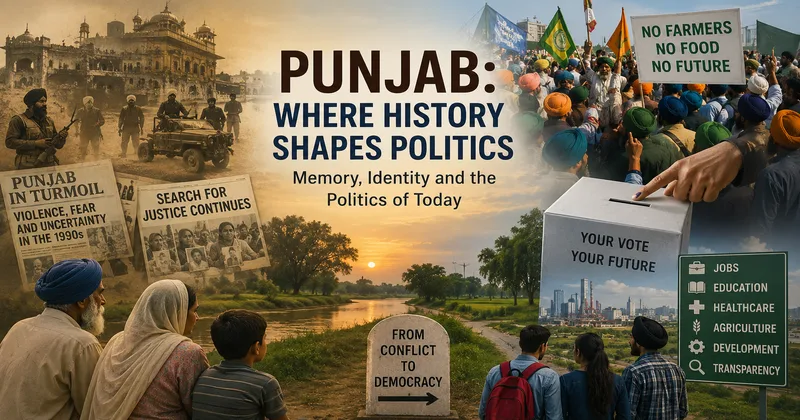
More than three decades after the violence of the late 1980s and early 1990s, Punjab continues to negotiate the legacy of that period in its politics, elections, and public discourse. The film serves as a reminder that history in Punjab is not confined to textbooks or archives. It remains an active force that shapes political identities, electoral narratives, and public expectations.
Unlike many Indian states, where elections are primarily dominated by economic issues or leadership contests, Punjab’s political landscape has long been shaped by historical memory. This does not mean that voters remain trapped in the past. Rather, the past provides a framework through which contemporary issues are interpreted. Questions of federalism, religious identity, law and order, agricultural policy, migration, and governance are often understood against the backdrop of the state’s experiences during the decades of conflict and recovery.
The roots of this political memory stretch beyond the 1990s. Punjab’s post-Independence history witnessed linguistic reorganisation, the Green Revolution, demands for greater state autonomy, and evolving debates over Centre-State relations. These developments created a political environment in which regional identity became closely intertwined with governance. By the late 1970s and early 1980s, political disagreements increasingly overlapped with religious and constitutional questions, setting the stage for one of the most difficult periods in the state’s modern history.
The violence associated with militancy during the 1980s and early 1990s transformed every aspect of public life. Civilians, police personnel, public officials, journalists, religious figures, and political workers became victims of violence. Alongside militant attacks, allegations of excesses during counterinsurgency operations generated long-lasting debates over accountability and justice. Families across Punjab experienced loss in different ways, making the period impossible to reduce to a single narrative. Some remember it primarily as a time when terrorism disrupted everyday life, while others also recall unresolved questions surrounding disappearances and human rights. For many, these experiences existed simultaneously.
The restoration of electoral politics during the 1990s marked an important transition from conflict toward democratic normalcy. Elections became symbols of institutional recovery as political competition gradually replaced armed confrontation. Governments that followed focused on rebuilding public confidence, restoring administrative functioning, and encouraging economic activity. Although security remained a concern, political discourse slowly shifted toward development, agriculture, infrastructure, and public services. Nevertheless, the memory of conflict remained embedded within institutions and society, influencing public trust and political behaviour.
Punjab’s party system also reflects this historical continuity. The rivalry between regional and national political forces has often revolved around competing interpretations of Punjab’s interests within the Indian Union. Regional parties have generally emphasised federal principles, linguistic identity, agricultural concerns, and Sikh institutions, while national parties have often highlighted broader questions of national integration, security, and economic policy. In practice, however, these distinctions have frequently overlapped, with parties adapting their positions according to changing electoral realities rather than fixed ideological boundaries.
Agriculture provides another example of how historical memory influences contemporary politics. The Green Revolution transformed Punjab into one of India’s most productive agricultural regions, but it also created structural challenges relating to groundwater depletion, crop diversification, and farm incomes. Farmers’ movements have consistently drawn upon historical narratives of sacrifice, self-reliance, and regional contribution to the nation. During the protests against the three farm laws between 2020 and 2021, references to Punjab’s political history frequently appeared alongside economic demands. The movement demonstrated how historical identity and contemporary policy debates remain interconnected.
Migration has similarly reshaped political conversations. Punjab has witnessed significant emigration over several decades, particularly among younger generations seeking educational and economic opportunities abroad. For many families, overseas migration represents aspiration rather than political disillusionment. Nevertheless, public debate often connects migration with concerns about unemployment, educational quality, and economic diversification. Political parties increasingly address these issues because younger voters are less likely to define their political choices solely in terms of historical memory. Their priorities include jobs, entrepreneurship, healthcare, digital infrastructure, and transparent governance alongside questions of identity.
This generational transition is one of the defining characteristics of present-day Punjab politics. Citizens who experienced the violence firsthand often evaluate political leadership through memories of insecurity and institutional breakdown. Younger voters, by contrast, know the period largely through family conversations, journalism, academic research, documentaries, and cultural works. Their understanding of the 1990s is therefore mediated rather than lived. As a result, history continues to matter, but its political meaning evolves with each generation.
The persistence of memory also reflects the absence of complete historical closure. Around the world, societies emerging from political violence often continue debating accountability long after armed conflict ends. Punjab is no exception. Legal proceedings, human rights documentation, scholarly research, and journalistic investigations have contributed to understanding different aspects of the period, but disagreements remain over interpretation, responsibility, and historical emphasis. Such debates are common in democracies where multiple perspectives coexist, and historical inquiry remains ongoing.
Political parties selectively invoke historical events to reinforce credibility, question opponents, or appeal to particular constituencies. Issues such as public debt, industrial growth, education, healthcare, environmental sustainability, narcotics control, urban development, and agricultural reform occupy increasingly central positions. Historical memory influences how these issues are understood.
The emergence of new political actors in recent elections further illustrates changing voter priorities. Demands for administrative efficiency, anti-corruption measures, improved public services, and accountable governance have gained prominence alongside traditional identity-based politics. This shift suggests that while history continues to shape political consciousness, voters increasingly evaluate governments through everyday performance rather than symbolic appeals alone. Electoral success now depends on balancing historical sensitivity with credible responses to present-day challenges.
This is where Satluj ’95 assumes limited but meaningful relevance. The film does not explain Punjab’s politics, nor does it claim to provide a complete history of the period. Instead, it reflects the persistence of public interest in questions that remain emotionally and politically significant. Its importance lies in illustrating that historical memory continues to invite debate, even decades after the events it depicts. The broader conversation extends far beyond cinema into classrooms, courtrooms, political speeches, academic research, and family discussions.
Punjab today is a state defined by both continuity and change. Its elections increasingly revolve around governance, employment, agriculture, education, and development, yet historical memory continues to influence how these issues are interpreted. The politics of the 1990s resonates not because society remains trapped in that decade, but because its consequences continue to shape institutions, political language, and collective identity.
Understanding contemporary Punjab, therefore, requires more than analysing electoral data or party strategies. It also requires recognising that memory itself has become a political force, one that informs democratic participation without determining it entirely.