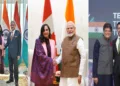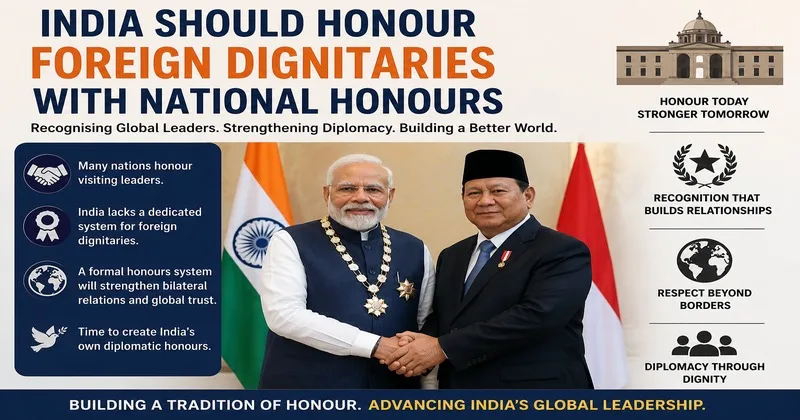
Indonesian President Prabowo Subianto conferred the country’s highest state honour, the Bintang Adipurna. The award was presented by President Subianto during the ongoing state visit of PM Modi to Indonesia on 7 July. The award is in recognition of PM Modi’s visionary leadership in strengthening bilateral ties and advancing regional cooperation between Indonesia and India. The conferment highlights the growing strategic partnership and mutual trust shared by the two countries in the Indo-Pacific region. With this award, PM Modi has received 35 international honours from countries across Asia, Europe, Africa and the Americas. In contrast, previous prime ministers like Jawahar Lal Nehru, Indira Gandhi and Manmohan Singh collectively received only 14 international awards.
India also confers honours and civilian awards to foreign dignitaries to recognise exceptional service and strengthen international diplomacy. India’s highest civilian award, Bharat Ratna, can be conferred upon non-Indians. Unfortunately, only two foreign dignitaries have received this honour: Khan Abdul Ghaffar Khan (1987) and Nelson Mandela (1990). Similarly, the Padma series of awards, namely Padma Vibhushan, Padma Bhushan and Padma Shri, can be conferred to foreign nationals for their contribution in various fields. Then we also have Jawahar Lal Nehru Award for International Understanding, which is given to honour outstanding contributions to the promotion of international understanding, goodwill and friendship among the people of the world. It was first given in the year 1965 to U Thant (Burma) and continued till the year 2009, last awarded to Angela Merkel (Germany).
From the above, it is evident that India does not have a formal system to recognise foreign dignitaries and heads of state during their visit to India for their contribution in strengthening bilateral relations, regional cooperation and international order. In an era of proactive diplomacy, the nations around the globe follow a system of international recognition for foreign dignitaries during their visit. In such nations, the visiting foreign dignitary is recognised publicly by the head of state. Such immediate and prompt recognition has been a key factor in strengthening the bilateral relations for them, besides other collateral benefits. In the era of PM Narendra Modi, India’s diplomacy has achieved significant gains as a major global player, particularly as the leader of the Global South. PM Modi has given a very high level of personal touch to India’s diplomacy. It is evident during the personal welcome at the airport, ceremonial welcome in the Rashtrapati Bhawan and high-level interaction in the Hyderabad House.
In my opinion, India should now constitute a series of awards specifically for the foreign dignitaries and heads of state. The nominated dignitaries should have played a key role in strengthening the bilateral relations and should have supported India’s cause in the international arena. Since the programme for the visit of a foreign dignitary, particularly a head of state, is finalised well in advance, a decision to recognise the dignitary can be taken in time. The award can be bestowed during the ceremonial welcome at the Rashtrapati Bhawan, or at the Hyderabad House, or at any other place of convenience. Such awards can be in two or three series in the form of diplomacy, global peace or climate change warrior.
Similarly, a separate series of military awards for foreign military commanders can also be instituted. But the first priority should be to immediately institute Bharat’s highest national honour to the foreign dignitaries who strengthen bilateral relations and further India’s cause in the international arena. Such a step would further India’s stature in the global arena and would play a key role in India’s proactive diplomacy.