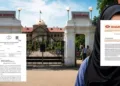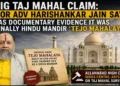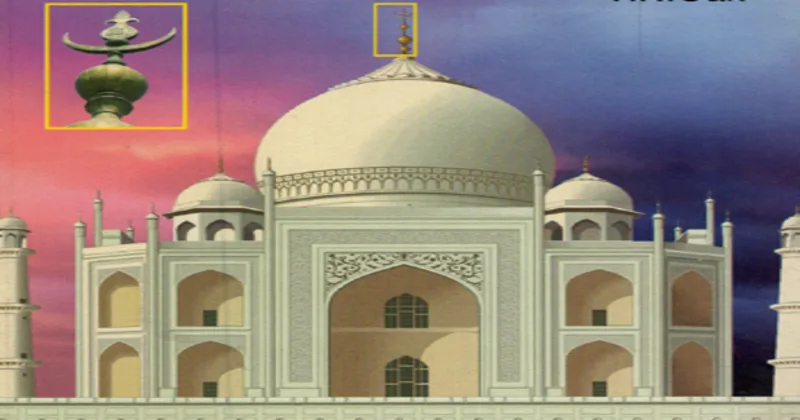
For decades, the question of whether the Taj Mahal stands upon an earlier Hindu religious structure-popularly described by some as “Tejo Mahalaya” has remained one of the most debated issues in Indian historiography. The debate has often been dismissed as politically inconvenient rather than academically examined. The recent proceedings before the Allahabad High Court, therefore, assume significance not because the Court has reached any historical conclusion, but because it has shown a willingness to allow the judicial process to examine the issue.
The High Court has sought responses from the Union Government and the Archaeological Survey of India (ASI) on a plea seeking appointment of an Advocate Commissioner under Order XXVI Rule 9 of the Code of Civil Procedure for a local inspection of the Taj Mahal. The Court has not held that the Taj Mahal was originally a Shiva temple, nor has it accepted the “Tejo Mahalaya” theory. What it has done is uphold a foundational principle of justice: disputed claims deserve to be examined through due process and evidence.
For far too long, several questions concerning India’s civilizational past have remained confined within ideological boundaries. Many believe that alternative interpretations of medieval history were ignored or rejected without adequate scholarly engagement. Whether that perception is justified is itself a matter of debate. Yet in a democratic society, no historical proposition should be immune from scrutiny merely because it challenges long-held narratives.
India is one of the world’s oldest civilizations. Its temples, sacred sites, and cultural institutions have witnessed centuries of political change, conquest, reconstruction, and preservation. It is therefore neither unreasonable nor unhistorical to examine claims relating to the origins of ancient monuments where credible evidence is asserted to exist. Such examination must, however, be guided by constitutional values, archaeological science, documentary records, and established historical methodology not by emotion or political rhetoric.
This is precisely where the judicial process acquires importance. Order XXVI Rule 9 CPC enables a court to appoint a Commissioner whenever a local investigation may assist in resolving matters in dispute. It is a procedural device intended to facilitate fact-finding; it is not a declaration of historical truth. The appointment of a Commissioner, if eventually ordered, would merely assist the Court in understanding the physical features of the monument. The final determination, if any, would continue to depend upon the evidence produced before the Court.
The willingness of the Allahabad High Court to hear the matter reflects confidence in the rule of law. Courts neither preserve historical orthodoxy nor rewrite history to suit contemporary preferences. Their constitutional role is to ensure that competing claims are tested fairly, transparently, and on evidence.
A mature nation should never fear historical inquiry. If the accepted historical account is correct, it will withstand scrutiny. If fresh archaeological or documentary material materially alters our understanding, scholarship must be willing to engage with it. Civilizations grow stronger when they possess the confidence to examine their own past without intellectual insecurity.
The present proceedings should therefore not be viewed as a contest between ideology and history. They represent an affirmation that legal institutions remain open to examining disputed questions through constitutional methods. That, in itself, is a healthy sign for a democratic republic committed to truth and justice.
The final word on the origins of the Taj Mahal has not been spoken by the Allahabad High Court. The Court has merely opened the door to legal examination. Whether that examination ultimately supports or rejects the claims will depend upon evidence placed before the Court. But the larger principle deserves appreciation: history should not be insulated from inquiry, and inquiry should never be insulated from evidence.
A civilization that respects its heritage must also respect the process through which historical truth is established. India’s past is too rich and too important to be reduced either to unquestioned orthodoxy or unquestioned revisionism. The pursuit of historical truth must remain open, rigorous and rooted in evidence.