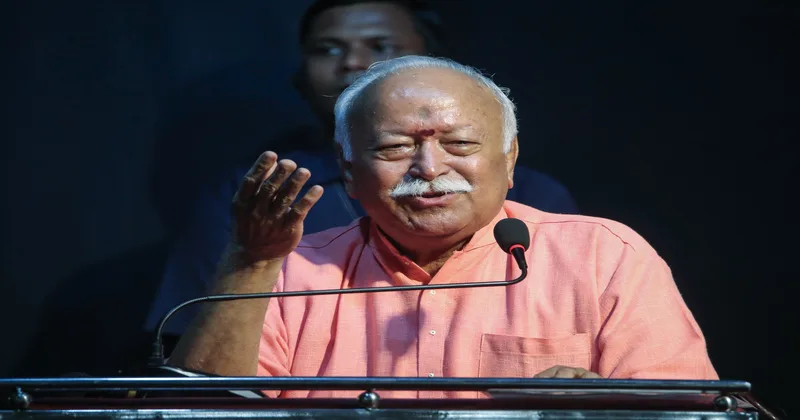
Nagpur: Rashtriya Swayamsevak Sangh (RSS) Sarsanghchalak Dr Mohan Bhagwat on July 4 asserted that the RSS does not function as the “remote control” of any organisation, emphasising that its primary role is to nurture individuals dedicated to society rather than direct independent institutions.
‘RSS Is Not Anyone’s Remote Control’
Addressing a long-standing perception about the organisation, Bhagwat categorically stated that the RSS does not exercise operational control over institutions working in different sectors.
He said organisations associated with various fields function independently, while the RSS remains focused on its core mission of character building and preparing dedicated volunteers committed to national and social service.
“The RSS does not operate any organisation through remote control. Its fundamental work is to build individuals and create volunteers devoted to society,” Bhagwat said.
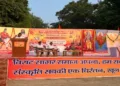
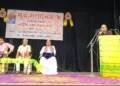
Addressing a public screening of the YouTube documentary “Dr. Hedgewar – Adhunik Yug Ke Shalivahan” at the Scientific Society Hall in Nagpur’s Laxminagar, Dr Bhagwat said that while the form and scale of an organisation’s work may evolve over time, its foundational values must remain unchanged.
“The nature of work may change with time, but its core principles should never change,” Bhagwat said, adding that the greatest challenge for any growing organisation is preserving its original ideals while expanding its reach and influence.
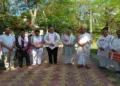
The event also marked the release of the 101st episode of Milind Rahatgaonkar’s audiovisual series “Asu Amhi Sukhane, Patthar Payatil.” The programme was attended by organising committee president Rajesh Avachat, secretary Shriram Pimpalikar, and a large number of RSS volunteers.
Growth Brings Greater Responsibility
Dr Bhagwat observed that as an organisation gains public trust, recognition and resources, it also faces the risk of complacency.
He said periods of struggle and neglect eventually give way to appreciation and institutional growth, but such moments demand greater introspection rather than self-satisfaction.
According to him, organisations must continually assess whether their commitment to their founding mission remains as strong as it was during their formative years and whether their efforts continue to move in the right direction.
Values Must Be Lived, Not Merely Studied
The RSS chief stressed that principles and ideologies cannot be fully understood through books alone.
He said values acquire meaning only when they are translated into daily conduct and that understanding any movement requires exploring its roots and practising its ideals in real life.
Bhagwat added that individuals should lead by personal example instead of expecting change from others.
RSS Shakha Is a Laboratory for Character Building
Describing the RSS shakha as a “laboratory for personality development,” Bhagwat said it is far more than a venue for daily activities.
He noted that the organisation seeks to shape volunteers who remain steadfast in their principles even under adverse circumstances and dedicate themselves to the service of society.
He also remarked that the RSS is better understood through direct experience than through reading or listening about it.
Volunteerism Is a Lifelong Discipline
Calling volunteer development a lifelong spiritual and moral discipline, Bhagwat said becoming a swayamsevak is not a short-term process but a continuous journey of self-improvement.
He underlined that true dedication requires surrender not only of time and effort but also of one’s ego and even one’s personal nature.
“Even after making sacrifices, a volunteer should not develop the ego of having sacrificed,” he said.
Ideal Conduct in Every Sphere of Life
Bhagwat said an RSS volunteer’s family, social and professional life should reflect exemplary conduct.
He maintained that inspiring new volunteers through personal character and social responsibility constitutes genuine organisational work.
Referring to growing international curiosity about the RSS, Bhagwat said people from several countries visit to understand its functioning and often ask whether the organisation’s model of cultivating socially committed youth could be adapted in their own societies.