In a state that has more certified persons with disabilities than the population of several European nations, only policy cannot afford to be an afterthought. On July 2, 2026, Chief Minister Yogi Adityanath chaired a high-level review of the Divyangjan Empowerment Department in Lucknow and announced a decision that speaks directly to the most vulnerable among the vulnerable. The monthly maintenance grant for mentally challenged and destitute divyangjan living in shelter-home-cum-training centres and halfway homes has been raised from Rs 2,000 to Rs 3,000 per resident. The 50 per cent enhancement, the Chief Minister explained, recognises a simple truth. These residents depend entirely on institutional care, and providing them nutritious food, proper healthcare, and a life of dignity is not charity but the government’s foremost duty, made more urgent by the rising cost of essentials.
CM Review That Went Beyond the Files
The Chief Minister directed that assistive-device distribution camps be organised regularly in every district so that eligible beneficiaries receive artificial limbs, motorised tricycles and other equipment matched to their actual needs, within fixed timelines rather than bureaucratic convenience. He placed particular emphasis on hearing-impaired children, instructing officials to identify them at the earliest stage, complete cochlear implant surgeries in a time-bound manner and ensure structured post-operative rehabilitation. The department reported that 226 such children underwent implants in 2025-26, while 335 more have already been identified across 68 districts in the current financial year. Special schools drew equally sharp attention where teacher postings must be completed on schedule, regular recruitment accelerated, and interim arrangements guaranteed so that no divyang child’s education suffers at any level. Barrier-free access in government buildings, the Chief Minister added, must move forward as a priority, not a formality.
From Sympathy to Shakti: The Antyodaya Lens
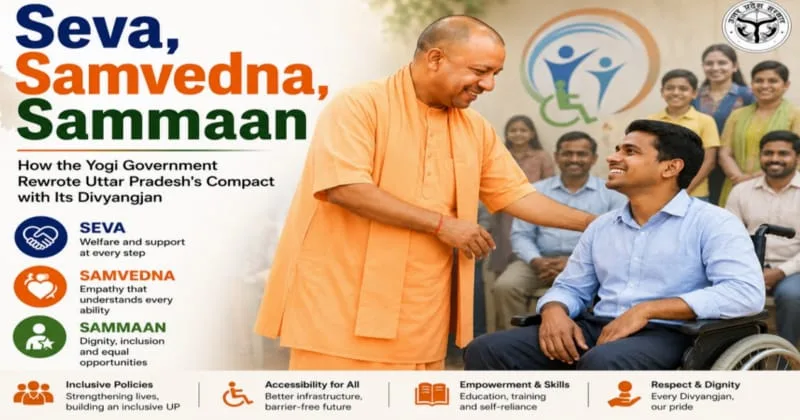
The philosophical thread running through nine years of this governance model is unmistakable. When Prime Minister Narendra Modi replaced the dismissive “viklang” with “divyang” in public discourse, he restored to lakhs of citizens the dignity that officialese had long denied them. Yogi Adityanath has repeatedly invoked this shift, citing Rishi Ashtavakra, Mahakavi Surdas and Jagadguru Rambhadracharya as proof that Bharat’s civilisational memory never equated physical limitation with incapacity. At the state-level award ceremony on International Day of Persons with Disabilities in December 2024, he framed the mission in three words: seva, samvedna, and sammaan, i.e. service, sensitivity and respect. This is Antyodaya in practice, the Deendayal Upadhyaya ideal of reaching the last person in the queue, translated into budget lines, buildings and bank transfers.
The Pension That Refused to Stay Token
Nothing illustrates the transformation more concretely than the Divyang Pension Yojana. In 2017, when the present government assumed office, the pension stood at a meagre Rs 300 a month and was routinely delayed. Today, every eligible beneficiary receives Rs 1,000 monthly, credited directly into bank accounts through the treasury’s e-payment system via PFMS, eliminating middlemen and leakage. The number of 12,23,295 divyangjan drew the pension in 2025-26 alone. Also, the department runs the leprosy-affected persons’ pension, the marriage incentive award scheme that encourages matrimonial inclusion, and the shop construction and operation scheme that converts welfare recipients into self-employed proprietors. Free travel on Uttar Pradesh State Road Transport Corporation buses completes a package designed around one principle where mobility of money, mobility of body, and mobility of opportunity matter most. Significantly, the pension was shifted from the Social Welfare Department to a dedicated Department of Empowerment of Persons with Disabilities, giving the constituency an administrative home of its own with focused budgeting and monitoring.
Rehabilitation Centres speaks of Development
Infrastructure has been the quiet revolution. In December 2025, the state cabinet approved fully equipped Divyangjan Sashaktikaran Kendras in all 18 divisional headquarters, each built at an estimated Rs 5 crore on the lines of the Composite Regional Centre model, with the state bearing the entire construction and recurring cost. Every centre will house physiotherapy, occupational therapy, speech therapy, psychological counselling, prosthetic and orthotic fitting, vocational training and early-intervention programmes for children under a single roof. The rationale is geographic justice as over 55 lakh certified persons with disabilities in Uttar Pradesh had long depended on limited facilities concentrated in Lucknow, Gorakhpur and a handful of cities. The divisional network cuts that travel burden decisively. Earlier the same year, the government moved to fund all 38 District Disability Rehabilitation Centres from state resources with an annual outlay of around Rs 12 crore, ending a situation where barely five or six centres received Central assistance. By October 2025, when the Chief Minister ordered that districts with functioning centres upgrade them into model facilities and districts without them establish new ones inside district hospitals, 37 districts already had operational rehabilitation centres. District-level committees chaired by the District Magistrate now monitor each facility, ensuring accountability travels down to the tehsil.
Classrooms That Refuse to Exclude
Education for divyang children has expanded on two fronts simultaneously. Special schools, numbering 16 until 2017, have grown to 28, offering free education, hostels, meals, health check-ups and assistive equipment. Bachpan Day-Care Centres for early childhood intervention, once confined to 10 districts, now operate in 25, with establishment underway in 28 more, a trajectory that will soon cover the bulk of the state.
At the apex stand two dedicated universities, a distinction few states can claim: Dr Shakuntala Misra National Rehabilitation University in Lucknow and Jagadguru Rambhadracharya Divyang State University in Chitrakoot, the latter founded by the Padma Vibhushan-decorated seer who lost his eyesight in infancy and went on to master 22 languages. The Chief Minister has pressed for trained teachers, adequate honorariums and technology integration across these institutions, alongside pre-primary and day-care facilities and shelter-cum-training centres for mentally challenged residents in cities such as Meerut, Bareilly and Gorakhpur.
The assistive-device pipeline demonstrates administrative muscle. In 2025-26, the department distributed 43,689 devices of various categories to 34,420 eligible divyangjan, from artificial limbs to hearing aids. The free motorised tricycle scheme has become a visible symbol of restored independence on the streets of Uttar Pradesh, letting beneficiaries commute to work, markets and temples without depending on family members. Nearly 15 lakh divyangjan in the state have registered on the UDID portal, most holding unique identity cards that unlock entitlements seamlessly across departments. Each of these numbers represents a household where dependence has yielded ground to agency, the difference between a young man waiting at home and the same young man running a shop allotted under the department’s livelihood scheme.
Guarding Those Who Cannot Ask
The July decision on shelter homes deserves to be read in this larger arc. Residents of these institutions, mentally challenged persons abandoned by families, destitute divyangjan with nowhere to turn, occupy the outermost margin of society. They do not lobby, vote in blocs or trend on social media. That a government chose to enhance their per-capita maintenance by half, unprompted by any agitation, reflects the samvedna the Chief Minister speaks of. He has simultaneously ordered that every scheme touching social, economic, medical, physical and educational rehabilitation show effective implementation on the ground, warning that dignity promised on paper means little unless it reaches the last bed in the last shelter home.
Uttar Pradesh divyangjan agenda now runs on three reinforcing tracks: direct income support at scale, permanent rehabilitation infrastructure in every division and an education-to-employment ladder from day-care centre to university to shop ownership. The distance travelled since 2017 from Rs 300 pensions to Rs 12 lakh-strong beneficiary rolls, from 16 special schools to 28, from scattered facilities to an 18-division network testifies that when governance is anchored in the civilisational conviction that every soul is divya, the divyang cease to be a category of pity and become partners in Bharat’s rise.