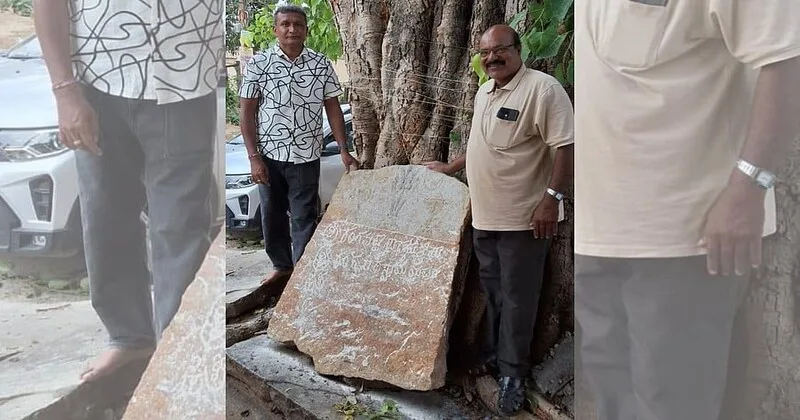
Bengaluru: An 18th-century inscription from the reign of Mysore ruler Immadi Krishnaraja Wadiyar has been discovered in Dibbur village of Hesaraghatta hobli, Bengaluru, shedding new light on village grants made to temples under the Mysore kingdom.
The inscription was identified during a field survey by history researcher M. Narendra under the guidance of historian Vivekananda Sajjan and epigraphist K. Dhanpal.
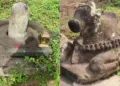
The stone inscription was discovered near the Anjaneya Mandir in Dibbur village. According to K. Dhanpal, it dates to 1750 during the reign of Immadi Krishnaraja Wadiyar (1734–1766) and records the grant of Dibbur village to the Sri Ranganatha Swamy Mandir in Srirangapatna to support Mandir rituals and daily worship.
“The inscription records that the revenue and taxes collected from the village were dedicated to the maintenance of the Mandir, the conduct of festivals, and the performance of daily worship and ritual services (anga-ranga bhoga and puja kainkarya),” Dhanpal said.
The newly discovered inscription, though brief, closely matches another inscription found near the Anjaneya Mandir at Nagamangala, a village near Yelahanka, in terms of its script, iconography and layout. This similarity suggests that both Dibbur and Nagamangala were granted to the same temple during the same royal donation.
The upper portion of the inscription is adorned with carvings of the sun and moon, while the centre features the Kirthimukha, a fierce, lion-like mythical guardian face with gaping jaws and fangs that served as an emblem of the Mysore Wadiyars. It also bears depictions of the Sudarshana Chakra, Shankha, and the Vaishnava Trinama symbol.
Narendra said the inscription had remained unnoticed for generations because villagers believed the carved stone was a sacred murti. The inscribed portion was buried beneath the ground, and the stone was worshipped under a small shrine. During the Mandir’s renovation, villagers relocated the slab and placed it beneath a peepal tree near the Mandir, inadvertently revealing the inscription.
Dhanpal said the discovery adds to growing evidence that Immadi Krishnaraja Wadiyar made a series of Mandir endowments across the Yelahanka region during the same year. While several of these inscriptions have been documented in Epigraphia Carnatica, others remain unpublished. He added that the newly documented inscription, along with the Nagamangala record, offers valuable insights into the administrative and religious policies of the Mysore Wadiyars and enhances the understanding of the kingdom’s temple economy during the mid-18th century.