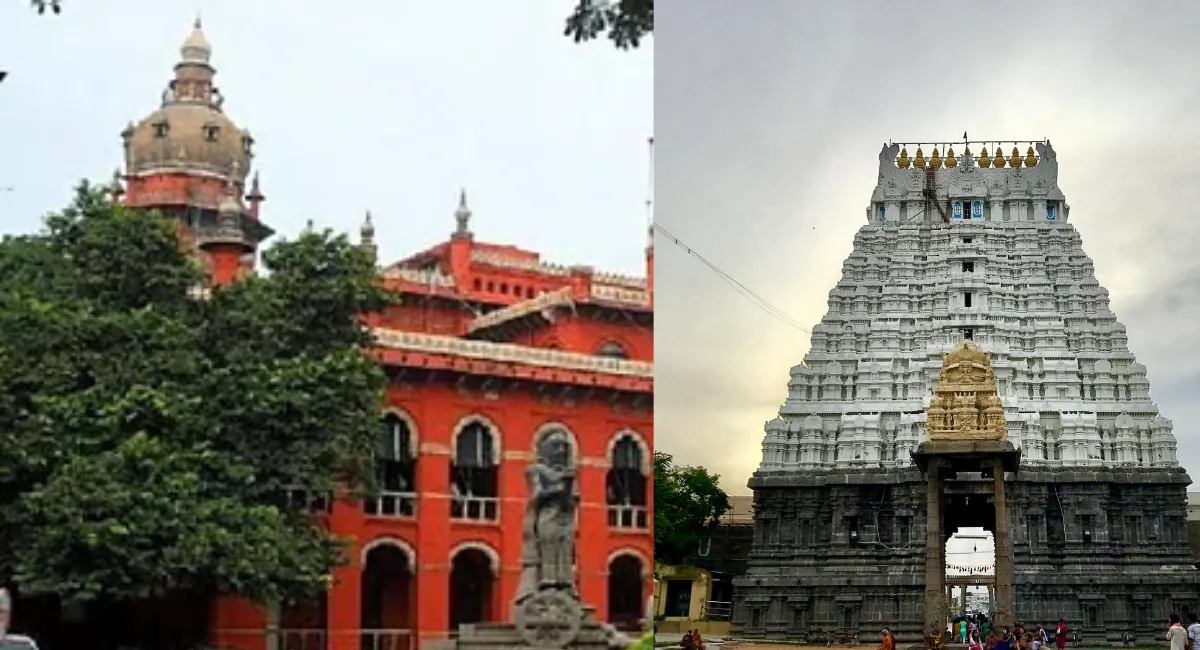
The Madras High Court has held that an American woman who embraced Hindutva cannot be denied entry into a temple merely because she bears a Christian name or holds foreign citizenship.
The court has recently directed the Hindu Religious and Charitable Endowments Department (HR and CE) and the authorities of Abishta Varatharajaperumal Temple in Thanjavur district to permit temple entry to an American woman who had converted to Hinduism. The court clarified that the petitioner shall not be entitled to claim any preferential treatment or special privilege beyond those available to similarly placed Hindu women devotees, thereby reinforcing the principle of equality in access to religious institutions under constitutional and statutory schemes.
Madras High Court allows American who converted to Hinduism to enter temple like any other devotee.
— News Arena India (@NewsArenaIndia) July 1, 2026
While hearing a writ petition filed by Laura Frances Iyengar, single judge Justice D. Bharatha Chakravarthy, in a nine-page order dated June 25, said that the authorities had wrongly described her as an “American Christian woman” and observed that the record demonstrated her consistent adherence to Hinduism.
“This Court is of the considered view that the finding recorded by the respondents describing the petitioner as an ‘American Christian woman’ is factually erroneous and unsustainable.
Merely because the petitioner bears the name ‘Laura Frances’ or holds American citizenship, she cannot be denied recognition as a Hindu when her conduct and belief unequivocally establish her adherence to Hinduism.”
The court said, “Accordingly, the petitioner shall be treated as a Hindu devotee. Consequently, all rights and obligations applicable to a Hindu woman devotee in relation to temple worship shall equally apply to the petitioner.”
The court further observed, “Hinduism is a faith that has historically been inclusive and accommodating. Unlike certain other religions, it does not prescribe any mandatory formal ceremony of conversion or issuance of any certificate as a condition precedent for acceptance into the faith,” while referring to the Supreme Court’s decision in Perumal Nadar (Dead) by LRs vs Ponnuswami.
The judge said that “a mere declaration of faith was insufficient to establish conversion”, while “a bona fide intention to embrace Hinduism, coupled with conduct unequivocally expressing such intention,” constituted adequate proof.
Laura’s counsel argued that describing her as an “American Christian woman” was factually incorrect and unsupported by any material, stating that she had professed and practised Hinduism for years and could not be characterised as a Christian solely because of her nationality.
The dispute arose after certain local residents objected to Laura’s entry into the temple on the mistaken assumption that she did not profess Hinduism.
The High Court declared the August 10, 2024 order illegal to the extent that it proceeded on the assumption that Laura was an American Christian woman.
Laura, an American citizen, had embraced Hinduism several years ago after being drawn to the faith. In her petition, Laura stated that she had undertaken pilgrimages to numerous Hindu temples across the Indian subcontinent and had consistently identified herself as a Hindu in official records, including visa applications, even before her marriage.
Laura married Varadha Balaji Venkadakrishnan, a Hindu, in a ceremony solemnised at the same temple on September 17, 2023. She continued participating in Vaishnavite religious rituals and practices. The petition also noted that her husband’s grandfather had previously served as the temple trustee.