
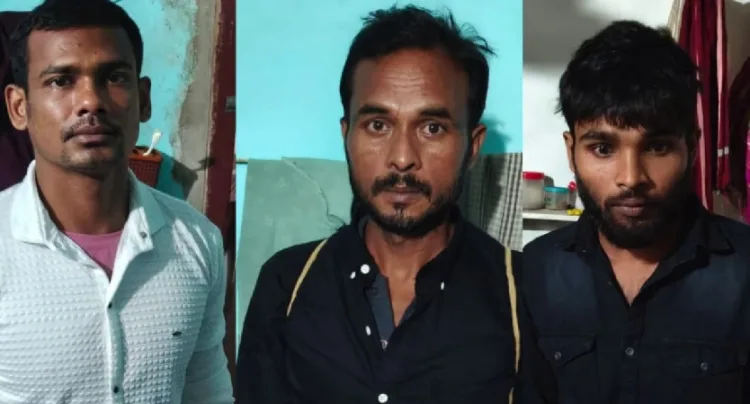
Three Bangladeshi nationals, who entered India illegally without valid passports or visas, are being interrogated by the Intelligence Bureau following their arrest in Kerala’s Kozhikode district. The trio was apprehended by Mavoor Police during a raid at Kalppalli Cottage in Mavoor on July 29 and booked for illegally entering the country.
The accused have been identified as Mohammed Woola (42) from Krishtiya district, and Mohammed Mafdi Hassan (28) and Mohammed Hassan Ali (27) from Upsila village in Bangladesh. Authorities are investigating how they entered India and allegedly obtained identity documents, including Aadhaar cards.
Investigation agencies are probing the origin of the fake identity proofs, SIM cards and other materials, besides examining whether the accused had local contacts. They have stated that they entered the country only 20 days ago.
Police found that the illegal Bangladeshis had stayed in Edavannappara before reaching Kalppalli. Police have seized their mobile phones and other documents. Their employers will also be questioned. They were living in a building owned by Kalppalli native Moideenkkutty. Police have ascertained that the they do not possess any official documents.
The entry of illegal Bangladeshis and their subsequent arrests have become a recurring issue in Kerala. However, mainstream media as well as leaders of mainstream political parties do not consider it a significant issue. The matter continues to be raised primarily by the RSS, BJP and other Sangh-inspired organisations, along with media outlets associated with them.
The recent arrests of illegal Bangladeshi nationals in Kerala point to an organised infiltration and document-forgery network operating across multiple districts. Within June 2026 alone, the Kerala Anti-Terrorism Squad (ATS), Special Branch and local police arrested at least 60 Bangladeshi nationals in separate operations across Kollam, Kochi, Tripunithura and Kozhikode.
The ATS reported the arrest of 36 Bangladeshi nationals, followed by 15 more in Kollam, six near Kochi and three in Kozhikode in subsequent operations. Investigators allege that many of those arrested possessed forged Aadhaar cards, voter IDs, ration cards and PAN cards, with several documents reportedly carrying West Bengal addresses, indicating the possible use of inter-state identity fraud networks.
According to investigators, the pattern emerging from these cases suggests that illegal entrants first cross into India through the eastern border before moving to labour markets in southern states, where they blend in with migrant worker populations. ATS investigations have focused on alleged local facilitators, document-forgery rackets and support networks that helped secure accommodation and forged identity documents. One investigation also examined the alleged use of a madrasa attached to a mosque in Kollam after a Bangladeshi national was arrested there with forged Indian documents.
Security agencies have repeatedly expressed concern that forged Indian identity documents enable illegal migrants to integrate into the workforce, obtain mobile connections, open bank accounts and move across states without immediate detection, raising concerns relating to internal security, identity fraud and the integrity of public records. The Union Government has also constituted a High-Level Committee to study demographic changes arising from illegal immigration and recommend policy responses.
Developments in West Bengal have also drawn attention in the wider debate on illegal immigration. In May 2026, the state government directed district administrations to establish holding centres for apprehended foreign nationals awaiting deportation or repatriation under Union Government guidelines. The move followed increased nationwide scrutiny of illegal Bangladeshi migration and deportation procedures.