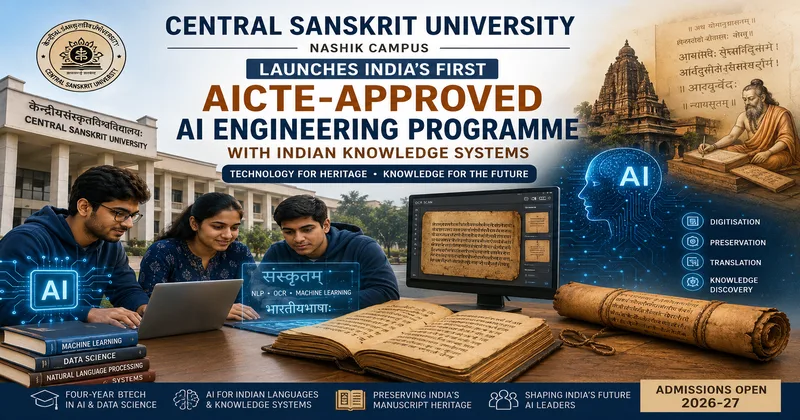
NEW DELHI: Central Sanskrit University (CSU) has launched the country’s first AICTE-approved Bachelor of Technology (BTech) programme in Artificial Intelligence and Data Science at its Nashik campus. The programme, commencing from the 2026-27 academic session will make future-ready AI professionals while harnessing technology to preserve and promote India’s vast repository of ancient knowledge. The four-year engineering programme is a historic milestone as the first AICTE-approved engineering course offered by a Sanskrit university in India. Admissions have already begun for the inaugural batch, with 66 seats available, including 60 regular seats and six supernumerary seats.
The initiative gained national attention after Prime Minister Narendra Modi mentioned it in his recent Mann Ki Baat programme. He said it was a good example of combining modern technology with India’s rich cultural heritage. The Prime Minister added that the programme would help young people develop advanced AI skills while supporting the digitisation and preservation of India’s ancient manuscripts and classical literature. The programme will play an important role in developing Artificial Intelligence tools for Indian languages, accelerating the digitisation of ancient texts, and making India’s centuries-old knowledge traditions more accessible to researchers and future generations.
Engineering Meets Ancient Knowledge
The new BTech programme has been designed to combine conventional engineering education with India’s linguistic and knowledge traditions in line with the vision of the National Education Policy (NEP) 2020, which encourages multidisciplinary learning and the integration of traditional knowledge with modern education. Students will study core engineering subjects including Artificial Intelligence, Machine Learning, Data Science, Python Programming, Statistics, Cloud Computing and Deep Learning. Alongside these, the curriculum introduces specialised courses in Natural Language Processing (NLP), Computational Linguistics, Speech Recognition, Conversational AI, Knowledge Representation, Optical Character Recognition (OCR) and language technologies specifically designed for Sanskrit and other Indian languages.
The interdisciplinary curriculum also enables students to explore how Artificial Intelligence can be applied to traditional Indian disciplines such as Ayurveda, Yoga, Jyotisha (Vedic astronomy and astrology), Vastu Shastra, Nyaya and other branches of Indian Knowledge Systems (IKS). The programme encourages innovative research where AI and computational techniques are used to analyse, organise and preserve centuries-old scholarly works.
Preserving India’s Manuscript Heritage
India possesses one of the world’s largest collections of ancient manuscripts, with millions of texts written in Sanskrit and other classical languages. However, a significant portion of these manuscripts remains undigitised, untranslated or inaccessible to scholars due to their fragile physical condition and linguistic complexity. Artificial Intelligence is playing an increasingly important role in addressing these challenges. Technologies such as OCR, machine learning, language processing and automated translation can help identify, digitise, classify and interpret historical manuscripts with greater speed and accuracy. AI-powered search systems can also improve knowledge retrieval, enabling researchers to access valuable information that has remained hidden for centuries.
By training engineers with expertise in both AI and Indian languages, the university is planning to accelerate the preservation of India’s literary and cultural heritage while contributing to the development of indigenous language technologies.
The course has been launched at a time when India is rapidly expanding its Artificial Intelligence ecosystem through investments in research, digital infrastructure and language technology. The demand for AI professionals is also increasing in sectors such as healthcare, education, finance, manufacturing, governance and scientific research. At the same time, India is focusing on developing AI models that can understand its many languages. The new programme at Central Sanskrit University supports this goal by training students to build AI solutions for Indian languages and help preserve the country’s cultural heritage.
The new programme also signals an important change in higher education. Sanskrit universities have traditionally focused on classical language studies, but this initiative shows how traditional knowledge and modern technology can be brought together. Instead of treating them as separate fields, the course will combine both.