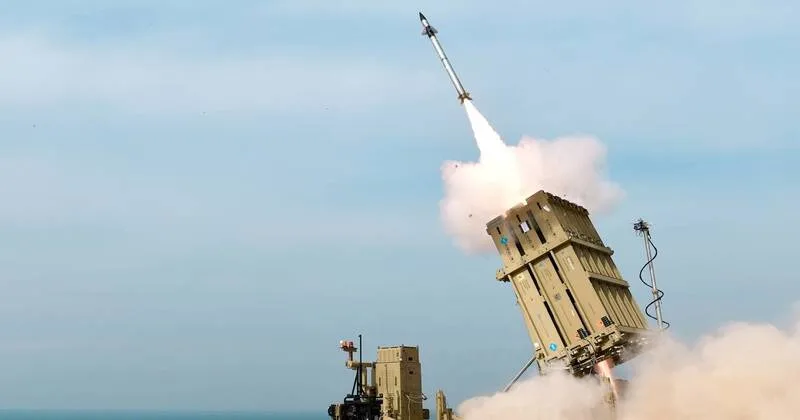
The strategic analysts and geopolitical experts have reiterated that the next phase of India-Israel relations will be overarchingly defined by defence and military partnership. This involves co-development, co-production of military weapons, transfer of critical technology and exchange of strategic information pertaining to collective security. As a reflection of this interpretation about the India-Israel bilateral relations, Tel Aviv is turning to India, to build Iron Dome’s Tamir missiles.
As per the sources, the defence giant of Israel Rafael Advanced Defence Systems, is actively negotiating with India and various defence firms of the country to co-produce Tamir missiles, which is an integral part of the world-class and state-of-the-art Iron Dome air defence system of Israel. Amid escalating geopolitical conflict in West Asia, Israel’s approach to India, reflects the growing credibility of New Delhi as a trusted defence partner to strengthen the regional security architecture.
According to reports, Israel is aiming to set up a production unit in India to co-develop and produce Tamir missiles for the Iron Dome. If rationalised, this will also add leverage and greater momentum to the Make-in-India vision of India. The India-Israel defence ties and co-production of the Tamir missiles will also be a hallmark in the defence indigenisation goal of India. It will also consolidate New Delhi’s footprint in the global defence supply chain as a reliable partner amid spiralling geopolitical faultlines, great power politics and hard-nosed contestations.
Why is Israel turning to India?
As the geopolitical conflict in West Asia soars and the region is suffering from serious fissures, Israel’s approach to India, underscores a greater strategic message and significance. Tel Aviv, which is entangled in a prolonged conflict, is in need of more weapons and military equipment to replenish its offensive and defensive capabilities. Since the conflict with Hamas broke out in October 2023 to the latest confrontation with Iran, Israel’s military reserves are exhaustively utilised. Also, the regional security in West Asia is highly unpredictable and precarious.
Amidst such a volatile scenario, Israel is under a geopolitical compulsion for swift production and stockpile of strategic missiles and other weapon systems. The strong air defence apparatus of any nation is decided by the extent of world-class missiles that the nation possesses. Israel, which is engulfed in a prolonged combat has severely depleted its missiles and other military interceptors. The rate of exhaustion of Tamir missiles and other weapons is far beyond the rate of restocking or replenishment.
Thus, Israel is looking for partners to co-produce missile systems to rigorously manufacture and replenish its weapon pool. In this path, Tel Aviv deems New Delhi as a trusted defence partner. Having a production unit in India, will thus aid Israel to fuel its military goals during intense operations or conflicts. Having decentralised and vast production units for critical weapons, also help Israel strengthen its global defence supply network. With this, Tel Aviv is also articulating a defence diversification strategy beyond the United States.
Washington DC is the primary defence supplier for Tel Aviv. However, with escalating conflicts, sustained military operations and geopolitical upheavals, Israel is looking for new credible defence partners apart from the United States, to reinvigorate its capabilities for battlefield challenges and other national security hiccups. Thus Tel Aviv is turning towards India, to seal a solid long-term defence partnership.
What is Iron dome and Tamir missiles
Iron dome is the hallmark of Israel’s military capabilities and cutting-edge weapon systems. It is a mobile, all-weather air defense system which is capable of intercepting and destroying short-range rockets, artillery, mortars, drones and other Unmanned Aerial Vehicles(UAVs). It helps to intercept and neutralise the intruding enemy targets with great precision and accuracy. It is particularly designed to protect densely populated civilian spaces and other critical infrastructures from the enemy threats.
Iron dome is a highly advanced three part military network. It consists of radar that helps to detect, target, intercept and neutralise incoming aerial threats. It also has a command and control unit that swiftly assesses the speed and trajectory of the threat, thus helps for precision and timely targeting.
Another most critical and complex part of the iron dome is the interceptor missiles. If the enemy threat is targeting a densely populated area or other strategic infrastructure, which is anticipated to cause massive damage, then the iron dome launches these guided interceptor missiles to destroy the threats mid-air. The mobility, operational efficiency, layered defence system and vast security shield rendered by the iron dome even across the densely populated area, makes it one of the world’s most acknowledged air defense systems to defend national security and territorial integrity.
Tamir interceptor missiles form the core and most critical component of Israel’s iron dome system. It is a short-range surface-to-air missile that aids in destroying enemy artillery, rockets, mortars and drones. Guided by the radars, Tamir missiles are extremely fast and flexible. It easily twists through the sky and successfully destroys the incoming threats. The missile is equipped with a high-explosive warhead that detonates near the target and destroys it midair. The missile’s small size and agility allow it to intercept rockets and drones that might otherwise evade larger interceptors.
Hence, Tel Aviv looking towards New Delhi, to co-produce these cutting-edge missiles, which forms the cornerstone of Israel’s national security and defence apparatus sends a significant strategic message about emerging defence partnerships across the volatile geopolitical chessboard.