New Delhi: Delhi Chief Minister Rekha Gupta has drawn a firm line on student safety, giving the city’s coaching institutes one month to comply with essential fire and building safety norms or face shutdown.
https://www.instagram.com/officialrekhagupta/reel/DaFqMR4BhLw/?hl=en
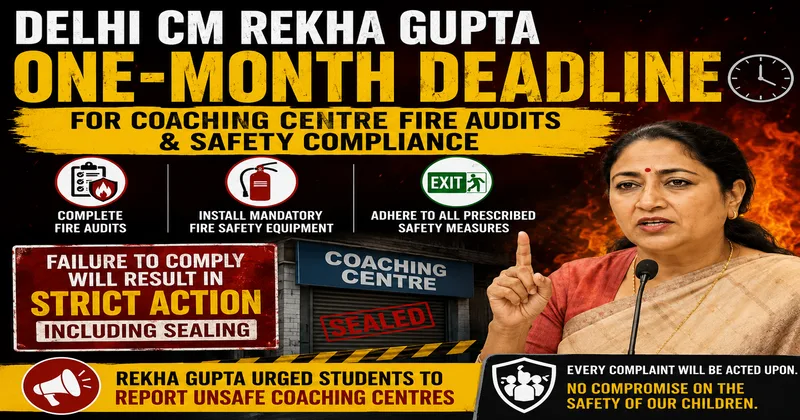
With zero tolerance to laxity and following multiple tragedies rooted in overcrowded, poorly regulated infrastructure across the capital’s education hubs, Chief Minister Gupta has issued a direct public statement declaring that non-compliant centres without proper fire audits, mandatory safety equipment, or adherence to prescribed measures will face strict action, including sealing.
One month. That is the deadline.
The number of coaching institutes in Delhi is not the issue. The safety and security of our children is.
Any coaching institute without a fire audit, mandatory safety equipment or prescribed safety measures will face strict action, including… pic.twitter.com/JZKnvJKaQc
— Rekha Gupta (@gupta_rekha) June 27, 2026
“One month. That is the deadline. The number of coaching institutes in Delhi is not the issue. The safety and security of our children is,” CM Rekha Gupta warned through a social media post.
On Wednesday, 24th June, Delhi Education Minister Ashish Sood directed multiple government agencies, including the Delhi Development Authority (DDA), Municipal Corporation of Delhi (MCD), Delhi Fire Service and Delhi Disaster Management Authority (DDMA), to carry out inspections of coaching centres operating in major educational hubs such as Mukherjee Nagar, Rajender Nagar and Katwaria Sarai.
The minister directed the Delhi Fire Service, Delhi Police, and other agencies to take strict action against coaching institutes violating safety norms or regulations.
Delhi: Minister Ashish Sood says, "There are approximately 923 coaching centers in Delhi. We have already called a meeting of the committee formed to prepare regulations and acts for these coaching centers, which was established based on the Gauba Committee's recommendations. By… pic.twitter.com/89DOEmUNjJ
— IANS (@ians_india) June 25, 2026
The MCD has been asked to submit daily reports on actions taken and compliance status.
The directions were issued during a high-level review meeting attended by officials from the Home, Urban Development, MCD, Delhi Fire Service, DDMA, and Directorate of Higher Education departments.
Officials reviewed existing safety standards, infrastructure, and the regulatory framework for coaching centres.
VIDEO | Delhi: Delhi Education Minister Ashish Sood says, "Our condolences are with the victims of Lucknow fire tragedy… We had formed a committee before the incident under the Director of Higher Education, in which regulations regarding the functioning of coaching centers were… pic.twitter.com/jzY6tbmLkm
— Press Trust of India (@PTI_News) June 25, 2026
OpIndia report cites an official statement, the MCD has already surveyed 923 coaching centres across Delhi and will share the details with all concerned agencies to ensure coordinated action during the inspection process.
Students and parents are urged to report unsafe conditions (such as centres lacking fire escapes, suffering poor ventilation, structural risks, or missing equipment) directly to authorities, with every complaint promised swift action.
Why Coaching Centres Operate in Cramped, Unsafe Spaces
The crisis stems from structural pressures in Delhi’s competitive exam ecosystem:
Hyper-Centralization: Aspirants flock in massive numbers to hubs like Mukherjee Nagar, Old Rajinder Nagar, and Laxmi Nagar for proximity to reputed faculty and library ecosystems. This demand inflates rents, pushing operators into smaller, cheaper, or non-compliant spaces, including basements, to stay financially viable.
Profit Maximization: Institutes often pack hundreds of students into limited areas within mixed-use buildings, prioritizing capacity over safety.
Regulatory Loopholes and Fragmented Oversight: Centres exploit Master Plan for Delhi (MPD) mixed-use provisions meant for smaller tuition setups. Many lack mandatory fire NOCs or other clearances. Oversight split among MCD, Delhi Fire Service (DFS), and other bodies has historically allowed lax enforcement and code violations.
These factors have repeatedly turned study spaces into hazards.
Recent Tragedies Highlight the Dangers
A string of deadly incidents has exposed the deadly consequences of neglect:
Lucknow Coaching Fire (June 22, 2026): At least 14–15 students (mostly 16–18 years old) died in a fire at a commercial building in Aliganj housing an animation coaching centre and library. Inadequate exits and smoke-filled staircases trapped victims; many jumped from windows in desperation. The multi-use structure amplified the risks.
Delhi Hotel Fire (June 3, 2026): At least 21 people, including foreign nationals, were killed in a blaze at Flourish Stay, a bed-and-breakfast in a crowded South Delhi neighbourhood. Narrow stairways, blocked exits, faulty wiring, and poor enforcement in converted buildings turned the structure into a death trap. The blaze started in the basement. When power was cut (or failed), electronic/key-card door locks and gate controls stopped working, trapping guests inside rooms. Additional issues included safety violations, locked basements, and inadequate emergency exits.
Delhi Basement Flooding (July 2024): Three IAS aspirants drowned in the flooded basement library of Rau’s IAS Study Circle in Old Rajinder Nagar after heavy rains overwhelmed the space. Limited emergency access worsened the outcome. Three UPSC aspirants (Shreya Yadav, Tanya Soni, and Navin Dalwin) drowned when heavy rains caused rapid flooding. The basement, approved only for storage/parking, was illegally used as a library. Water entered quickly, trapping students. Power issues and poor drainage/exit design worsened the situation, with delayed rescue.
Similar patterns of cramped conditions, difficult exits, and neglected safety have recurred in other fires and collapses, underscoring systemic failures. Basements in Delhi’s dense urban buildings remain high-risk without enforced manual exits, sump pumps, fire-rated doors, and non-electronic fail-safes. Reliance on electronic systems without backups has literally spelled death in these cases.
Government’s Crackdown and Way Forward
In response, the Delhi government is rolling out decisive steps:
One-Month Deadline: Full compliance with fire audits and safety standards is mandatory.
Citywide Inspections: Coordinated audits targeting all ~924 coaching centres, involving MCD, DFS, and police.
New Legislation: A comprehensive regulatory law, drawing from High Court recommendations, is in the works. It will address student capacity caps, ventilation requirements, mandatory clearances, and stronger ongoing accountability.
Public Participation: Direct reporting channels empower students to flag violations. Here’s where students (or anyone) can flag safety violations in Delhi coaching institutes:
Contact the Directorate of Higher Education (DHE), the nodal agency for coaching centre regulations.
Email: [email protected] or [email protected]
Phone: +91-11-27313035 / 20871224 (Director)
You can also tag/message the Education Minister or CM’s office on X (Twitter) or official handles for quicker visibility.
The Path Forward
Delhi’s coaching industry has long driven aspirational mobility but at a growing cost to safety. CM Gupta’s ultimatum marks a critical pivot: commercial viability must no longer override student lives. Operators now face a clear choice between two routes: invest in compliant, safer infrastructure or cease operations.
As inspections intensify and the new legal framework takes shape, the coming months will test enforcement resolve. For the lakhs of students navigating India’s toughest exams, these reforms aim to ensure their pursuit of success no longer occurs in the shadow of preventable tragedy.
Just like the Delhi CM points out, “No compromise with the safety of our children.”