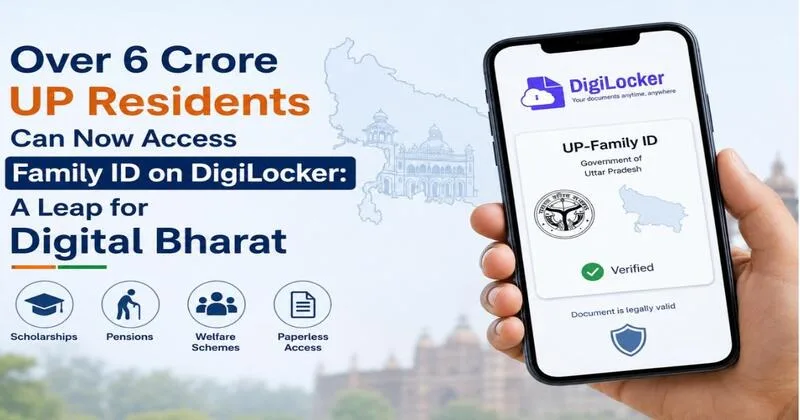
Over six crore residents of Uttar Pradesh can now fetch, store and share their UP-Family ID directly on DigiLocker, Indian flagship digital document wallet under the Digital India programme. With the household credential now onboarded onto the platform, citizens of the most populous State no longer need to carry or photocopy the physical card. A verified, legally valid copy now sits in their pocket, available round the clock from any phone or computer.
The move is part of a wider national rollout. On June 17, the Ministry of Electronics and Information Technology (MeitY) announced that DigiLocker had onboarded Family ID credentials from Rajasthan, Maharashtra, Madhya Pradesh and Uttar Pradesh, enabling more than 37 crore citizens across the four states to digitally access, store and share key household identity documents. Uttar Pradesh, with its six-crore-plus base of Family ID holders, has the largest figure of a single State integration in the batch.
What Changes for the UP Citizen
For a household in Lucknow, Gorakhpur or Bundelkhand, the practical difference is immediate. The Family ID is Uttar Pradesh’s key household identifier, linking each family to the welfare benefits it is entitled to. Until now, availing those benefits often meant a trip to a government office, a pile of photocopies and the perennial risk of a misplaced document.
The DigiLocker copy removes that friction entirely. The verified digital document can be used to apply for and avail scholarships, pensions and other state welfare schemes without the need to carry or photocopy physical documents. It is faster, it is paperless, and it is available at any hour, with qualities that matter most for the rural and lower-income households. It leans most heavily on State support and can least afford repeated visits to a tehsil office.
Hosting the Family ID on DigiLocker also places it on the same trusted shelf that citizens already use for their Aadhaar, PAN, driving licence and academic certificates. There is no new app to learn and no separate login to remember, the credential simply joins the documents a citizen already keeps on a platform they already trust.
How to Fetch It: Four Simple Steps
The process is built for a first-time user. According to MeitY, citizens can retrieve the document by signing into the DigiLocker app or website, searching for the relevant State Family ID service, entering the required details, giving consent and fetching the credential, which is then saved instantly to their account. In practice, the four steps are:
1. Open the DigiLocker app or visit digilocker.gov.in and sign in.
2. Search for “Family ID Uttar Pradesh.”
3. Enter the required details and give consent.
4. Fetch the document- it is saved instantly to the DigiLocker account.
The integration is consent-based and two-way. DigiLocker is connected as a requestor to the respective State Family ID systems, enabling eligible residents to enrol for new Family IDs digitally and provide consent from within the platform. The citizen will decide when the document is shared, there is no interference by machine, a full version of privacy will be maintained.
How It Will Strengthens Bharat
The significance of this step runs well beyond convenience for one State. India has, over the past decade, built the world’s most ambitious Digital Public Infrastructure (DPI), a homegrown stack of Aadhaar, UPI, CoWIN and DigiLocker that no other nation has matched at this scale or speed. Where many countries still debate the feasibility of population-scale digital identity, Bharat has already operationalised it for more than a billion people and is now extending it into the granular work of welfare delivery.
The Family ID integration marks exactly that evolution. As one policy analysis observed, the initiative expands the scope of India’s Digital Public Infrastructure by bringing welfare-linked household identifiers into a trusted national document ecosystem, signalling that India’s Digital Public Infrastructure is evolving beyond identity, payments, and document storage towards a broader role in welfare governance. In other words, the same rails that revolutionised payments through UPI are now being laid under the delivery of pensions, scholarships and rations.
For Bharat, a verified, consent-based household credential makes beneficiary identification cleaner and harder to game, which means welfare reaches the genuinely eligible while leakage and duplication shrink. The result is leaner administration, when a scholarship office or pension desk can verify a family’s status instantly and digitally, the layers of paperwork that once invited delay and discretion fall away. The move is aimed at simplifying access to government services and welfare schemes while reducing dependence on physical paperwork.
This is also a quiet assertion of technological self-reliance. The entire system, from the Family ID databases maintained by State governments to the DigiLocker wallet built by MeitY, is Indian-conceived, Indian-built and Indian-governed. At a time when nations are increasingly wary of foreign-controlled digital plumbing, Bharat DPI stands as a sovereign alternative, one that several developing countries are now studying and seeking to adopt. Every State that plugs its welfare database into this national stack strengthens the case that the Indian model, open, interoperable and citizen-consented, is a template the world can follow.
Uttar Pradesh gives this milestone particular weight. As home to the largest population of any Indian State, UP, a country-sized state, is a proving ground. A system that works for six crore Family ID holders across its districts, from dense urban centres to remote villages, is a system that has been tested against the full range of India’s developmental diversity.
A Citizen-Centric Digital Ecosystem
The integration reflects the shared commitment of the Government of Uttar Pradesh and DigiLocker to build a citizen-centric digital ecosystem, one that promotes transparency, efficiency and ease of access to public services. The State supplies the welfare-linked data; the Centre’s digital wallet supplies the secure, universal access layer, and the citizen sits at the centre in control of their own document.
As DigiLocker continues to expand its repository of trusted credentials, integrations such as the UP-Family ID strengthen India’s digital public infrastructure and carry forward the vision of Digital India, making government-issued documents more accessible, secure and convenient for every citizen. With Madhya Pradesh’s Samagra, Rajasthan’s Jan Aadhaar and Maharashtra’s Mahasarathi joining UP’s Family ID in the same wave, the effect of the nationwide welfare-identity layer is coming clearly into view.
For the six crore residents of Uttar Pradesh, the change is simple and tangible; their household gateway to welfare is now always in their pocket, secure, verified and available the moment it is needed. For Bharat, it is one more brick in a digital foundation that is fast becoming the envy of the world.