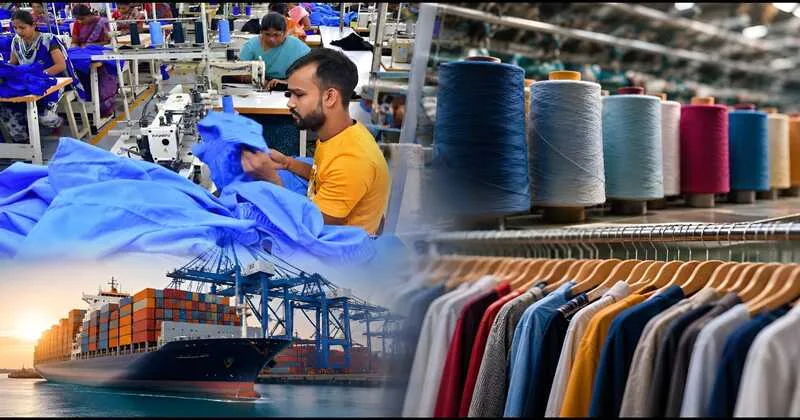
India’s textile sector has entered a decisive phase with a clearly defined objective of achieving $100 billion in textile and apparel exports by 2030. As global demand patterns evolve and international competition intensifies, the country has launched a coordinated national effort that seeks to strengthen every segment of the textile ecosystem. Rather than focusing solely on increasing export volumes, the initiative aims to transform the sector through stronger collaboration between the Centre, states, industry stakeholders and exporters, while building a more competitive and value-driven textile industry.
The latest step in this direction is the launch of a nationwide exercise by the Ministry of Textiles, marked by a two-day summit that brought together state governments, industry bodies and exporters. The summit was designed to convert extensive consultations into a practical roadmap for export growth. It followed a large-scale engagement process that covered all 36 states and Union Territories and nearly 200 districts, resulting in detailed state and district export action plans intended to strengthen India’s position in global textile markets.
The discussions reflected a comprehensive approach that combines production capabilities, regional strengths, infrastructure improvements, technology adoption and market expansion. Instead of treating export growth as the responsibility of a single stakeholder, the initiative recognises that sustained progress will require coordinated action across multiple levels of governance and industry.
The sector’s recent export performance provides a strong foundation for this long-term ambition. According to data released by the Ministry of Textiles in April 2026, India’s textile sector continued to demonstrate resilience in global markets during FY 2025–26. Total textile exports, including handicrafts, rose from Rs 3,09,859.3 crore in FY 2024–25 to Rs 3,16,334.9 crore in FY 2025–26, registering a 2.1 per cent growth. The increase reflects steady global demand for Indian textile products and the sector’s continued competitiveness across major product categories, reinforcing the momentum behind the country’s drive towards $100 billion in textile and apparel exports by 2030.
Building export growth through regional strengths
A major focus of the summit was India’s established textile clusters, which are expected to play a leading role in achieving the 2030 export target. Industry representatives and policymakers discussed strategies centred on Tiruppur, Surat, Ludhiana and Bhadohi, recognising these hubs as key contributors to future export expansion.
The discussions examined how specialised production centres can be further strengthened through improved infrastructure, better market access and stronger policy support. These regions already possess distinct manufacturing capabilities, and the objective is to leverage those strengths while integrating them more effectively into global value chains.
The Textiles Summit 2026 on “Textiles for Global Markets” concluded with insightful deliberations and valuable recommendations from government representatives, industry leaders, exporters, trade associations, and other stakeholders.
The discussions highlighted key priorities for… pic.twitter.com/ddvijGDFGa
— Ministry of Textiles (@TexMinIndia) June 24, 2026
The nationwide consultations also reinforced the importance of district-level planning. The preparation of district export action plans reflects an effort to identify local production strengths and align them with international demand. This district-led approach was highlighted by Union Minister of Textiles Giriraj Singh, who emphasised district-driven export growth, product diversification and value addition as essential components of the national strategy.
The minister also underlined the importance of setting targets for both champion and aspirational districts, signalling that export growth is expected to emerge not only from established manufacturing centres but also from regions with untapped potential. Such an approach seeks to broaden participation in export growth while ensuring that local capabilities receive focused policy attention.
Diversification, value addition and competitiveness
Another central theme of the summit was diversification within the textile sector. While conventional textile products continue to remain important, discussions highlighted emerging opportunities in technical textiles, man-made fibre products, GI-tagged goods and premium segments.
These areas are increasingly being viewed as important drivers of export expansion. The emphasis reflects an effort to broaden India’s export basket while responding to changing global market requirements.
Alongside diversification, value addition emerged as another priority. Rather than limiting exports to lower-value products, the initiative encourages greater emphasis on branded and finished products that can command stronger positions in international markets. The creation of branded products was specifically highlighted during the summit as an important component of the country’s export strategy.
Technology adoption was another significant area of discussion. Policymakers and industry representatives examined the role of modern technology in improving manufacturing efficiency and enhancing competitiveness. At the same time, infrastructure development and logistics improvements were recognised as equally important for reducing operational constraints and supporting export expansion.
Market access also formed a major part of the deliberations. Improving access to international markets is viewed as essential for expanding exports, while leveraging trade agreements has been identified as an important instrument for reaching new destinations and strengthening India’s presence in global textile trade.
The summit further emphasised sustainability and skilling as long-term pillars of sectoral growth.
Sustainability is increasingly becoming an important consideration for international markets, while skill development remains necessary for supporting advanced manufacturing and improving productivity across the textile value chain.
These multiple elements, product diversification, value addition, branding, technology, infrastructure, logistics, skilling, sustainability and market access, were discussed as interconnected components that together can strengthen India’s export competitiveness.
A national roadmap towards 2030
The nationwide exercise extends beyond the summit itself. The recommendations emerging from the discussions will be incorporated into a National Textile Export Roadmap 2030, which will serve as the guiding framework for the sector’s future development.
According to the Ministry of Textiles, the roadmap will focus on strengthening the textile value chain, improving export competitiveness and leveraging trade agreements to tap new markets. The objective is to create a structured pathway for achieving the national export target while reinforcing India’s standing in global textile markets.
The ministry also stated that the summit is being organised under the Cabinet Secretariat’s initiative on Departmental Summits to strengthen Centre-State collaboration and promote cooperative federalism in achieving national development goals. This reflects an institutional approach that places equal importance on policy coordination and implementation across different levels of government.
भारत के वस्त्र एवं परिधान क्षेत्र को $100 बिलियन निर्यात लक्ष्य तक पहुँचाने के लिए केंद्र और राज्य, दोनों को मिलकर नए चैंपियन जिलों और नए निर्यातकों को तैयार करना होगा। प्रतिभा को अवसर, मार्गदर्शन और सही मंच मिले तो नए कीर्तिमान स्थापित होते हैं।
साझा प्रयास, स्पष्ट रोडमैप और… pic.twitter.com/K3jaYZIpkq
— Giriraj Singh (@girirajsinghbjp) June 25, 2026
The consultations conducted across states, Union Territories and districts have already created a broad foundation for this effort. The resulting export action plans are expected to provide region-specific strategies while contributing to the larger national framework.
The coordinated participation of policymakers, state governments, industry bodies and exporters demonstrates an effort to align policy formulation with industry requirements. Such collaboration is expected to support improvements throughout the textile ecosystem, from production and processing to branding, logistics and international market outreach.
India’s textile sector is therefore entering a new phase marked by structured planning and clearly defined objectives. The focus extends beyond expanding exports to strengthening competitiveness through district-led growth, diversified product portfolios, improved infrastructure, technology adoption, sustainability, skilling and better market access.
With the National Textile Export Roadmap 2030 set to consolidate the recommendations from the summit and nationwide consultations, the country is laying down a comprehensive framework aimed at enhancing the textile value chain and expanding its global presence. By combining regional strengths, coordinated policymaking and industry participation, India is positioning its textile sector to pursue the ambitious milestone of $100 billion in textile and apparel exports by 2030, reinforcing its aspirations to secure a stronger place in global textile trade.