The message of the anti-Emergency struggle remains relevant even after 50 years; speakers at a Patna seminar highlight the significance of democracy’s ‘second freedom’
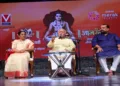
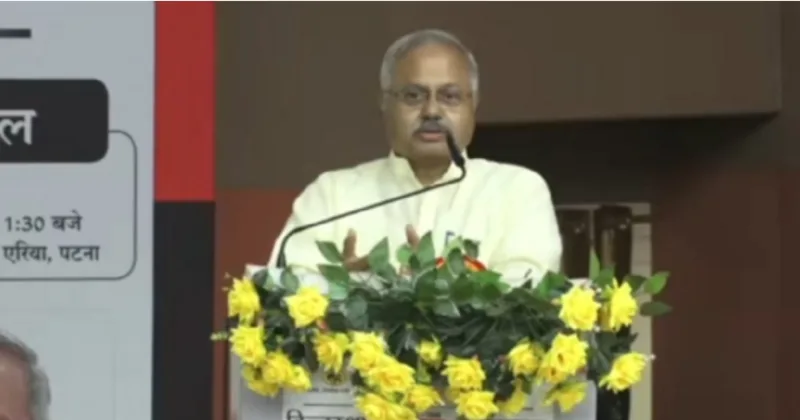
Patna. In the history of Indian democracy, June 25, 1975, is recorded as a chapter representing the ultimate test of democratic values. Speaking at a seminar in Patna titled “50 Years of Emergency: The Bihar Movement and the Emergency”, held to mark the 50th anniversary of the event, speakers described the Emergency as a vivid example of the collective consciousness, struggle and resolve of society in safeguarding democracy.
Speakers at the event, including Sunil Ambekar (Akhil Bharatiya Prachar Pramukh Rashtriya Swayamsevak Sangh), senior journalist and thinker Padma Shri Rambahadur Rai, former Union Minister Ashwini Kumar Choubey and Arvind Bhalchandra Mardikar (Chairman of Hindusthan Samachar News Agency), shared detailed insights on various facets of democracy, the Bihar Movement, and the struggle against the Emergency.
Societal awareness defeated dictatorship
Keynote speaker Sunil Ambekar stated that the greatest strength of Indian democracy lies not merely in constitutional provisions, but in societal awareness and democratic consciousness. He remarked that if society remains vigilant and active, no dictatorial regime can endure for long.
Ambekar noted that while dictatorships persisted for decades in many countries across the world, the Emergency in India ended in just 19 months. The driving force behind this was not any political party, but society’s deep faith in democracy. Although many prominent leaders were imprisoned during that period, ordinary citizens, students, social activists and volunteers continued the struggle to protect democracy. It was this ‘people’s power’ that ultimately led to the restoration of democracy.
He emphasized that the most significant message of the Emergency is that democracy is not secured merely through elections or constitutional provisions; rather, it is safeguarded by aware citizens and an empowered society. Democracy is strengthened when society remains vigilant against the excessive centralization of power and authoritarian tendencies.
The Ban on the Sangh and the Fight for Democracy
Sunil Ambekar stated that the Rashtriya Swayamsevak Sangh (RSS) was not a political party, yet it was banned during the Emergency. Attributing this to a political mindset, he noted that certain political forces had long viewed the Sangh as a rival. However, he clarified that the Sangh’s struggle was not limited merely to getting the ban on itself lifted; its volunteers worked extensively to safeguard democracy, the Constitution and civil liberties. It was not a movement to capture power, but rather an effort to save the democratic system.
Democracy is Not Merely a Matter of Politics
Ambedkar stated that the Emergency made it clear that safeguarding democracy is not the sole responsibility of political parties; families, educational institutions, social organizations and ordinary citizens are equal partners in this endeavor. Democracy strengthens when society remains conscious of its duties alongside its rights. Highlighting the connection between the Indian Constitution and Indian culture, he noted that values such as liberty, equality, and fraternity are not merely constitutional terms but integral parts of the Indian philosophy of life. The cultural consciousness and moral values of society lend stability to democracy.
Referring to the call for ‘Panch Parivartan’ (Five Transformations) made on the occasion of the Sangh’s centenary year, he identified social harmony, the strengthening of the family system, an eco-friendly lifestyle, a sense of duty and social awakening as essential elements for the strengthening of democracy.
The Anti-Emergency Struggle: A Second Freedom for Democracy
Padma Shri Rambahadur Rai, the keynote speaker at the seminar, described the anti-Emergency movement as the “second battle for freedom” for Indian democracy. He remarked that just as the Quit India Movement of 1942 was a decisive step towards political independence, the struggle of 1975–77 was a movement that liberated democracy from dictatorship. He noted that while India gained freedom from foreign rule in 1947, democracy was liberated from authoritarian tendencies in 1977; thus, both struggles hold equal significance in Indian history.
Rambahadur Rai stated that the greatest achievement of the Bihar Movement was the return of Loknayak Jayaprakash Narayan to active politics. Although he had distanced himself from active politics after 1955, he accepted leadership of the Bihar Movement in 1974, transforming a student agitation into a nationwide mass movement.
The Broad Vision of ‘Total Revolution’
Rambahadur Rai observed that viewing the Bihar Movement merely as an anti-corruption campaign would limit its true nature. Its fundamental objective was systemic change through ‘Total Revolution’ (Sampoorna Kranti). Jayaprakash Narayan did not speak merely of changing the government; rather, he sought comprehensive reforms in political culture, the administrative system and the social structure. He stated that JP’s vision was remarkably far-sighted. As early as 1959, he had written to the then Prime Minister Jawaharlal Nehru, emphasizing the need for a comprehensive review of the Constitution and the state’s governance structure. This clearly indicates that he was a proponent of structural reforms.
A Historical Perspective on the Causes of the Emergency
Rambahadur Rai also challenged the notion that the Emergency was imposed solely due to Jayaprakash Narayan’s speech at Delhi’s Ramlila Maidan. He noted that the political crisis arising after the Allahabad High Court declared the election of the then Prime Minister Indira Gandhi void on June 12, 1975, had actually set the stage for the Emergency.
According to him, the desire to cling to power and apprehensions regarding political instability were among the primary reasons for imposing the Emergency. He remarked that the Shah Commission report serves as the most authentic document for understanding this entire sequence of events, offering a detailed account of the impact on democratic institutions, civil liberties and constitutional processes.
People’s Power Saved Democracy
Rambahadur Rai stated that the struggle against the Emergency was not confined to political parties alone; it also involved students, the youth, social organizations, voluntary groups, and ordinary citizens who believed in democracy. Thousands of people endured imprisonment and fought to safeguard civil liberties. Highlighting the roles of Loknayak Jayaprakash Narayan and the then ‘Sarsanghchalak’ of the Rashtriya Swayamsevak Sangh (RSS), Balasaheb Deoras, he noted that both played a pivotal role in mobilizing pro-democracy forces.
Following the announcement of elections in January 1977, the people delivered their verdict through the ballot box, paving the way for the restoration of democracy. This stood as the greatest testament to the democratic consciousness of Indian society.
The Bihar Movement Laid the Foundation for the Struggle
Former Union Minister Ashwini Kumar Choubey stated that the Bihar Movement did not emerge suddenly; the groundwork had already been laid by student agitations and growing public discontent. He pointed out that the ‘gherao’ (siege) of the Bihar Legislative Assembly on March 18, 1974, proved to be a decisive turning point, transforming the student agitation into a mass movement. He stated that under the leadership of Jayaprakash Narayan, this movement evolved into a nationwide campaign for democratic transformation and subsequently proved to be a strong foundation for the struggle against the Emergency.
Ethics and Accountability Essential for Democracy
Senior columnist and former member of the Bihar Legislative Council, Dr. Harendra Pratap, remarked that democracy does not function merely through elections; rather, it is strengthened by the credibility of institutions and the trust of the people. Sharing his experiences of imprisonment and the underground movement, he noted that the battle for democracy is also fought on an ideological level. He expressed concern that the crisis of ethics and accountability in public life today is emerging as a major challenge for democracy.
Additionally, the program shed detailed light on the evolution of the Hindusthan Samachar news agency, highlighting how the agency has continued to operate from its inception in April 1948 to the present day, guided by its motto of ‘Truth, Dialogue and Service’ (Satya, Samvad, Seva). He also effectively outlined the organization’s challenges and achievements.