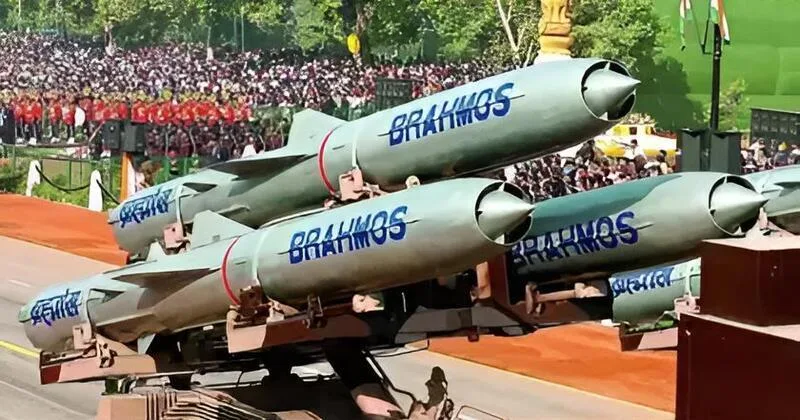
India’s flagship BrahMos supersonic cruise missile programme is entering a period of significant industrial expansion as rising requirements from all three branches of the Indian military, coupled with growing international demand, drive the need for substantially higher production rates. With manufacturing infrastructure being expanded across multiple facilities and new procurement orders expected in the coming years, the programme is increasingly moving towards the capability to produce more than 150 missiles annually.
Over the past decade, BrahMos has transformed from a specialised strategic weapon into one of the most widely deployed precision-strike systems in India’s arsenal. Originally introduced primarily for naval operations, the missile has since been inducted by the Indian Army for land-based strike missions and integrated with the Indian Air Force’s Su-30MKI fighter fleet. As India continues to strengthen its long-range precision strike capabilities, BrahMos has become a central component of several major military modernisation programmes.
Expanding demand across the armed forces
The Indian Army continues to increase its BrahMos inventory through additional missile regiments designed to deliver rapid and highly accurate strikes against critical targets. The missile’s combination of supersonic speed, precision guidance and ability to survive hostile air defence environments has made it a key element of India’s conventional deterrence posture along both the western and northern borders.
For the Army, BrahMos provides the capability to engage high-value targets at long distances while reducing the adversary’s reaction time. As operational requirements evolve, additional regiments and missile deployments are expected to generate sustained demand for both missiles and associated launch systems.
The Indian Navy remains the largest operator of the BrahMos family. The missile is already deployed on a wide range of frontline warships, including destroyers and frigates, and has become a cornerstone of India’s anti-surface warfare capability. Future naval expansion plans are expected to further increase demand as new-generation warships enter service with larger numbers of vertical launch cells capable of firing BrahMos missiles.
EXCLUSIVE: India in talks to sell supersonic BrahMos missile to UAE, sources say https://t.co/cTbVz3DXKn https://t.co/cTbVz3DXKn
— Reuters (@Reuters) June 22, 2026
Several upcoming surface combatant programmes are expected to incorporate the missile from the outset, ensuring that naval demand remains a major driver of future production. As the Navy expands its fleet and replaces older vessels with more heavily armed platforms, procurement requirements for ship-launched BrahMos variants are likely to rise correspondingly.
The Indian Air Force is also expected to play an increasingly important role in driving production growth. The air-launched BrahMos-A variant has already demonstrated its value as a long-range stand-off strike weapon integrated with the Su-30MKI fleet. The missile provides the ability to strike targets from significant distances while keeping aircraft outside heavily defended zones.
Future integration efforts involving upgraded aircraft and next-generation platforms could further increase procurement requirements. As India continues to enhance its air-delivered precision strike capabilities, the demand for air-launched BrahMos variants is expected to grow alongside other military requirements.
Exports create a new growth engine
Alongside domestic orders, exports have emerged as a major factor shaping the future of the BrahMos programme. The Philippines became the first international customer for the missile system, marking a significant milestone in India’s efforts to establish itself as a major defence exporter.
The successful export of BrahMos has generated interest from a growing number of countries. Several nations across Southeast Asia, the West Asia, Latin America and Africa have expressed interest in acquiring the missile, attracted by its reputation as one of the world’s fastest operational cruise missiles and its proven capability across multiple launch platforms.
International demand is expected to increase further with the development of the BrahMos-NG (Next Generation) missile. Designed to be lighter and more compact than existing versions, the new missile will be compatible with a wider range of aircraft, naval vessels and land-based launch systems.
The broader platform compatibility of BrahMos-NG is expected to significantly expand the potential customer base both within India and abroad. As more countries seek advanced precision-strike capabilities, the next-generation missile could create additional production requirements beyond those already anticipated for current variants.
To support these growing demands, BrahMos Aerospace has been steadily expanding manufacturing capacity. Greater participation by private industry, increased indigenisation of critical subsystems, and the establishment of additional production facilities are helping transform the programme from a relatively limited production line into a larger missile manufacturing ecosystem capable of meeting both domestic and export requirements.
Building capacity for sustained operations
The expansion of production capacity reflects lessons drawn from modern conflicts, where missile inventories can be consumed rapidly during prolonged military operations. The ability to manufacture more than 150 missiles annually would provide India with greater flexibility to replenish stockpiles, sustain operational readiness and meet wartime requirements while continuing to honour export commitments.
🚨Thailand and Chile have shown interest in acquiring BrahMos missiles. https://t.co/wMP11X0plI pic.twitter.com/ln9eqtsexT
— India Plus (@india_plus_) June 22, 2026
A larger industrial base also supports India’s broader objective of becoming a major defence manufacturing and export hub. As international interest in BrahMos continues to grow, maintaining sufficient production capacity will be critical to ensuring that overseas orders do not affect domestic military requirements.
The emphasis on higher manufacturing rates is therefore not merely an industrial objective but a strategic necessity. It strengthens national security, enhances deterrence and reinforces India’s position in the global defence market.
Russia explores BrahMos integration
An important new development for the programme has emerged from Russia, where the Russian Navy has expressed interest in equipping its frontline warships with the Indo-Russian BrahMos missile. Discussions are currently underway between New Delhi and Moscow regarding the potential integration of the weapon into Russian naval platforms.
According to the reports, India has proposed establishing a local BrahMos production line in Russia while also offering to supply key systems and sub-systems from Indian facilities to support manufacturing within the country.
The development represents a remarkable evolution in the history of the programme. BrahMos originated as a joint Indo-Russian venture in the late 1990s and was based on Russia’s P-800 Oniks, also known as the Yakhont, supersonic anti-ship missile. Over the following decades, however, India made substantial contributions in areas ranging from production infrastructure and platform integration to technological improvements and operational deployment.
Today, BrahMos has evolved into one of the world’s most successful supersonic cruise missile programmes, attracting export orders and interest from foreign militaries. The possibility of Russia adopting the missile for its own naval platforms highlights the extent to which the programme has matured.
🚀🇮🇳🤝🇷🇺 *India-Russia Eye Next-Gen BrahMos With 1,500 km Strike Range*
BrahMos Aerospace CEO Dr. Jaiteerth Joshi has confirmed the 1500KM variant of the India-Russia joint missile venture has been incorporated into the programme's future strategic roadmap.
The two countries… pic.twitter.com/F2PNbBoQ0f
— RT_India (@RT_India_news) June 22, 2026
The Russian Navy currently operates a diverse range of anti-ship missiles that include supersonic, subsonic and emerging hypersonic systems. Central to Russia’s naval modernisation effort has been the adoption of the Universal Shipborne Firing System, or UKSK 3S14 Vertical Launch System, which enables multiple missile types to be launched from common cells.
The launcher can accommodate the Kalibr missile family, the P-800 Oniks and the Tsirkon hypersonic missile. Among these, the Oniks remains one of Russia’s principal supersonic anti-ship weapons. Powered by a ramjet engine, the missile can reach speeds of approximately Mach 2.5 at high altitude and around Mach 2.0 during sea-skimming terminal attacks.
Designed to penetrate heavily defended naval formations, the missile incorporates an active-passive radar seeker and advanced electronic counter-countermeasure capabilities. Depending on the flight profile employed, the Oniks is believed to possess a range of between 300 and 600 kilometres. The Oniks served as the technological foundation for BrahMos when India and Russia established their joint venture. Since then, BrahMos has undergone extensive refinement and upgrades. Newer versions feature improved guidance systems, greater accuracy, expanded engagement envelopes, and the ability to be launched from ships, submarines, aircraft and land-based launchers.
Following India’s entry into the Missile Technology Control Regime (MTCR), the programme also developed extended-range variants, substantially increasing the missile’s strike capability.
For Russia, adopting BrahMos could provide access to improvements introduced through years of development while retaining compatibility with operational concepts built around supersonic anti-ship warfare.
Given the common design heritage shared by BrahMos and Oniks, integration could potentially be easier than introducing an entirely new missile family.
India’s proposal to establish production facilities in Russia is equally significant from an industrial perspective. Such an arrangement would allow Russian defence and shipbuilding enterprises to participate directly in manufacturing while benefiting from Indian production expertise. The supply of critical systems and sub-systems from India could create a new framework for defence-industrial cooperation between the two countries.
As domestic military requirements expand, export opportunities multiply, and international partners show increasing interest in the missile, the BrahMos programme is entering a new phase of growth. The combination of rising production capacity, technological evolution and widening global demand is positioning BrahMos not only as a cornerstone of India’s military modernisation but also as one of the country’s most significant defence export success stories.