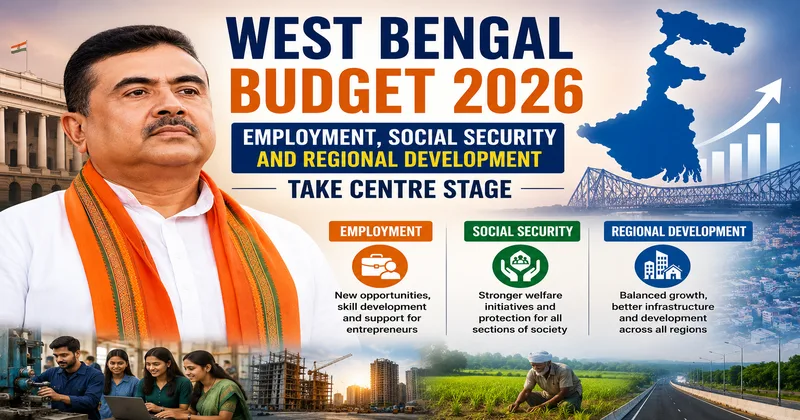
The first budget of a newly elected government is more than a financial document; it is a statement of intent. The West Bengal Budget 2026, presented by the new BJP-led government, seeks to address some of the most pressing concerns of the state—employment generation, Dearness Allowance (DA) parity, transparent recruitment, social welfare, infrastructure development, and the long-standing issue of regional imbalance between South Bengal and North Bengal. The budget attempts to combine welfare measures with developmental initiatives, while also signalling a shift towards administrative transparency and accountability. At a time when unemployment, recruitment controversies, and demands for higher DA have dominated public discourse in West Bengal, the budget appears designed to reassure both government employees and unemployed youth. Simultaneously, it seeks to expand infrastructure and industrial opportunities across the state, particularly in North Bengal.
One of the most significant announcements in the budget is the increase in Dearness Allowance (DA) for government employees and pensioners. The government has announced a 20 percent hike in DA, a move that directly addresses a long-standing demand of state employees who had been protesting for parity with central government employees. For years, the issue of DA had become a symbol of dissatisfaction among government workers. Numerous protests, court battles, and demonstrations reflected the frustration of employees who felt disadvantaged compared to their counterparts in other states and at the Centre. The new government’s decision is therefore not merely an economic measure; it is a political and administrative response to a long-standing grievance. The increase is expected to improve the purchasing power of lakhs of employees and pensioners, particularly amid rising inflation. It also sends a message that the government intends to maintain a more employee-friendly approach while attempting to restore confidence among the state’s workforce.
Perhaps the most striking feature of the budget is the promise of one lakh government jobs, with 33 percent reservation for women. West Bengal has witnessed rising concerns regarding unemployment and allegations of irregularities in recruitment processes over the last decade. The budget’s employment focus aims to address both concerns simultaneously. By creating one lakh vacancies, the government seeks to provide opportunities for educated youth while strengthening administrative capacity. The emphasis on women’s reservation is particularly noteworthy. Female participation in government employment has traditionally lagged behind expectations in several sectors. A 33 percent reservation could significantly improve women’s representation in public administration and enhance economic empowerment. The success of this initiative, however, will depend on transparent recruitment procedures, timely examinations, and merit-based selection.
No sector illustrates the importance of transparency more clearly than education. While taking charge, School Education Minister Dipak Barman said, “I have been given the easiest department because, even if I wanted to, I could not make it perform any worse than it already does.”
The decision to recruit 50,000 teachers comes against the backdrop of one of the most damaging recruitment controversies in the history of West Bengal. Allegations of corruption and irregular appointments not only harmed deserving candidates but also weakened public faith in educational institutions. The consequences of such scandals extend far beyond employment. When teaching positions remain vacant or are filled through questionable means, the quality of education suffers. Ultimately, it is students who bear the cost. The government’s commitment to large-scale teacher recruitment is therefore both an educational and moral imperative. Schools across the state require qualified educators, and thousands of aspirants deserve a fair opportunity to serve. If implemented transparently, this initiative could help rebuild confidence in the recruitment process and strengthen the state’s educational infrastructure for years to come.
The proposal to recruit 20,000 police personnel deserves equal attention. Modern policing requires far more than maintaining public order. Police forces today are expected to combat cybercrime, trafficking, organized crime, financial fraud, and various forms of cross-border criminal activity. In a geographically complex state such as West Bengal—with international borders and strategic transit routes—the need for adequate policing is particularly acute. Additional recruitment can help address personnel shortages while improving response times and public safety. At the same time, it creates another avenue of employment for thousands of young people. The broader significance of this measure lies in its recognition that development and security are interconnected. Economic growth flourishes where law and order are strong and institutions function effectively.
The budget’s welfare initiatives reflect an understanding that development must be inclusive. The increase in pensions for senior citizens, widows, and specially-abled individuals acknowledges the vulnerabilities faced by these groups in an inflationary environment. Similarly, enhanced honorariums for civic volunteers, village police personnel, and grassroots workers recognize contributions that often go unnoticed despite being essential to local governance. For many families, these benefits are not supplementary income; they are vital sources of financial security.
Critics often portray welfare and development as competing priorities. This is a false dichotomy. A society that neglects its vulnerable populations cannot claim to be truly developed. The objective should be to combine welfare with empowerment, ensuring that social support complements rather than substitutes economic opportunity.
While welfare measures dominate the headlines, the budget’s long-term significance may ultimately lie in its infrastructure commitments. The proposed metro projects in towns such as Siliguri—one of the most important cities not only in North Bengal but also in Northeast India—as well as metro connectivity in industrial cities like Durgapur and Asansol, reflect an ambitious vision for urban development. The proposal to establish airports in North Bengal towns such as Malda and in relatively underdeveloped regions like Purulia, along with investments in bridges, highways, and other connectivity initiatives, indicates an understanding that sustainable economic transformation requires robust physical infrastructure.
Historically, West Bengal benefited from its strategic location and industrial base. However, infrastructure deficits have often limited investment and economic expansion. Modern infrastructure reduces transaction costs, improves mobility, attracts industries, and creates employment opportunities. Projects such as the Bhagirathi bridge, expansion of transportation networks, and improved regional connectivity could generate multiplier effects across sectors ranging from tourism to logistics and manufacturing. Infrastructure spending is not merely expenditure; it is investment in future growth.
Among the most politically and economically significant aspects of the budget is its emphasis on North Bengal. For decades, development in West Bengal has been heavily concentrated around Kolkata and adjoining districts. While these regions naturally serve as economic hubs, the imbalance has often generated feelings of neglect in northern districts. The new budget appears to acknowledge this reality.
The first budget of West Bengal’s new government seeks to balance immediate public concerns with long-term development goals. By prioritizing DA, employment, recruitment, welfare, infrastructure, and North Bengal’s growth, it presents a vision of renewal and inclusive governance. Its core message is that effective governance must address present grievances while investing in the future. Ultimately, the success of this budget will depend on its implementation, transparency, and administrative efficiency.