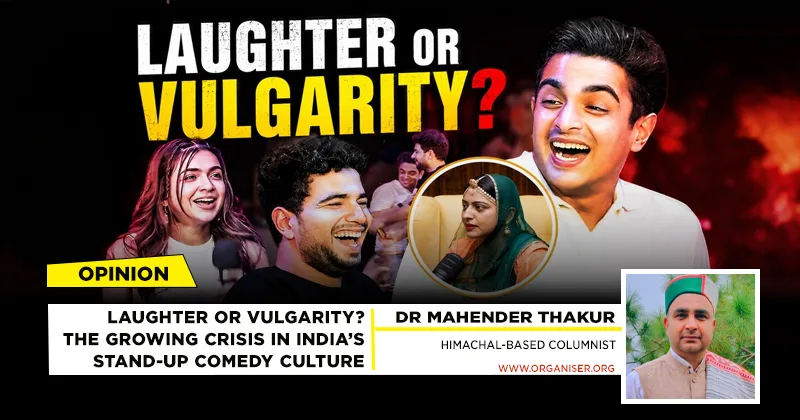
The English word “comedy” traditionally refers to a form of humour intended to entertain while conveying positive social messages through laughter. However, recent developments in India’s stand-up comedy and digital entertainment space compel one to say: enough is enough. From the government and institutions to ordinary citizens, there is a pressing need for collective introspection.
Social media, OTT platforms, YouTube, and podcasts have undoubtedly opened new avenues for creative expression. This is a welcome change, as humour and satire are important elements of any vibrant democracy. They expose social contradictions, question authority, and encourage people to think while making them laugh. Yet, when humour degenerates into vulgarity, personal attacks, insensitivity, and obscenity, it ceases to be merely entertainment and becomes a matter of social concern.
Over the past few years, numerous instances have emerged in which comedy has mocked parents, family relationships, religious beliefs, women, differently-abled individuals, death, and even donated human bodies used for medical education. The language employed in some shows and podcasts is so crude and indecent that it raises serious questions about the standards of public discourse.
Recent controversies involving digital programs and comedy shows have once again triggered a debate. Is it acceptable to sink to such levels merely for views, popularity, and money? Can every subject be treated as material for jokes in the name of entertainment?
The issue here is not freedom of expression. Artists and comedians have every right to comment on society and employ satire. However, every right carries responsibility. When expression begins to injure the dignity of others and humour becomes a tool for shock value and controversy, society must ask whether the line between entertainment and obscenity is disappearing.
One of the major problems of today’s digital culture is the race to go viral. Social media algorithms often reward content that provokes outrage and controversy. As a result, some creators believe that the more provocative and offensive their language, the greater their popularity. Consequently, thoughtful satire gradually gives way to double entendres, abusive language, and vulgar comments about personal relationships.
At the same time, it would be unfair to blame only comedians or young people. Society, families, educational institutions, and all of us share responsibility. Human behaviour does not develop in isolation. It is shaped by family values, education, and social surroundings.
Parents today are often focused on providing material comforts—expensive schools, foreign universities, gadgets, and comfortable lifestyles. While these are important, values such as sensitivity, discipline, social responsibility, and respect are equally essential. If children are taught to view success solely through the lens of wealth and popularity, they may choose any means necessary to achieve fame.
There was a time when family conversations played an important role in shaping moral values. Joint families allowed children to learn from elders. Today, technology has made life easier but has also reduced meaningful interaction. Family members may be physically present under the same roof while remaining emotionally disconnected. In such circumstances, social media often becomes the primary teacher for the younger generation.
Society has also hesitated to discuss important issues such as values, dignity of relationships, mental health, responsible citizenship, and sex education in a balanced manner. Consequently, young people turn to the internet for guidance, where they often encounter content that equates entertainment with provocation and vulgarity.
The solution does not lie in censorship or blanket bans but in a balanced approach. Artists should enjoy creative freedom, but they must also understand that their words influence millions. Viewers too have a responsibility. Just as markets supply products based on demand, digital platforms promote the content people consume. If society encourages meaningful humour, thoughtful satire, and creative entertainment, the direction of content will change accordingly.
Future generations will reflect the values we impart to accordingly
If we glorify only material success, they will adopt the same outlook. But if we teach them sensitivity, respect, and human values, society itself will move in that direction.
The need of the hour is not to blame a single artist or a generation, but to engage in serious self-examination. What kind of society do we wish to create? One where popularity justifies crossing every boundary, or one where freedom of expression coexists with sensitivity, dignity, and responsibility?
Humour should flourish. Satire should thrive. Freedom of expression must remain protected. But so too must human dignity, social decency, and sensitivity. The balance between these values is the hallmark of any civilized, conscious, and cultured society—and perhaps the greatest need of our collective future.