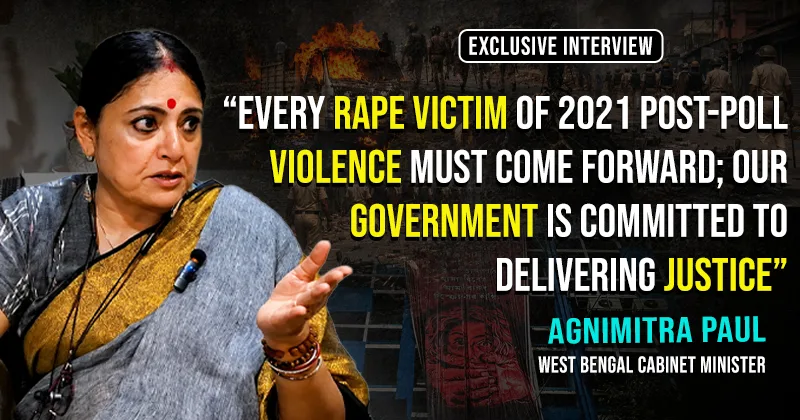
Less than two months after the BJP formed its first Government in West Bengal, expectations are high and challenges even higher. In a wide-ranging conversation with Organiser Senior Assistant Editor Nishant Kumar Azad, West Bengal Cabinet Minister Agnimitra Paul outlines the Government’s priorities, discusses justice for victims of the 2021 violence, explains her vision for the State, and explains comprehensively how the BJP plans to reshape governance in the State. Excerpts:
The West Bengal Cabinet has formally launched the Annapurna Yojana, and the first instalment of Rs 3,000 has already been credited to around 29 lakh beneficiaries on June 3. However, the state’s financial condition is not in good shape. This is the situation your Government inherited. How do you plan to manage such a large-scale welfare scheme?
It was challenging, which is why we were initially sceptical. However, we had promised that every woman receiving Lakshmir Bhandar benefits would be brought under the Annapurna Yojana, and we approved that commitment in our very first Cabinet meeting. The Chief Minister Suvendu Adhikari then directed us to complete the verification process and review all beneficiary data, including names deleted during the SIR exercise, to identify genuinely eligible applicants. Those who have applied under the CAA or approached the tribunal are also eligible. During the review, we found several irregularities, including cases where men were receiving benefits. We therefore restarted the application process with a new form and asked everyone to reapply. Around 68 lakh applications were received, and nearly 65 lakh beneficiaries have already received the first instalment. The enrollment process will remain open for another three months to ensure that every eligible woman is covered.
Women’s safety was one of the most prominent promises made by the BJP during the election campaign. Now that you are in Government, and as a woman yourself, how do you plan to ensure the safety and security of women, not just in urban areas but also in rural Bengal?
The CM has made it clear that crimes against women and children will not be tolerated. While such crimes can occur in any society, the Government’s responsibility is to respond swiftly and effectively. Under the previous Government, victims were often forced to run from one police station to another because FIRs were not registered. We have adopted a zero-tolerance policy. Every complaint must be registered through a Zero FIR immediately, with the investigation following thereafter. As promised in our Sankalp Patra (Manifesto), women’s help desks are being established in every police station, and each subdivision will have at least one dedicated women’s police station staffed by female officers. We are also expanding CCTV coverage across West Bengal to strengthen surveillance and accountability.
In addition, we are working on a technology-based safety mechanism. Inspired by our Swachha app, which allows citizens to report civic issues through geo-fencing, we plan to introduce a similar system for women’s safety. In any emergency, women and children will be able to send an alert, enabling the nearest police station to respond immediately. Ultimately, the key factor is political will. If a Government is committed to ensuring women’s safety and refuses to tolerate such crimes, meaningful change can be achieved.
You mentioned police reforms and FIR registration. Many victims of the 2021 post-poll violence, particularly from Scheduled Caste and Scheduled Tribe communities, are still awaiting justice. Is the Government considering any special mechanism to help such victims, especially those from rural and vulnerable backgrounds, access justice more effectively?
In 2021, I was serving as the State President of the BJP Mahila Morcha, and I witnessed first and the horrific violence that followed the election results. Many of the women targeted were not even formal party members; they were booth workers, supporters, and ordinary citizens. The brutality they faced was unimaginable. We spent countless nights receiving reports of violence from across the State.
Today, there is a Government that is committed to delivering justice. I want all those victims to come forward. My appeal is to all victims: approach the police, register your complaints and do not remain silent. Every case will be examined. A commission headed by Justice Shampa Ghosh and senior police officer Mehenti Sen has already been constituted by the CM Suvendu Adhikari to look into these cases. We are committed to ensuring that justice is delivered and that no one responsible escapes accountability. We do not want anyone to feel that the events of 2021 have been forgotten.
INDUSTRIALISATION IS A TOP PRIORITY FOR OUR GOVERNMENT. WE ARE SEEING STRONG INTEREST FROM INVESTORS IN THE UK, DUBAI, SINGAPORE, AND FROM BENGALIS LIVING ABROAD.”
Many TMC leaders are reportedly in touch with the BJP again. Your fellow Minister, Swapan Dasgupta, recently cautioned against importing TMC’s political culture into the BJP. How do you view the possibility of TMC leaders joining your party?
From the very beginning, our party leadership has been very clear on this matter. Our State President, Samik Bhattacharya, and Chief Minister, Suvendu Adhikari, both made their position very clear. On the day the results were announced, we saw many active TMC workers and even TMC goons suddenly appearing with BJP flags and wearing saffron colours. Our State President publicly stated that, for at least the next three months, no one would be inducted into the BJP. After three months, a committee will examine each individual case. It will assess whether a person is tainted or untainted, what their background is, and only then will the party decide whether to admit that person.
UNDER THE PREVIOUS GOVERNMENT, VICTIMS WERE OFTEN FORCED TO RUN FROM ONE POLICE STATION TO ANOTHER BECAUSE FIRS WERE NOT REGISTERED. WE HAVE ADOPTED A ZERO TOLERANCE POLICY. EVERY COMPLAINT MUST BE REGISTERED THROUGH A ZERO FIR IMMEDIATELY, WITH THE INVESTIGATION FOLLOWING THEREAFTER.
As Urban Development and Municipal Affairs Minister, one of your immediate challenges is mitigating Kolkata’s annual waterlogging crisis during the monsoon. The previous Municipal Affairs Minister, Firhad Hakim, has resigned as Kolkata Mayor. What steps has your Government taken to ensure the city is better prepared this year?
Although our Government had only been in office for one month on June 8, we began work on drainage and monsoon preparedness almost immediately. I personally visited several waterlogging-prone areas, including the airport region, and directed BJP MPs, MLAs, municipalities, and corporations to start cleaning drains, canals, and waterways.
KOLKATA’S DRAINAGE PROBLEMS ARE DEEPLY STRUCTURAL. YEARS OF NEGLECT AND UNCHECKED ENCROACHMENTS HAVE SEVERELY WEAKENED BENGAL’S URBAN INFRASTRUCTURE”
During these visits, I discovered that Kolkata’s drainage problems are deeply structural. Multiple departments are involved in maintaining different parts of the drainage network, and in many places, manholes and drainage channels have been covered or damaged by poorly planned construction and beautification projects. In some areas near the airport, major canals have been heavily encroached upon, with roads, houses, and other structures built over critical drainage infrastructure. Are we expected to believe that Firhad Hakim, Mamata Banerjee, and the local municipal authorities did not know this was happening? Of course, they knew. In many cases, money changed hands. People paid money and were allowed to build houses or shops on public land and over critical drainage infrastructure. Years of neglect and unchecked encroachments have severely weakened Bengal’s urban infrastructure and contributed to recurring waterlogging. With the monsoon approaching, we have very little time. However, our officers, sanitation workers, and field teams are working on a war footing to clear bottlenecks and improve drainage.
Lack of jobs and industrial growth have long been major challenges for Bengal. What is your Government’s vision for industrialisation and reviving the State’s industrial base?
Industrialisation is a top priority for our Government. We are seeing strong interest from investors in the UK, Dubai, Singapore, and from Bengalis living abroad. Many companies that were considering leaving Bengal are now showing renewed confidence following the change in Government.
Alongside supporting entrepreneurs and small businesses, we are focused on reviving major industrial assets such as Hindustan Cables and Burn Standard. We have discussed these projects with Railway Minister Ashwini Vaishnaw and are exploring development of ancillary industries around facilities such as the Chittaranjan Locomotive Works.
Large industrial land banks remain underutilised, and our goal is to bring them back into productive use. The Prime Minister has already outlined a vision of Singur as a trade hub and the Asansol–Durgapur belt as a major industrial centre.
You come from North Bengal region. During election coverage, many people in North Bengal complained that under the Mamata Banerjee regime, development work was largely concentrated around South Bengal and Kolkata region, while North Bengal has been neglected. How do you respond to this concern?
I think there is considerable truth in that perception. For years, North Bengal did not receive the attention it deserved. Projects such as AIIMS were shifted elsewhere, and the region missed out on several major institutions. We are now working to change that. North Bengal is set to receive key institutions, including an IIT, an IIM, and an AIIMS. These projects have the potential to transform the region. North Bengal also has immense strengths in tourism, tea, and emerging sectors such as beauty and wellness, but previous governments failed to build the necessary ecosystem around them. Our vision is not to create a competition between North and South Bengal. We are one Bengal. Our goal is balanced development so that every region, district, and community benefits from the opportunities created by this Government.