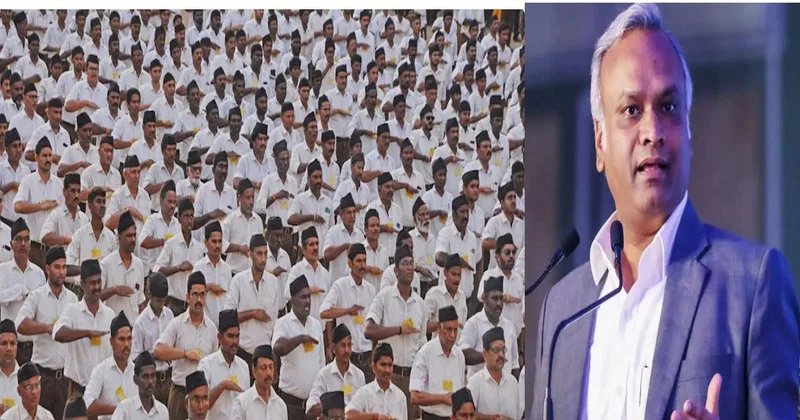
Karnataka Home Minister Priyank Kharge’s letter to RSS Sarsanghchalak Mohan Bhagwat has been widely projected as a call for transparency and accountability. The letter asks how an organisation of the RSS’s size can function without formal registration and demands explanations regarding its finances, structure and legal status.
Yet beneath the rhetoric lies a more fundamental question that the letter itself fails to answer: which law requires the RSS to register?
In a constitutional democracy governed by the rule of law, legality cannot be determined by political suspicion. If an organisation is acting illegally, the specific law being violated must be identified. If registration is mandatory, the statutory provision requiring such registration must be cited. Curiously, despite the length of the minister’s letter and the seriousness of its allegations, no such provision is mentioned. This omission is not a minor detail; it strikes at the heart of the entire argument.
The Constitution guarantees citizens the right to form associations under Article 19(1)(c). The exercise of that right does not depend upon obtaining prior approval from the government. Registration may be useful for acquiring a distinct legal personality, holding property, entering contracts or availing statutory benefits, but registration itself is not the source of the constitutional right to associate. Citizens are free to come together for social, cultural, ideological or charitable purposes unless a law specifically prohibits their activities.
The Supreme Court affirmed this position in State of Madras v. V.G. Row, AIR 1952 SC 196, holding that restrictions on the right of association must rest upon a clear statutory basis and cannot be justified by vague apprehensions of public disorder or executive suspicion. The State’s power to regulate associations is not open-ended; it must satisfy the test of reasonable restriction under Article 19(4) and must be grounded in law, not administrative preference.
The freedom of association jurisprudence under Damyanti Naranga v. Union of India, AIR 1971 SC 966, and Raghubar Dayal Jai Prakash v. Union of India, AIR 1962 SC 263, reinforces this further. Both decisions affirm that the right to form associations includes the right of members to organise themselves as they see fit and that the State cannot compel a particular organisational form upon a voluntary body without express statutory authority.
Therefore, where no statute mandates registration, the absence of registration cannot be treated as a legal deficiency, let alone a ground for political censure.
What makes the present criticism particularly difficult to sustain is the legal position already articulated by the Madhya Pradesh High Court in Purushottam Gupta v. Union of India, decided on 25 July 2024 by a Division Bench of Justices Sushruta Arvind Dharmadhikari and Gajendra Singh. The petition challenged the constitutional validity of the restrictions imposed through Office Memorandums of 1966, 1970 and 1980, which had prevented Central Government employees from joining or participating in RSS activities for over five decades.
While disposing of the petition following the Union Government’s removal of the restriction through an Office Memorandum dated 9 July 2024, the Court chose to record its observations given what it described as the national ramifications of the issues raised. The Bench observed:
“…once the government has decided and taken a conscious decision to review and remove the name of RSS from the litany of banned organisations, then its continuation shouldn’t be dependent only on the vagaries, mercy and pleasure of the government of the day.”
The Court’s observations establish a principle that goes beyond the RSS itself: a voluntary organisation does not become unlawful merely because it is large, influential or has been made politically controversial. The mere existence of a political perception surrounding an organisation cannot justify treating all its activities or every form of association with it as political in nature. The relevant inquiry must necessarily focus upon the actual character of the activities undertaken and the legal framework governing them.
In this regard, the High Court also examined the wider nature of activities undertaken under the RSS umbrella and observed that the organisation cannot be viewed solely through the lens of political activity. The Court noted that the RSS and its associated organisations are involved in various fields including education, healthcare, social welfare, self-reliance, rural development and humanitarian assistance, many of which are undertaken by volunteers as part of community service rather than political engagement.
Referring to institutions such as Rashtriya Sewa Bharati, a registered public trust engaged in education, healthcare and social welfare initiatives through affiliated organisations, trusts and NGOs, the Court questioned whether participation in such activities could be equated with participation in a political organisation merely because of an institutional association. It also referred to educational initiatives such as Saraswati Shishu Mandir schools and disaster relief efforts, observing that individuals may associate themselves with such activities as teachers, educators, volunteers or social workers without any political objective.
The Court therefore cautioned that a blanket classification of all organisations or individuals associated with RSS as engaging in political activity would require careful scrutiny. A distinction must be maintained between political participation and voluntary involvement in social, educational or philanthropic activities, as restrictions cannot be extended beyond their legitimate legal purpose.
The irony is that the RSS is perhaps one of the least anonymous organisations in India’s public life. For nearly a century, it has operated openly, conducted public programmes, published literature, maintained identifiable leadership structures and interacted repeatedly with governments across political lines. It has been investigated, criticised, restricted, defended, debated and scrutinised more extensively than most institutions in the country. A state cannot subject an organisation to prolonged scrutiny, regulate association with it and engage with its leadership for decades, while simultaneously suggesting that its legal existence is somehow undefined.
The financial argument, however, must also be examined within the existing statutory framework. Questions regarding whether the RSS reports income and whether its funding is transparent are legitimate, but they fall squarely within the jurisdiction of existing laws. Income tax authorities possess wide powers to investigate financial irregularities. If there is evidence of tax evasion, unlawful funding or regulatory violations, the law provides clear mechanisms for inquiry and enforcement. The existence of those mechanisms makes political insinuation unnecessary. Allegations are not substitutes for evidence.
Moreover, much of the wider Sangh ecosystem already operates through separately registered trusts, educational societies, charitable institutions and service organisations that comply with applicable laws, maintain accounts and function under regulatory oversight.
The broader danger in the argument advanced by Kharge’s letter is the precedent it creates. If the State can demand compulsory registration from one voluntary association merely because it has become influential, the same logic can be applied to religious movements, cultural organisations, social campaigns, literary groups and countless other associations of citizens. The criterion ceases to be legal compliance and becomes political significance and the same is a dangerous road for any democracy to travel.
Transparency is important, and accountability is indispensable. However, both must be anchored in the rule of law. Before asking why the RSS has not registered itself, the Minister must first identify the legal provision that actually mandates such registration. In the absence of any statutory requirement, the question itself rests on a flawed premise.
Until that question is answered with a specific statutory provision, the debate remains less about legality and more about politics. And politics, however passionately argued, cannot substitute for constitutional reasoning.