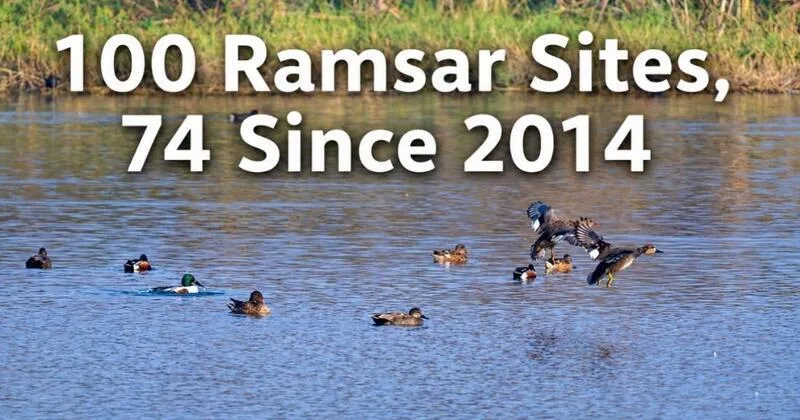
When India signed the Ramsar Convention on Wetlands of International Importance on February 1, 1982, it took the country thirty-two years to add just 26 wetlands till 2014 to the global list. By 2014, India’s Ramsar network had barely moved beyond two dozen sites a number that reflected decades of bureaucratic laziness, fragmented governance and a conservation culture that treated wetlands as wastelands to be drained, encroached upon or simply forgotten. A little over a decade later, that number stands at 100. How India nearly quadrupled its Ramsar count in roughly twelve years is not a statistical curiosity, but it is a story of governance reform, institutional restructuring and a civilisational reawakening to the idea that water bodies are not obstacles to development but the very foundation of ecological and national security.
The Stagnant Decades: 1982-2013
For more than three decades after India signed the Ramsar Convention, wetland conservation remained an afterthought in national policy. The first two Indian sites to receive the Ramsar tag are Chilika Lake in Odisha and Keoladeo Ghana National Park in Rajasthan, which were designated in 1981, even before India formally became a party to the treaty. From that point until 2013, only 24 more wetlands joined the list, taking the total to 26. This translates to less than one new site per year across a country that is home to over seven lakh wetlands covering roughly 4.5 % of its geographical area.
The reasons for this slow pace were political will. India’s first dedicated wetland regulation, the Wetlands (Conservation and Management) Rules, 2010 centralised almost all decision-making in New Delhi through a National Wetland Regulatory Authority. States had little ownership of the process, local communities were rarely consulted and the identification of new wetlands for Ramsar nomination moved at the pace of file movement rather than ecological urgency. Wetlands continued to be lost to urban expansion, industrial effluent, agricultural encroachment and unregulated reclamation. Even as India’s global commitments under the Convention remained largely symbolic.
The Turning Point: A New Governance Architecture
The shift began after 2014, when wetland conservation was repositioned not as an isolated environmental subject but as part of a larger national push on water security, biodiversity protection and climate resilience. The most consequential structural change came through the Wetlands (Conservation and Management) Rules, 2017, which replaced the 2010 framework following directions from the Supreme Court.
The 2017 Rules fundamentally altered who held responsibility for wetland protection. Instead of a single central authority, the rules mandated that every state and Union Territory constitute its own State Wetlands Authority, chaired by the state’s environment minister or chief secretary, with the power to identify, notify and manage wetlands within its jurisdiction. The Central Government’s role was redefined as monitoring, advisory and coordinating by exercising through a National Wetland Committee that guides states on the wise use principle central to the Ramsar philosophy, reviews the progress of Ramsar site management, and recommends sites for international designation.
States that had never prioritised wetland documentation suddenly had a statutory body, a defined mandate, and political accountability for outcomes. The rules also introduced a comprehensive list of prohibited activities for notified wetlands by banning reclamation, conversion for non-wetland use, dumping of solid waste, discharge of untreated effluents and new industrial setups within wetland boundaries, while regulating other activities through site-specific management plans. A nationwide digital wetland inventory, to be updated every decade, gave the system a scientific backbone that had been missing earlier.
These rules also widened the very definition of what counted as a wetland worth protecting. Many of India’s recent Ramsar additions are human-made tanks, reservoirs and irrigation structures, such as Siliserh in Rajasthan and Karaivetti in Tamil Nadu, among them, finally aligning India’s list with the Ramsar Convention’s own broader definition, which has always recognised constructed wetlands alongside natural ones.
The Ramsar Convention itself, signed at the Iranian city of Ramsar in 1971 and in force since 1975, recognises wetlands as ecosystems of global importance for biodiversity, water regulation, and climate moderation, often described as the planet’s kidneys for their role in filtering pollutants and its sponges for their capacity to absorb floodwaters and recharge groundwater.
Designation as a Ramsar site does not transfer ownership or control to any international body; it remains a recognition of national importance, paired with a commitment to the Convention’s wise use principle, which permits sustainable fishing, grazing and community livelihoods so long as a wetland’s ecological character is preserved. This distinction matters in the Indian context, where many wetlands support dense human populations dependent on them for water, food and income.
The acceleration after 2017 has been striking. Between 1982 and 2013, India added 26 sites. Between 2014 and mid-2026, it added 74 more, an increase of nearly 285 % in just over a decade. The pace peaked in 2022, India’s 75th year of independence, when 28 wetlands were designated as Ramsar sites in a single year as part of the Azadi Ka Amrit Mahotsav celebrations, pushing the national tally past 75. The momentum has continued since: by August 2024 India had 85 sites, by December 2025 the count reached 96 and by early 2026 the network crossed 98 with the addition of the Patna Bird Sanctuary in Etah, Uttar Pradesh, and Chhari-Dhand in Kutch, Gujarat wetlands that shelter migratory birds alongside desert wildlife such as chinkara, caracal and desert foxes. The Shekha Jheel Bird Sanctuary in Aligarh followed soon after as the 99th site, before India crossed the symbolic threshold of 100 Ramsar sites in 2026.
A century as far as Ramsar sites are concerned!
Glad that the Jai Prakash Narayan Bird Sanctuary (Surha Tal) in Ballia, Uttar Pradesh has been designated as India’s 100th Ramsar site. This wetland is rich in avifaunal biodiversity, attracting several migratory and resident… pic.twitter.com/HENtPJoRnt
— Narendra Modi (@narendramodi) June 5, 2026
These 100 wetlands today span more than 13.8 lakh hectares, an area larger than several Indian states put together. Tamil Nadu leads the country with 20 Ramsar sites, followed by Uttar Pradesh with around ten. States such as Sikkim and Jharkhand received their first-ever Ramsar designations only in the last two years, a sign that wetland recognition is no longer concentrated in a handful of traditionally “green” states but is spreading into India’s central and north-eastern landscapes as well. Internationally, this places India as the country with the highest number of Ramsar sites in Asia, and among the top three globally.
Wetlands as Civilisational and Ecological Assets
What makes this significant is not the count itself but what these wetlands represent. The Sundarbans in West Bengal, India’s largest Ramsar site at over 4,230 square kilometres, is both home to a mangrove forest sheltering the Royal Bengal Tiger and a natural cyclone buffer for millions of coastal residents. The Vembanad-Ashtamudi backwaters in Kerala support fisheries that sustain entire coastal communities. Loktak Lake in Manipur, with its unique floating phumdis, anchors the cultural identity of the Meitei community as much as it shelters the endangered Sangai deer. Renuka Wetland in Himachal Pradesh, India’s smallest Ramsar site at just 20 hectares, carries deep religious and folk significance for the hill state.
Wetlands in India are not abstract ecological units but living systems intertwined with traditional knowledge, livelihoods, and cultural memory. Union Minister Kirti Vardhan Singh, speaking at the World Wetlands Day observance in February 2026, made this connection explicit, describing wetlands not merely as ecological assets but as repositories of traditional knowledge and cultural identity. The government’s Wetland Mitra programme, which trains local volunteers to monitor and protect wetlands in their own neighbourhoods, reflects this same philosophy of conservation rooted in community stewardship rather than imposed from above.
This community-centric approach mirrors the broader architecture that now underpins India’s biodiversity governance. The country’s three-tier system, the National Biodiversity Authority at the apex, State Biodiversity Boards and Union Territory Biodiversity Councils at the regional level and over 2.76 lakh Biodiversity Management Committees functioning in villages, towns and cities, has produced more than 2.72 lakh People’s Biodiversity Registers documenting local species and ecological knowledge. Wetland conservation under the 2017 Rules slots neatly into this larger framework, ensuring that Ramsar designation is not a one-time international honour but part of an ongoing, locally anchored conservation process.
This is reinforced by India’s Access and Benefit Sharing mechanism under the Biological Diversity Act, which, since 2017, has issued over 12,800 approvals linked to the utilisation of biological resources, channelling nearly Rs 145 crore to roughly 11,000 Biodiversity Management Committees as of 2026. The principle is consistent across both wetland and wider biodiversity governance: conservation works best when the communities living closest to an ecosystem are also its primary beneficiaries and custodians, rather than passive subjects of a policy designed elsewhere.
Challenges That Remain
Two of India’s Ramsar sites, Keoladeo Ghana National Park and Loktak Lake, remain on the Montreux Record, the Ramsar Convention’s list of wetlands facing significant ecological stress, due to water scarcity and hydrological alteration, respectively. Chilika Lake, once on the same list, was successfully removed after sustained restoration work, offering a template for how the remaining sites might be rehabilitated. Pollution from urban sewage and industrial effluent, encroachment pressures near growing cities, and the practical difficulty of enforcing wise use principles across thousands of smaller, undesignated wetlands remain real challenges. Designation under Ramsar confers international recognition and access to technical support, but the harder work of maintaining a wetland’s “ecological character” over decades depends on sustained state-level implementation, precisely the area where the 2017 Rules placed the greatest responsibility and where continued vigilance will determine whether the headline number of 100 translates into lasting ecological outcomes.
A Decade of Aatmanirbhar Conservation
Indian wetland story over the past decade reflects a wider pattern visible across its environmental governance, where forest and tree cover have expanded to over 8.27 lakh square kilometres covering 25.17 per cent of the country. Protected areas now exceed 1,134 in number, and the tiger population has grown from 2,226 in 2014 to 3,682 in recent estimates.
The Ramsar expansion fits this same narrative of an India that no longer treats conservation as a constraint on growth but as integral to it, aligning domestic action with global commitments under the Kunming-Montreal Global Biodiversity Framework while ensuring that the benefits of conservation, through mechanisms like the National Biodiversity Authority Fund, flow back to local communities and traditional knowledge holders.
From 26 sites accumulated over three decades of indifference to 100 sites secured within little more than ten years of structural reform, India’s wetlands have moved from the margins of policy to the centre of its environmental and civilisational self-conception. As the country looks toward its 2030 biodiversity targets, the wetland story stands as evidence that when governance is decentralised, communities are empowered, and natural heritage is treated as national heritage, transformation at scale is possible, and it is already underway.