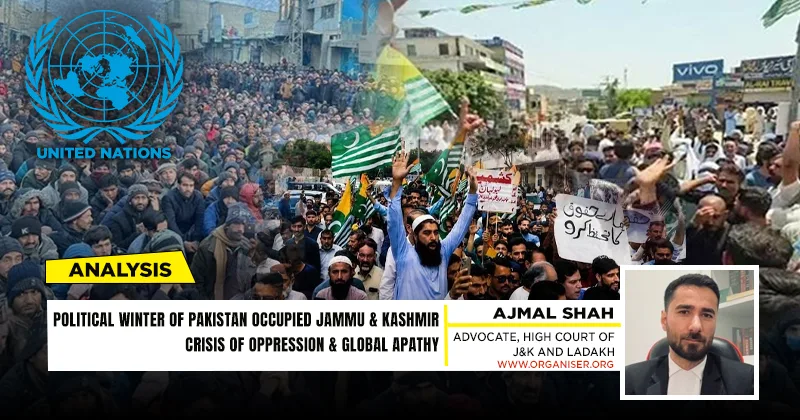
The majestic valleys of Kashmir have witnessed centuries of shifting seasons, yet the political winter imposed upon Pakistan Occupied Jammu and Kashmir remains relentlessly harsh and deeply unforgiving. Behind the pristine, snow capped peaks lies the tragic story of a people enduring systemic oppression at the hands of a tyrannical regime. The citizens of this region have demonstrated remarkable resilience and unyielding courage in the face of a paranoid state apparatus that answers legitimate civic pleas with lethal military force.
For far too long, the global community has perceived this region through the distorted lens of Islamabad’s polished diplomatic rhetoric and false promises. However, the ongoing tragic events have completely shattered this carefully constructed illusion, revealing the grim reality of an occupied territory where basic human dignity is treated as a severe threat to national security.
The ongoing crisis in PoJK represents the climax of decades of structural deprivation. The relationship between Islamabad and Muzaffarabad remains fundamentally parasitic. While PoJK generates immense hydroelectric power through infrastructure projects like the Mangla Dam, local citizens face crippling electricity tariffs. Energy generated from their ancestral lands is systematically siphoned off to illuminate mainland Pakistan, leaving the indigenous population to grapple with severe shortages. This systematic exploitation extends beyond energy to all other regional resources.
In May 2023, economic desperation sparked powerful protests, which culminated in the formation of the Joint Awami Action Committee. This grassroots coalition crystallised the aspirations of the people into a 38-point charter. The charter articulated reasonable demands, including electricity at localised production costs and the eradication of lavish elite privileges. Following paralysing strikes last year, the administration signed the Muzaffarabad Agreement. By this summer, however, it became glaringly clear that the government had no intention of honouring these promises.
These economic grievances are deeply intertwined with a calculated democratic deficit. The political system ensures that the actual residents of the occupied territory exercise zero meaningful political power. The most glaring mechanism of this systemic disenfranchisement is the preservation of 12 legislative assembly seats exclusively reserved for refugees residing in mainland Pakistan. Mainstream Pakistani parties use these absentee constituencies to manipulate electoral outcomes and maintain an unassailable hegemony over the regional assembly. By relying on votes cast hundreds of miles away, the federal government ensures that the true voice of local residents is constantly vetoed.
When the JAAC demanded the complete abolition of these 12 seats ahead of the upcoming elections on the 27th of July, they struck at the very heart of Islamabad’s control mechanism. The federal government refused this demand, transforming a civic movement into a territory wide confrontation over democratic representation. Faced with a highly mobilised public, the administration unleashed draconian state terror. On the 5th of June 2026, authorities officially proscribed the JAAC under the severe Anti Terrorism Act. By branding a peaceful civil rights coalition as a terrorist organisation, the state criminalised the fundamental human right to protest.
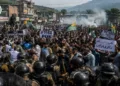
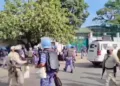
The government shockingly placed one crore rupee bounties on the heads of prominent civic leaders and initiated sedition proceedings against them. This aggressive lawfare quickly escalated into physical violence. Following the tragic shooting of Shahzaib Habib near the Khaigla Burma Bridge, thousands of grieving citizens gathered peacefully outside a hospital morgue in Rawalakot. Heavily armed security forces responded to the unarmed mourners with indiscriminate live ammunition, perishing numerous lives. To conceal these atrocities, the state enforced a severe internet blackout across the entire region.
These brutal actions permanently expose the staggering hypocrisy of Pakistan on the global stage. Islamabad routinely invokes United Nations Security Council Resolution 47 at international forums, masquerading as the righteous guardian of Kashmiri rights. However, Pakistan deliberately obscures the explicit first condition laid out in that document. The United Nations unequivocally demanded that Pakistan must secure the immediate withdrawal of all tribesmen and Pakistani nationals who entered the territory for the purpose of fighting. Pakistan has never honoured this foundational prerequisite.
Instead of vacating its regular military forces, the state actively orchestrated a massive demographic change. The occupied territory has been systematically flooded with Punjabi settlers and retired military personnel to alter demographic realities. Furthermore, the state provides sanctuary to globally proscribed terrorist organisations. These militant outfits function as an extension of the Pakistani security apparatus, acting as irregular proxies that wreak havoc across the region and turn the territory into a heavily armed launchpad for cross-border terrorism.
For decades, Pakistan has weaponised the Kashmiri diaspora to serve its geopolitical interests against India, utilising expatriate communities as a diplomatic tool to project a false narrative of solidarity. The sheer brutality of the recent state crackdowns has completely exposed this hypocrisy. Following the massacre of unarmed civilians in Rawalakot, members of the Kashmiri diaspora organised massive demonstrations outside the Pakistani Consulate in Bradford. British parliamentarians have even formally written to their government, raising grave alarm over the mass arrests and civilian killings.
Despite this clear evidence of state violence, the broader international community remains glaringly silent. Global powers have largely chosen to look the other way in a calculated abdication of moral responsibility. They refuse to stand up because their foreign policies are driven entirely by political expediency and resource interests. Many nations prioritise lucrative diplomatic, military and trade ties with Pakistan over the blood of the Kashmiri people. This collective apathy emboldens the military establishment in Islamabad to continue its atrocities in PoJK without fear of global accountability.
What stings more than the silence of the global audience is the glaring silence of specific political leaders in Jammu and Kashmir. J&K’s leadership frequently spins elaborate webs of solidarity regarding domestic political manoeuvring and global conflicts. Yet, when confronted with the brutal subjugation of their own people living under Pakistan’s illegal occupation, their voices completely vanish. This selective outrage demonstrates that their expressions of solidarity are entirely conditional and their failure to condemn the slaughter exposes a deep moral and intellectual bankruptcy.
Standing in sharp contrast to the brutal disenfranchisement of the people of PoJK by Pakistan, the Indian constitutional framework offers a testament to their genuine political inclusion. The Republic of India officially reserves 24 legislative seats in the Jammu and Kashmir Assembly specifically for the people of PoJK. These vacant seats serve as an explicit legal and moral declaration that the residents across the Line of Control are our own people. They are Indian citizens entitled to the full protection and prosperity of the Indian state.
With this framework in mind, India must fulfil its constitutional mandate toward its people in the occupied territories. Activists in PoJK have publicly urged the Indian Prime Minister to intervene, openly declaring that India is the only hope to guarantee a better life, justice and dignity for the subjugated residents. The Indian government must proactively amplify the voices of the oppressed and bring the undivided attention of the world toward the specific atrocities Pakistan is committing against its people living under an illegal occupation.
New Delhi must leverage its geopolitical influence to force the international community to take a definitive stand. The Ministry of External Affairs must systematically document these human rights violations and present them at the United Nations General Assembly. Furthermore, the Indian government must move the International Court of Justice against Pakistan and its military officials for the war crimes being perpetrated against innocent civilians in PoJK.
The darkness of tyranny may temporarily obscure the aspirations of a besieged people, but it can never extinguish their inherent desire for true freedom. As these citizens face the bullets and the blackouts imposed by a paranoid establishment, their unwavering courage stands as a powerful beacon of hope.