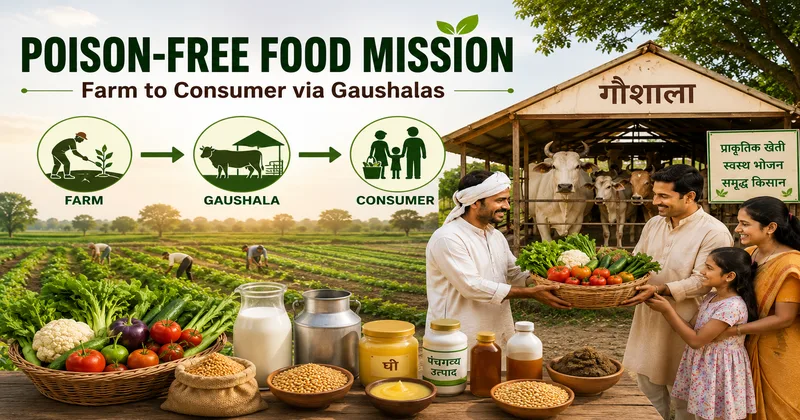
Lucknow: The Uttar Pradesh government is preparing to launch a large-scale “Poison-Free Food” campaign which will promote natural farming, ensure access to chemical-free food, and create sustainable livelihood opportunities in rural areas. The initiative, being implemented by the Uttar Pradesh Go-seva Aayog under the guidance of Chief Minister Yogi Adityanath, aims to directly connect farmers with consumers through a farm-to-consumer model based around gaushalas.
The programme is designed to transform gaushalas from being solely centres of cattle protection into hubs for organic food production, distribution and rural economic activity. Through this model, naturally grown vegetables, fruits, grains, milk and Panchgavya-based products will be supplied directly to households, which will reduce the dependence on conventional market chains and ensure that consumers receive fresh produce sourced from nearby farms.
According to the action plan prepared by the Go-seva Aayog, selected gaushalas across Uttar Pradesh will act as collection, processing and distribution centres for naturally grown agricultural products. In the first phase, the campaign will target families residing within a five-kilometre radius of identified gaushalas. These households will have access to a range of products cultivated through natural farming methods, including seasonal vegetables, fruits, grains, pure milk and Panchgavya-based products such as ghee and other traditional formulations. The objective is to create a local supply network that benefits both consumers and farmers while promoting healthier dietary choices.
Officials say the initiative will encourage farmers to adopt natural farming methods and reduce the use of chemical fertilizers and pesticides. The campaign is also expected to raise awareness about the benefits of consuming naturally grown, chemical-free food.
Farm-to-consumer model to ensure fair prices
A key feature of the programme is its Farm-to-Consumer model, which will reduce the supply chain between producers and consumers. By reducing the number of intermediaries who are involved in the marketing process, farmers are expected to receive better returns for their produce while consumers gain access to fresh products at reasonable prices. Under the proposed system, gaushalas will act as community level marketplaces where naturally grown produce can be aggregated and distributed. This arrangement is expected to provide a stable and assured market for farmers engaged in chemical-free farming, many of whom often face challenges in finding buyers willing to pay a premium for organic produce.
The initiative also aligns with the Uttar Pradesh government’s efforts to promote natural farming and strengthen the rural economy through cattle-based agriculture. The campaign places special emphasis on the use of cow-based agricultural inputs such as cow dung and cow urine, which are widely used in natural farming practices. Panchgavya-based products and organic manure prepared at gaushalas are expected to support farmers in reducing dependence on chemical fertilizers while improving soil health. Officials say the initiative seeks to establish a circular rural economy in which cattle conservation, natural farming and food production reinforce one another. Gaushalas will function not only as cattle shelters but also as centres that support farming activities and create livelihood opportunities in rural areas.
Beyond food production and distribution, the programme is expected to create significant employment opportunities in rural areas. Activities such as sorting, packaging, storage, transportation, branding, marketing and processing of agricultural products will require local manpower.
Chairman of the Uttar Pradesh Go-seva Aayog, Shyam Bihari Gupta, said the campaign would connect rural youth with multiple economic activities linked to the “poison-free food” value chain. According to him, the initiative has the potential to generate employment at the village level while creating new opportunities in food processing, logistics and marketing. He described the campaign as an effort to combine public health objectives with economic development and rural prosperity.
The proposed campaign complements several ongoing efforts by the Uttar Pradesh government to encourage natural and organic farming. In recent years, UP has promoted the use of indigenous cattle, organic manure, vermicompost and natural farming techniques under various agricultural and rural development programmes. The government has also been working to strengthen the gaushala network across the state.
By integrating natural farming, cow conservation, food distribution and rural employment under a single framework, the Yogi government will create a self-sustaining model that can be replicated across districts. If implemented successfully, the “Poison-Free Food” campaign could emerge as a unique example of how gaushalas can serve multiple roles i.e., supporting livestock welfare, promoting natural agriculture, improving access to healthy food and generating livelihood opportunities, while contributing to the broader goal of rural development in Uttar Pradesh.