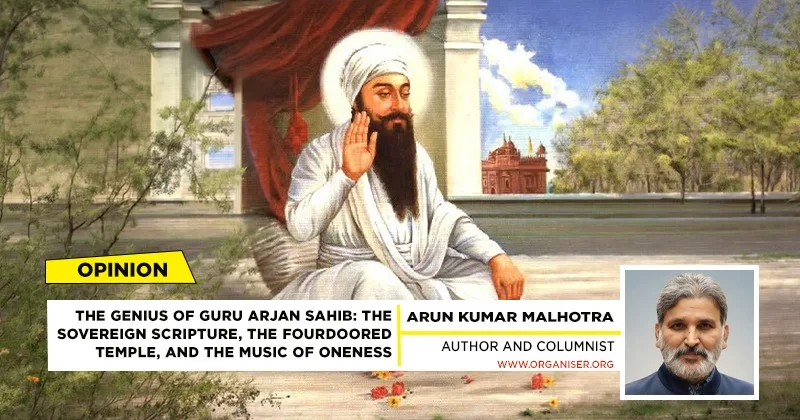
The River Ravi does not forget. It flows today as it flowed on that scorching morning in May 1606 — past the walls of Lahore, composed in motion, indifferent to empire. On its banks stood a forty-three-year-old Guru who had spent his life compiling the most inclusive scripture the world had ever seen. He had not raised an army. He had not incited sedition. He was a Guru who compiled the most inclusive scripture for humanity which carried the voices of Gurus, Sufi mystics, and enlightened masters from all hierarchies of society, into a single testimony that God is one and belongs to all. Yet one wonders why, for what reasons, a Guru, a Saint compiling a universal scripture of oneness of humanity would meet such death under the rule of Akbar’s son, Jahangir.
The Inheritance
The answer begins a hundred years before, at another river.
Around 1499 CE, at the Kali Bein in Sultanpur Lodhi, a young devout seeker who would later be known as Guru Nanak disappeared while bathing. His companions searched for three days, found only his clothes on the bank. When he emerged, he carried a sentence that has reverberated across five centuries: “Na ko Hindu, na ko Musalman.” There is no Hindu. There is no Muslim.
Guru Nanak had prayed in temples and mosques both. He had walked to the Mecca in a faqir’s robes with a Muslim companion-disciple, Mardana, at his side. He had stood in the Kaaba’s precincts, feet pointing toward the sacred stone, and when an outraged Qazi demanded how he could show such contempt, Nanak asked him to point his feet in any direction where God was not. The Qazi could not answer.
For three decades and roughly 28,000 kilometres–east to Bengal, south to Sri Lanka, north to Tibet, west to Medina, Mecca, Baghdad, Turkey–Guru Nanak walked and listened and sang. From every tradition, he found the same thing beneath the noise of doctrine. A single light, divided into a thousand arguments about whose lamp it truly belonged to. The first two words of what would become the Guru Granth Sahib ‘Ik Onkar’, One Universal Creator were the description of what he had seen, the oneness of God.
The World Akbar Made
When Guru Arjan Dev Ji was born on April 15, 1563 in Goindwal Sahib, the Mughal emperor was Jalal-ud-Din Muhammad Akbar and Punjab breathed a different air back then.
Akbar was that rare emperor whose curiosity outran his orthodoxy. In 1575, at Fatehpur Sikri, he built the Ibadat Khana, the House of Worship and filled it, every Thursday evening, with the widest possible human argument about God. Sunni Ulema and Shia theologians, Sufi mystics, Portuguese Jesuits (Father Rodolfo Acquaviva and Father Francisco Henriques, come from Goa), Hindu Pandits from Varanasi, Jain scholars (the great Hira Vijaya Suri nudged him toward banning animal slaughter on Jain holy days), Zoroastrian mobeds like Dastur Meherji Rana, Buddhists, Sikhs for genuine theological contests, fierce and sometimes chaotic, with an emperor who participated.
In 1564, as a result he abolished the Jizya, the tax non-Muslims paid to Muslims for protection from Muslims under Muslim rule. His great court historian, Abul Fazl, gave this pluralism its philosophical name Sulh-i-Kul, universal peace.
The Sovereign Scripture the World Had Never Seen
Guru Arjan Sahib became the fifth Sikh Guru in 1581, at eighteen. He saw immediately what was needed. An authenticated, permanent canon that would carry the tradition’s voice into eternity, sealed against forgery, corruption, and the attrition of time.
The compilation work was done over three years, roughly 1601 to 1604, near the Ramsar Sarovar in Amritsar, with the scholar-poet Bhai Gurdas Ji, whom Guru Arjan called “the key to the Guru Granth Sahib” as his chief scribe.
The Adi Granth contains 5,894 hymns and verses. Of these, 2,218 from Guru Arjan’s contribution. The rest came from the four Guru Sahibs and from fifteen Bhagats saints of the Hindu bhakti and Muslim Sufi traditions whose presence on these pages was itself a revolution.
Baba Farid, Kabir, Trilochan, Beni, Ravidas, Namdev, Dhanna, Jaideva, Bhikhan, Sainu, Pipa, Sadhana, Ramanand, Parmanand, Sur Das enlightened mystic masters born to various religions, various social hierarchies from royalty to the untouchable, all these saints gathered under one roof, given one voice, granted one dignity. No scripture had done this.
The Genius of Guru Arjan Sahib
Guru Arjan Sahib arranged this vast, multi-voiced work not by author, not by theology, not by chronology, but by Raga, by the classical musical modes of the Indian tradition, which was an act of genius. It reverberates in every Sikh Gurdwara in the world after centuries as the core principle of the Sikh religion.
The Adi Granth contains 30 primary ragas and their mixed forms, yielding 62 melodic frameworks across the full Guru Granth Sahib. Why Guru Arjan included Raga? In fact, as per ancient Indian spiritual traditions, Naad Brahma means ‘the soundless sound, denoting that the ‘sound is God’ which is the primordial cosmic vibration from which existence emerges. Anahat Naad–the cosmic vibration audible only in the depths of meditation is distinguished from Ahat Naad, the struck sound of voice and instrument, the sound originating from tapping the two objects. Gurbani written in ragas is conceived as a journey from the audible (Ahat Naad) toward the ineffable (Anhat Naad) the human voice reaching for the cosmic silence it was made to find.
Each Raga is tied to a time of day, a season, an emotional weather. Rag Asa for early morning, the mind unencumbered, the day still new. Rag Bhairav for the hour before dawn, when darkness and light dissolve into each other. Raag in music, and Gurbani in raag, is an art that makes Gurbani not merely readable but permanently, universally singable. That was precisely the absolute genius of Guru Arjan Sahib, ensuring that a Sikh does not read this scripture in the way one reads a law or a philosophy. But it enters through the feelings, and lands in the soul. Guru Sahib says,
“Dhan su raag surangrai, alapat sabh tikh jaiye” (SGGS, p.958)
(Blessed are the beautiful ragas in their varied form, the singing of which quenches all the thirst.)
The Harmandar Sahib Temple of Four Doors
Guru Arjan Sahib completed the most audacious architectural statement of the era–The Harmandar Sahib later known to the world as the Golden Temple of Amritsar which had been begun by Guru Ram Das Ji as a pool of nectar (amrit sarovar). Guru Arjan completed it and placed the shrine at the centre of that pool, accessible by a single narrow causeway as a jewel in a mirror of still water. The foundation stone was laid by not a Sikh, not a Hindu, but the most revered Sufi saint of Lahore Hazrat Mian Mir (1550–1635), a Qadiri mystic of such towering reputation. On 1 January 1588, Mian Mir laid that stone. A Muslim saint’s hands building a Sikh house of God. No instruction was needed. The gesture said everything.
The architecture spoke the same language as the scripture. Most temples and mosques of the era had one entrance, oriented toward a specific sacred direction eastward in Hindu temples, toward Mecca in mosques. The Harmandar Sahib was built with four doors, facing all four directions of the compass. The message was without subtlety. Whoever you are, wherever you come from, whatever name you call God, this house is yours.
On 1 September 1604, the completed Adi Granth was installed in Sri Harmandar Sahib, carried in on the head of the revered Baba Buddha Ji, while Guru Arjan walked behind, waving the Chaur Sahib in service to the sovereign scripture.
The World of Jahangir
What Guru Arjan built, Jahangir was making sure to gather forces to destroy.
In Agra, Akbar’s relationship with his eldest son Prince Salim was a case in point. Salim was calculative, violent, and impatient, a man who had no interest in acquiring the legacy of his father. Contrarily, Jahangir’s most favourite ally was Shaikh Ahmad Sirhindi (1564–1624), the Naqshbandi scholar who was propagating that the honour of Islam lies in insulting qufr and that one who respects the qafirs dishonours the Muslims and proposing Jizya to humiliate Hindus. The first payment of this friendship was a murder on 12 August 1602, Abul Fazl, Akbar’s greatest mind, the philosopher of ‘Sulh-i-Kul’. His severed head was sent to Salim as receipt.
When Akbar died in October 1605 and Salim became Emperor Nur-ud-Din Muhammad Jahangir. Jahangir means the conqueror of the world, the world that had made Guru Arjan possible, he would conquer that soon.
The Architecture of Hatred
To understand why Sirhindi celebrated Guru Arjan’s death, one must understand from the perspective of Naqshbandi orthodoxy. He called Guru Sahib the ‘Tāj al-Kufr’ the crown of infidels of Islam in Punjab. The Adi Granth carried Sheikh Farid’s hymns, installed on equal terms with the Gurus’ own revelation, implied that a Muslim mystic’s encounter with God was not uniquely Islamic but universal, dissolving the boundary that orthodox theology had spent centuries building. The Harmandar Sahib’s foundation stone, laid by Mian Mir of the rival Qadiri order, was a public endorsement of Sikh legitimacy that enraged Sirhindi on two fronts simultaneously. The four-doored temple with no Qibla–no orientation toward Mecca, was not an architectural oversight. It was a declaration that the divine has no exclusive address. And Muslims were crossing over to Sikhism in numbers that alarmed even the emperor Jahangir would record in Tazuk-e-Jahangiri his contemptuous distress at the ‘ignorant, stupid Muslims’ drawn to Guru Arjan’s teaching.
Jahangir’s Confession
The account that Jahangir wanted to eliminate Guru Sahib because of his eldest son Khusrau Mirza would be partially correct. In the summer of 1606, three months after the execution, Jahangir wrote in his Tuzuk-i-Jahangiri, his private memoir, composed in Persian, “There was a Hindu named Arjan in Gobindwal on the banks of the Beas River..” Let’s evaluate what he scribbled word by word.
“For a long time, I had been thinking.” The premeditation is stated by the killer himself, in his own hand. “The Khusrau incident, Jahangir’s rebellious eldest son had passed through Goindwal, where Guru Arjan placed a saffron tilak on his forehead, the customary gesture of blessing, which was not the cause of the execution.
“This false trade” a century of spiritual teaching across four generations, dismissed as a Dukan-e-batil, a shop of falsehood. “Even some ignorant, stupid Muslims” the real alarm was not Hindus following the Guru, but Muslims crossing over to a faith that claimed no monopoly on the divine. “Brought into the embrace of Islam” conversion, not death, was the first preference. Guru Arjan was offered a choice-alter the Adi Granth, remove what offended orthodoxy, convert. He refused both. The scripture was the word of God. Not a line would be changed.
The River Ravi and the Martyrdom
Guru Arjan was arrested in late May 1606, held in Lahore Fort, and subjected to brutal torture for approximately five days (May 24–30, 1606). The Dabistan-i Mazahib records he was “deprived of food and water and put into the hot blazing sand. Traditional Sikh accounts additionally describe a burning iron plate (tapdi tavi) and boiling sand poured on his body. It was the ‘Yasa’ law at work, the Mongol tradition of death without bloodshed, death by water or by fire rather than the sword, a technical mercy for a man too significant to simply behead.
When Mian Mir arrived and offered to call divine wrath upon the tormentors, the Guru stopped him. “This suffering is the Will of God,” he said. “I accept it with gratitude. This will become an example of patience for generations yet unborn.”
“Tera bhana mitha lage” – Your Will is sweet to me, O Lord.
“As the legend goes, he walked into the water and never returned.”
From that seed planted in his father’s blood grew the Khalsa, which Guru Gobind Singh would forge in 1699. From the Khalsa grew, in time, the Sikh Empire of Maharaja Ranjit Singh. By the nineteenth century, the descendants of those whom Jahangir had called simple-minded fools were ruling Punjab. Sirhindi’s descendants were their subjects.
Every year, on the Shaheedi Divas of Guru Arjan Sahib ji, Sikhs set up ‘Chabeels’- stalls of sweet, cool sharbat, freely offered to strangers passing in the summer heat. A glass of sweetness pressed into the hands of someone you have never met. It is one of the smallest gestures imaginable. It is also one of the most precise single act, of everything Guru Arjan lived and died for-Tera Bhana Meetha Laage.
#