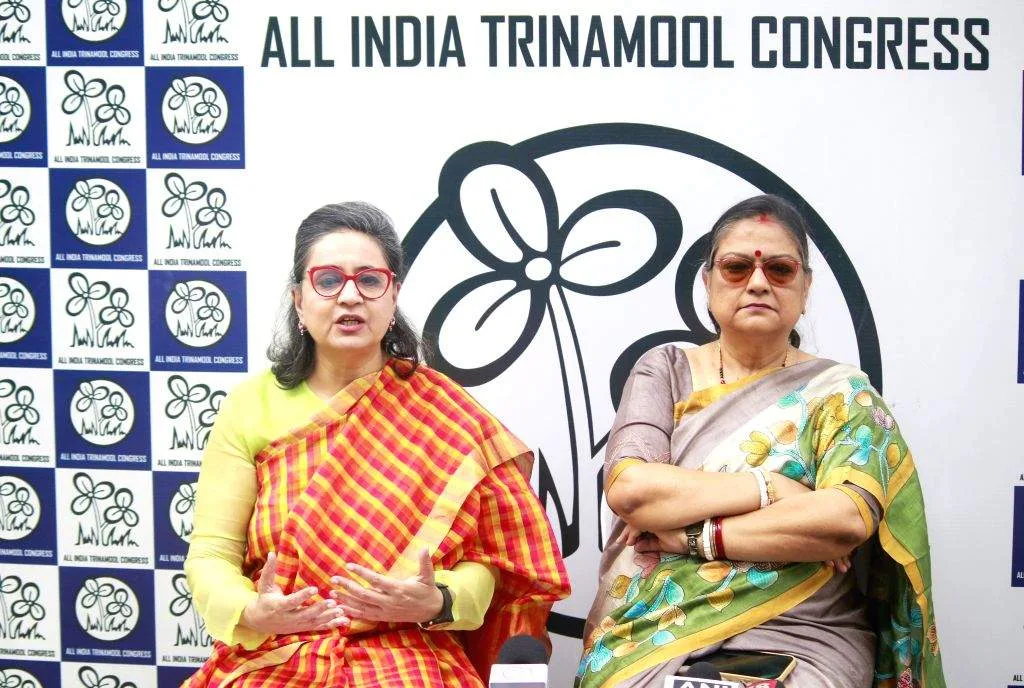
The internal battle within the Trinamool Congress (TMC) took a bitter turn on Tuesday as rebel leader and Barasat MP Kakoli Ghosh Dastidar hit back strongly at Rajya Sabha MP Sagarika Ghose after the latter branded rebel leaders as “traitors”.
The public exchange has highlighted the growing divisions within the party, which is facing one of the most serious internal crises in its history following its defeat in the 2026 West Bengal Assembly elections.
Sagarika Ghose, considered a close confidante of TMC chief Mamata Banerjee, had targeted the rebel faction through a social media post, drawing a clear distinction between those loyal to the party leadership and those who have broken ranks.
“There are TWO teams. Team TMC or team @AITCofficial and team of gaddars or traitors,” Ghose wrote on X.
Her remarks were widely seen as a direct attack on the group of rebel MPs who recently revolted against the party leadership and subsequently aligned themselves with a new political formation.
Kakoli’s Sharp Response
Responding to the accusation, Kakoli Ghosh Dastidar launched a scathing counterattack against Ghose and the TMC leadership.
“What about the team of thieves and criminals to which you belong?” Dastidar wrote in response on social media.
The remark marks one of the sharpest public exchanges between the rival factions since the rebellion erupted and signals that prospects of reconciliation within the party appear increasingly remote.
Dastidar has emerged as the most prominent face of the rebellion among TMC MPs and has repeatedly accused the party leadership of corruption, internal favouritism and abandoning the principles on which the party was built.
How the TMC Crisis Began
The confrontation comes against the backdrop of a major political upheaval inside the Trinamool Congress following its heavy defeat in the recently concluded West Bengal Assembly elections.
The electoral setback triggered widespread unrest within the party, with several senior leaders, MPs and MLAs openly questioning the leadership’s direction and strategy.
What initially appeared to be isolated voices of dissent soon evolved into a coordinated rebellion involving both legislators and parliamentarians.
The first major challenge emerged when rebel MLA Ritabrata Banerjee, reportedly backed by a group of 58 legislators, staked claim to the position of Leader of Opposition in the West Bengal Assembly, directly challenging the authority of the party leadership.
The rebellion then spread to the parliamentary wing of the party.
Rebel MPs Back NDA, Join NCPI
The political crisis deepened further when a group of Lok Sabha MPs led by Kakoli Ghosh Dastidar reportedly wrote to Lok Sabha Speaker Om Birla expressing support for the BJP-led National Democratic Alliance (NDA).
In a dramatic development, the rebel MPs later merged with the Nationalist Citizens Party of India (NCPI), a relatively small political party based in Tripura that is considered an ally of the NDA.
The move effectively formalised the split and transformed internal dissent into an open political rebellion.
The merger also raised fresh questions about the future of the Trinamool Congress at the national level, particularly after losing a significant number of MPs from its parliamentary ranks.
Why Did the Rebellion Happen?
The rebellion has been driven by a combination of political, organisational and leadership-related grievances that had reportedly been building within the party for several years.
Kakoli Ghosh Dastidar and other rebel leaders have repeatedly alleged that corruption and misconduct within the party went unaddressed by the leadership.
The rebels have also voiced concerns over what they describe as the growing concentration of power around TMC general secretary Abhishek Banerjee, Mamata Banerjee’s nephew and widely regarded as her political heir.
Several dissenting leaders have claimed that decision-making within the party increasingly became centralised and that senior leaders were sidelined from key organisational and political processes.
The dissatisfaction intensified after the assembly election defeat, with many leaders questioning the party’s strategy and leadership decisions.
An Existential Challenge for Mamata Banerjee
For Mamata Banerjee, the rebellion represents perhaps the most serious challenge to her leadership since the formation of the Trinamool Congress.
The party, which dominated West Bengal politics for over a decade, now finds itself grappling with internal fragmentation, leadership disputes and a shrinking parliamentary presence.
The public sparring between Sagarika Ghose and Kakoli Ghosh Dastidar reflects the widening gulf between the loyalist and rebel camps.
With senior leaders openly accusing one another of betrayal, corruption and criminality, the political battle within the TMC appears far from over.
As the NCPI-backed rebel faction seeks to establish itself as an alternative political force, all eyes will be on whether more MPs and MLAs choose to break ranks or whether Mamata Banerjee can regain control of a party facing its biggest internal crisis in years.