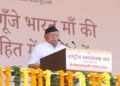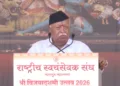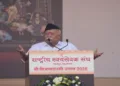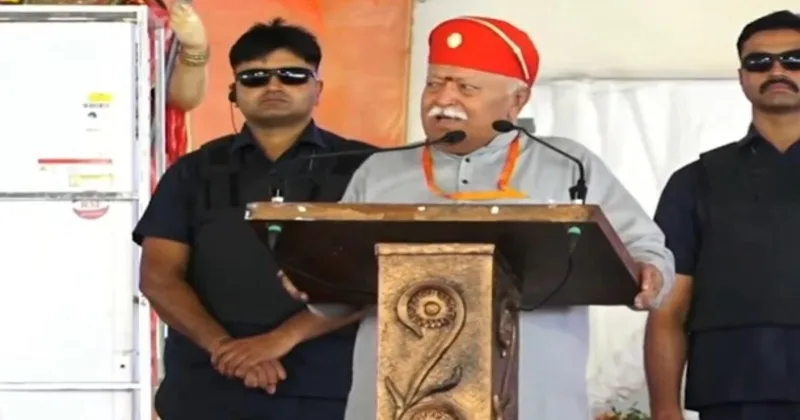
UDAAIPUR: The Battle of Haldighati was a victory for those who fought on the side of Bharat, said RSS Sarsanghchalak Dr Mohan Bhagwat while addressing a gathering on the occasion of the 486th birth anniversary of Maharana Pratap and the 450th anniversary of Battle of Haldighati at Gandhi Ground, Udaipur.
“The debate often proceeds in the opposite direction, but the facts say otherwise,” he said. Referring to accounts written by Mughal chroniclers themselves, he stated, “They record that after the very first assault they had to abandon their position and retreat six to seven miles. Then whose victory was it?”
Dr Bhagwat recalled that in the second assault a leading Mughal commander was cut down along with his horse, and that Chetak placed his forelegs upon the elephant of the enemy commander. After the battle, he said, the Mughal forces withdrew to Gogunda, fortified themselves within walls, and did not dare come out. “When their food was exhausted, they survived on raw mangoes and even ate the flesh of their own horses, yet they would not emerge from the fort. Who, then, was victorious?” he asked.
Drawing a parallel with Babu Kunwar Singh of the 1857 freedom struggle, Dr Bhagwat said that British reports often described Kunwar Singh as having fled, even though he ultimately recaptured Jagdishpur and restored his rule there. “Such narratives were created by historians then, and they are created even today,” he remarked.
He said that the campaign against Mewar was launched with the objective of crushing Maharana Pratap. “A vast imperial force descended upon Mewar, yet what was the result? They returned with little to show for it, while the people of Mewar pelted them with clods of earth. Can such a force claim victory?”
According to Dr Bhagwat, the Battle of Haldighati was not merely a military engagement. “It was a decisive episode in Bharat’s long civilisational struggle against foreign invaders. Though Maharana Pratap led a comparatively small force of Mewar’s warriors and people, the eyes of the entire country from north to south and east to west were fixed upon that battle.”
He said the battle established that foreign aggression could not bend Bharat. “Invaders may remain for as long as destiny permits, but they will pass away. Bharat, along with its dharma and culture, existed before them and will remain after them.”
Recalling earlier resistance to invasions, Dr Bhagwat referred to figures such as Bappa Rawal and Lalitaditya, saying that determined resistance had repeatedly forced aggressors to retreat. He mentioned that Haldighati restored confidence that Bharat would never abandon its dharma, culture, and civilisational identity.
Emphasising that the battle symbolised Bharat’s enduring resistance against foreign aggression, he said the real strength behind Maharana Pratap’s struggle was the unity of society, rooted in dharma, self-respect, and a shared commitment to preserving Bharat’s cultural identity.
“Many storms have arisen in Bharat from time to time,” he said. “The world may have thought for a moment that Bharat had ended, yet Bharat has never ended. As the poet said, ‘Yunan, Misr, Roma though they vanished, there is something about our civilisation that it cannot be erased.’”
Dr Bhagwat attributed Maharana Pratap’s success not to numerical strength or weaponry, but to social unity. “Not only Maharana Pratap, not only his army, and not only the royal house of Mewar fought. The entire society fought together, forgetting distinctions of caste, custom, food habits, and even differences in modes of worship.”
“To become one, it is not necessary to become identical,” he said. “What is necessary is unity of mind and social harmony.”
He recalled an anecdote from the life of RSS founder Dr KB Hedgewar, who, when asked why he was walking a long distance in the scorching Nagpur heat to meet someone, he replied, “When there is closeness in the heart, distance ceases to matter.” Dr Bhagwat said this reflected Bharat’s civilisational outlook of respecting diverse paths while nurturing a shared sense of belonging.
Contrasting this with imperial ideologies that claimed exclusive correctness, he said such doctrines had brought devastation across the world. Bharat, he said, had traditionally spread knowledge, culture, and friendship rather than conquest.
Dr Mohan Bhagwat said, “Today we celebrate the birth anniversary of Maharana Pratap. Have you heard of Akbar’s birth anniversary being celebrated in the same way? Then who truly won?” He emphasised that the real strength of Haldighati lay in truth, self-respect, and unwavering resolve. “Weapons, wealth, and numbers may have favoured the other side, but Maharana Pratap possessed the conviction that the people of Bharat do not willingly live in slavery.”
“Our history is not the history of a people resigned to servitude,” Bhagwat said. “It is the history of continuous struggle against those who sought to enslave us.”
Concluding his address, he said that Maharana Pratap gave a message to the whole of Bharat that the nation was alive, strong, and capable of defending its freedom. “On his birth anniversary, we remember not only his valour but also the qualities that sustained its self-respect, devotion to dharma, and unity of society.”