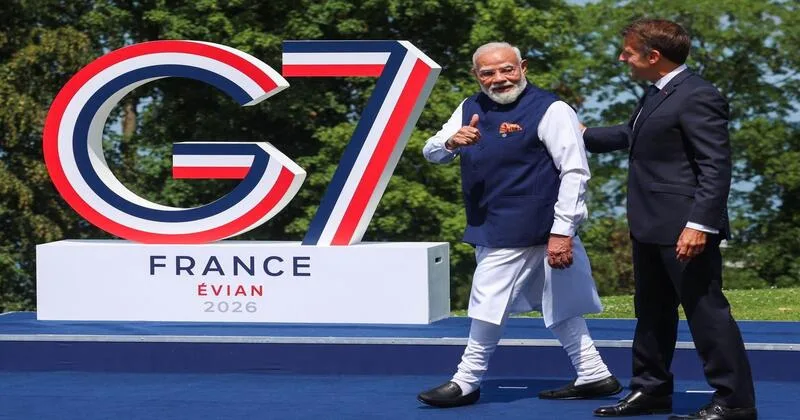
Prime Minister Narendra Modi’s ongoing Europe visit from June 13-18 2026 is more than a routine diplomatic tour. Covering France, Slovakia and the G7 Summit in Evian, the visit comes at a moment when Europe is reassessing its economic dependence on China, confronting growing trade disputes with Beijing, and searching for trusted partners in an increasingly fragmented global order. The timing is significant. Barely a month earlier, between 15 and 20 May 2026, Modi had completed another major European outreach covering the Netherlands, Sweden, Norway and Italy. Taken together, these visits reveal a clear pattern that India and Europe are moving closer precisely when trust between Europe and China is steadily eroding.
The current visit began in France, where Modi met President Emmanuel Macron in Nice to review the India-France Special Global Strategic Partnership. The two leaders jointly inaugurated the ‘Bharat Innovates’ initiative connecting Indian start-ups with global investors, while Modi also participated in the VivaTech Summit in Paris. The visit then moved to Slovakia, marking the first visit by an Indian Prime Minister since Slovak independence in 1993. Discussions focused on trade, manufacturing and investment cooperation. The final leg is the G7 Summit in Evian, where leaders are discussing global economic growth, artificial intelligence and geopolitical stability.
These engagements are taking place against a rapidly changing European strategic landscape. The European Union is no longer looking at India merely as a large market. Increasingly, it sees India as a geopolitical partner capable of contributing to Europe’s economic security, technological resilience and strategic autonomy.
Europe’s China reassessment and the search for alternatives
For much of the last two decades, Europe’s economic engagement with Asia revolved around China. Following Beijing’s economic reforms and especially after China’s entry into the World Trade Organisation in 2001, European businesses invested heavily in the Chinese market. Germany, France and other major European economies viewed China as a critical manufacturing hub and growth market. That perception has changed dramatically.
A major turning point came in 2019, when the European Commission officially described China as a “systemic rival.” This was not merely rhetorical. Several developments reinforced European concerns. China’s coercive trade measures against Lithuania, export restrictions on critical raw materials, and Beijing’s close alignment with Russia after the 2022 invasion of Ukraine convinced many European policymakers that excessive dependence on China carried serious strategic risks.
Shared my thoughts at the Outreach Session on ‘Forging New Partnerships and Rebuilding International Solidarity’ at the G7 Summit in Evian. In a world that is getting more interconnected and interdependent than ever before, this subject becomes all the more vital. But,… pic.twitter.com/NjNddWGtFF
— Narendra Modi (@narendramodi) June 16, 2026
The COVID-19 pandemic further exposed supply-chain vulnerabilities. European governments discovered how dependent they had become on Chinese manufacturing networks for critical goods. As a result, Brussels increasingly adopted a policy of “de-risking” rather than outright decoupling from China. The objective became clear that diversify economic partnerships and reduce overreliance on Chinese supply chains. India emerged as one of the most attractive alternatives.
Unlike China, India combines a large market, democratic institutions, a rapidly growing economy and increasing geopolitical influence. Moreover, New Delhi’s emphasis on strategic autonomy resonates strongly with Europe’s own search for greater geopolitical independence.
The revival of the EU–India economic partnership
One of the clearest indicators of this shift is the revival of negotiations for the EU–India Free Trade Agreement (FTA). Negotiations had originally collapsed in 2013 after years of disagreements. However, changing geopolitical realities led both sides to reopen talks in 2022. Today, the agreement is among the most ambitious trade negotiations undertaken by either side.
The proposed arrangement covers three major pillars, trade, investment protection and geographical indications. It seeks to eliminate tariffs on approximately 96 percent of bilateral trade, potentially saving European exporters around €4 billion annually.
The economic stakes are substantial. EU–India bilateral trade currently stands at approximately €120 billion, while services trade alone reached €59.7 billion in 2024. European foreign direct investment in India has reached around €132 billion.
Europe expects greater access to India’s markets for automobiles, machinery, chemicals, pharmaceuticals and wines. India seeks expanded opportunities for textiles, gems and jewellery, leather products and professional mobility services. The agreement would also open access across 144 service subsectors, including engineering, information technology and business services.
https://twitter.com/i/status/2066956763212157258
For Europe, the FTA is not merely a trade agreement. It is increasingly viewed as part of a broader strategy to reduce dependence on China. European Commission President Ursula von der Leyen described it as the “mother of all deals,” reflecting its strategic significance.
Modi’s repeated engagements across Europe over the past month demonstrate that New Delhi intends to ensure that this momentum is translated into tangible outcomes.
Growing economic friction between Europe and China
While India and Europe are drawing closer, economic tensions between Europe and China continue to intensify.
One major area of conflict involves Chinese e-commerce platforms such as SHEIN and TEMU. Their rapid expansion across Europe has triggered political and commercial backlash.
In the first half of 2025, SHEIN reportedly attracted 146 million monthly unique visitors across the European Union, an increase of 11.6 percent year-on-year, including over 27.3 million users in France. TEMU recorded approximately 116 million monthly active users.
European retailers argue that these platforms benefit from regulatory loopholes and ultra-low pricing strategies that distort competition. In response, policymakers have moved towards tighter regulations. France has debated measures to remove tariff exemptions on imported goods valued below €150, while the European Commission accelerated plans to eliminate customs duty exemptions by 2026, instead of the previously planned 2028 timeline.
The concerns extend far beyond online retail. Chinese investments in Europe’s electric vehicle and battery sectors have generated increasing scrutiny. Chinese automaker BYD sold 80,800 vehicles in Europe during 2025, three times higher than the previous year. The company is constructing a manufacturing facility in Hungary and evaluating another in Spain or Turkiye.
Battery giant CATL has launched a joint venture with Stellantis in Spain to establish a factory with annual capacity of 50 GWh, expected to employ around 4,000 workers. Similar projects are emerging across the continent.
While these investments create jobs, they also raise concerns regarding industrial dependence, technological sovereignty and market competition.
The digital sector presents another challenge. Chinese technology firms are increasingly acquiring stakes in European companies and expanding their presence in logistics, e-commerce and digital services. Such developments have fuelled debates about data security and digital sovereignty across Europe.
As a result, Europe’s approach towards China is becoming increasingly cautious and defensive.
India’s advantage in Europe’s strategic calculus
India benefits from this changing environment not simply because Europe is becoming wary of China, but because India offers qualities that many European policymakers find attractive.
Unlike China, India is not perceived as seeking to overturn the existing international order. While New Delhi maintains strategic autonomy and pursues an independent foreign policy, it consistently emphasises a rules-based international framework.
External Affairs Minister S. Jaishankar’s formulation that India is “non-West rather than anti-West” captures this distinction. India participates actively in forums such as BRICS, yet it has repeatedly resisted efforts to transform the grouping into an anti-Western platform.
This matters greatly in Europe. Many European governments are concerned about the increasingly close alignment between China and Russia. Although India has also maintained relations with Moscow, European policymakers generally view India’s position as more pragmatic and less ideologically confrontational.
Before the start of the proceedings at the G7 Summit in Evian this afternoon.
Always insightful to exchange perspectives with G7 leaders.@G7 pic.twitter.com/54wJN40uan
— Narendra Modi (@narendramodi) June 16, 2026
At the same time, India’s economic trajectory is difficult to ignore. The country recorded 6.6 percent GDP growth in 2025, with growth projected at 6.7 percent in 2026. As India moves towards becoming one of the world’s largest consumer markets, European businesses increasingly see opportunities that extend beyond manufacturing diversification.
The India–Middle East–Europe Economic Corridor (IMEC) further strengthens India’s appeal. The corridor promises to enhance connectivity between Europe, the West Asia and India, reducing transportation costs and creating alternative trade routes that bypass strategic chokepoints.
Modi’s recent European engagements reflect this broader economic vision. During his May 2026 visit, discussions in the Netherlands focused on semiconductors, defence and security cooperation. A particularly significant outcome was the agreement between Tata Electronics and Dutch technology leader ASML to support semiconductor manufacturing expansion in India.
In Sweden, Modi addressed a CEO roundtable in Gothenburg, where discussions focused on doubling bilateral trade and investment. In Norway, participation in the Third India-Nordic Summit strengthened cooperation in green technologies and sustainable development. In Italy, Modi and Prime Minister Giorgia Meloni advanced implementation of the Joint Strategic Action Plan 2025–2029 covering trade, clean energy and defence cooperation. These initiatives collectively position India as a long-term strategic partner rather than merely an alternative market.
Modi’s diplomatic offensive and Europe’s strategic future
The significance of Modi’s Europe visits lies not only in the agreements signed but also in the diplomatic message they convey.
Europe is navigating multiple uncertainties simultaneously. Relations with China and the US are becoming increasingly difficult. Trade tensions continue to rise. Supply-chain vulnerabilities remain a concern. The continent also faces uncertainty regarding future American commitments under President Donald Trump’s renewed administration.
Trump’s aggressive trade posture has added further urgency to Europe’s diversification efforts. Threats of higher tariffs and disputes involving transatlantic security commitments have encouraged European leaders to expand partnerships beyond traditional alliances.
स्वागत है @narendramodi. pic.twitter.com/qmdGdDrFSu
— Emmanuel Macron (@EmmanuelMacron) June 16, 2026
In this environment, India offers a combination that few countries can match, scale, economic growth, political stability, technological capability and strategic compatibility.
The symbolism surrounding recent India-Europe interactions reflects this reality. Modi was the guest of honour at France’s Bastille Day celebrations in 2023. Macron attended India’s Republic Day celebrations in 2024. The two leaders co-chaired the Paris AI Action Summit in February 2025. Such exchanges demonstrate that the relationship has evolved far beyond conventional diplomacy.
President von der Leyen’s observation during her visit to India in February 2025 that European and Indian interests “align like never before” captures the essence of this transformation.
Europe is not abandoning China. China remains one of Europe’s largest trading partners and an important economic actor. However, Europe’s growing distrust of Beijing is reshaping its strategic priorities. The combination of economic coercion concerns, supply-chain risks, geopolitical disagreements and market access frustrations has compelled European leaders to seek stronger partnerships elsewhere.
India is uniquely positioned to benefit from this transition. Prime Minister Modi’s ongoing June 2026 visit therefore represents much more than a series of diplomatic meetings. It reflects the emergence of a new geopolitical reality in which India is becoming central to Europe’s economic diversification, technological partnerships and strategic balancing efforts. As distrust between Europe and China deepens, New Delhi’s importance in European calculations is likely to grow further. For India, the moment presents an opportunity to transform goodwill into long-term influence and establish itself as Europe’s most consequential partner in the Indo-Pacific era.