Don’t we as citizens of an electoral democracy deserve better from our politicians than these clumsy attempts at delimitation? For five decades, the foundational promise of equal representation has been held hostage by political cartels that treat administrative boundaries not as conduits for development, but as gerrymandered trenches to preserve their own survival.
The Indian constitutional experiment that began in 1947 has undergone many political shifts, revealing a complex relationship between our democratic representation and the underlying reality. A primary myth in this discourse is the fear that dividing India into small states would lead to chaos and weaken national unity. In reality, the current large states, as defined by linguistic borders, obscure economic disparities and exacerbate regional tensions. This has resulted in a system in which regional politicians create ‘enemies’ to maintain contrived ‘identities’. Instead, by establishing smaller, more coherent states—for instance, by dividing West Bengal into Mallabhum, Kamtapur, and Gauda (other such examples abound in most states today) these contrived ‘enmities’ would simply disappear. Such state reorganisation would reflect actual identities, reduce identity-based conflicts, and enhance both national unity and administrative efficiency.
To understand our descent into cartographic surrealism, we must examine the legacy of colonial rule and the British-created language trap. The modern political map of India was born from colonial convenience and post-independence panic, not from democratic design. Our British masters set provincial borders through military conquests and revenue extraction. With independence, the State relied on ad hoc compromises, leading to linguistic reorganisation throughout the 1950s. While this temporarily eased regional anxieties, it established the dangerous idea of one language, one state. This critical error betrayed B.R. Ambedkar’s warnings against excessive linguistic identity, which he said could fracture national unity and perpetuate north-south polarisation. He proposed “one state, one language”, suggesting that a state should use the language spoken by most, if not all, of its inhabitants, even as the same linguistic group could span multiple states. Modern India has overlooked Ambedkar’s view of federalism as a means of human capital development; instead, it has used tools to establish dominance and to sustain low-productivity practices within select networks.
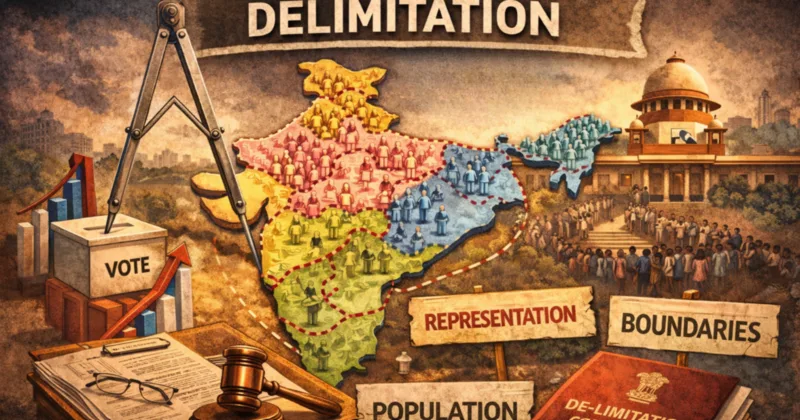
The suspension of the delimitation process in 1976 and 2001 has led to significant design flaws, resulting in what can be called delimitation arbitrage. In a true democracy, each vote should carry roughly equal weight; however, the political elite has excluded urban and industrial India to protect rural interests. Currently, about 37 per cent of India’s population lives in urban areas, yet these areas hold only 16.4 of Lok Sabha seats, with even greater disparities in state assemblies. For example, Tamil Nadu has a 54 prer cent urban population but only 17 per cent per cent of assembly seats, while Maharashtra’s urban residents make up 49 per cent yet hold just 22 per cent of seats. In Karnataka, Bengaluru’s representation is reduced by 10-15 percentage points. This misrepresentation offers a political arbitrage opportunity, allowing dynasties to accumulate wealth while legislative bodies remain immobilised.
This distortion has created an asynchronous state where our political institutions are disconnected from the political economy. Economies typically experience turbulent transitions in a country’s rise. In India, the first was marked by the rise of mass agriculturalists after the Green Revolution, displacing industrialists as wealth creators. The second transition in the 1990s saw landless individuals becoming wealthy through service exports. Currently, we are entering a third transition, with service exports declining and new technological innovations emerging. However, our political maps remain tied to the agrarian landscape of the 1970s, resulting in a parliament dominated by beneficiaries of the first transition. While sectors accounting for only 18% of the Lok Sabha make up over 80% of the economy, the legislature’s role in managing economic transitions and providing safety nets for yesterday’s losers has been completely stalled.
Without a proper platform to negotiate between urban capital and rural labour, Indian politics has defaulted to an ecology of clientelism and embedded conflict. To maintain their grip on power, landed caste elites suffering from a relative decline in agricultural returns have turned the state into a pure allocator of spoils. They utilise their artificially preserved legislative weight to throw the exchequer’s wealth at wasteful, environmentally catastrophic Peter Pan projects designed purely to nourish patronage networks. Consider the massive, water-guzzling sugarcane fields in arid Maharashtra, so globally uncompetitive that the state must heavily subsidise their conversion into ethanol. Consider the subsidies provided to rice farmers in semi-arid Punjab, which account for over 20% of the country’s MSP expenditure on rice, while permanently degrading the region’s water table and soil health. When these uncompetitive economic practices inevitably fail to deliver lasting prosperity, politicians double down on identitarianism, turning to freebies and competitive, sub-categorised reservations. This is the application of Carl Schmitt’s friend-enemy distinction and Charles Le Bon’s crowd psychology, stripped bare: politicians use the power of suggestion to invent an enemy-other, infusing rational individuals with a sense of collective vulnerability to milk them for votes.
We see this extreme model illustrated in the politics of West Bengal, where synthetic regional pride has long been used to mask systemic economic decay. For decades, the political model of Bengal relied on militant trade unions, the cultivation of illegal immigration as a permanent client base, and the extraction of value through local party offices. The sheer fraud infesting this system was unmasked by the SIR exercise, which weeded out a staggering 91 lakh fake, dead, or relocated names—amounting to 12% of the state’s voting population. When regional politicians can secure victory through roll manipulation, clientelist sops, and voter intimidation, poor governance becomes a feature of design rather than a result of incompetence.
The May assembly election results have significantly changed the political landscape, presenting a crucial opportunity for reform. The Dravidian movement, led by the DMK and AIADMK, has long obstructed rational delimitation efforts, fostering a climate of fear while misrepresenting the South’s population control success. Their narrative dismissed important factors, such as female literacy, that preceded State efforts, even before independence. Despite claiming to protect the South’s industrious spirit, they ignored their own policies that hurt urban and industrial representation, leading to unsustainable debt levels in Tamil Nadu and Karnataka. Their opposition to Hindi served as a strategy to create a ‘northern adversary’, while they benefited from alcohol syndicates. The possible decline in Dravidian influence after these elections may lead to the dismantling of regionalism, paving the way for more democratic representation, as a comprehensive census is expected by 2027.
Both delimitation and state reorganisation are two sides of the same coin; they are no longer abstract ideations but practically exercisable policy choices. If we seize this historic moment to reorganise India into roughly 75 scientifically, geographically, and economically coherent states by 2035, we can permanently dismantle the operating system of extractive clientelism. For an ordinary citizen, governance would become hyper-local and accountable, as smaller distances to state capitals eliminate the vast spaces where identitarian vacuums are farmed. Capital flows would naturally align with high-productivity urban centres, funding robust infrastructure and genuine skilling architectures rather than competitive populism.
A recent working paper by the Economic Advisory Council to the Prime Minister (EAC-PM), which presents a complex statistical model for ‘targeted’ constituency splitting, reads less like independent research and more like an officially commissioned alibi. By utilising gender-disaggregated turnout metrics to retroactively justify the expansion of the Lok Sabha to over 800 seats, the note provides pseudo-scientific padding for an impending, heavy-handed legislative push. Armed with newly augmented majorities in both Houses following recent political shifts, the government appears poised to overcome prior procedural gridlock. The strategy is deeply disingenuous: it deliberately hitches the contentious, cartographic restructuring of delimitation to the wagon of the universally popular cause of women’s reservations, effectively weaponising gender equity as a political shield to push through structurally flawed boundaries.
The ruling Bharatiya Janata Party has a remarkable opportunity to rise above the challenges posed by gerrymandering. As we approach the post-2026 landscape and the 2027 census, it is crucial for the BJP to embrace a responsible approach that prioritises the long-term unity and well-being of our society over short-term electoral gains. By striving for a thoughtful, data-informed restructuring, we can align our legislative chambers with both modern economic realities and our rich civilizational heritage. We stand at a pivotal moment: let us seize the chance to create an electoral map that genuinely reflects the hopes and priorities of our diverse population. Together, we can foster a political environment that strengthens our social fabric and enhances our democracy.