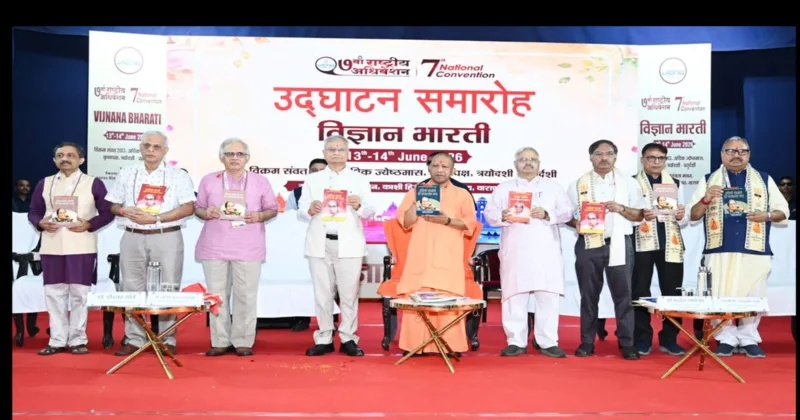
Uttar Pradesh CM Yogi Adityanath at 7th National Convention of Vijnana Bharati (VIBHA)
Varanasi: The 7th National Convention of Vijnana Bharati (VIBHA) commenced on June 13 at Swatantrata Bhavan, Banaras Hindu University. The two-day convention, organised jointly by the Vedic Science Centre of Banaras Hindu University, the Indian Institute of Technology (BHU), and the Inter-University Centre for Teacher Education, has brought together more than 1,300 scientists, researchers, academicians, policymakers and industry representatives from India and abroad.
In the inaugural session, Uttar Pradesh Chief Minister Yogi Adityanath said that the purpose of research and innovation should be human welfare, economic progress and national development. He noted that research and innovation have always been integral to Indian civilisation and have contributed to Bharat’s prosperity and global leadership. Ancient Bharatiya traditions, whether related to agriculture, healthcare or food systems, were founded on scientific principles. These traditions not only strengthened society but also provided people with inspiration and a renewed sense of purpose.
Referring to the COVID-19 pandemic, he said that Bharat’s traditional knowledge systems proved beneficial when indigenous practices were adopted to strengthen immunity. He emphasised that no nation can progress without research and innovation and urged the youth to dedicate their scientific talent and research capabilities to nation-building. Stressing the need to integrate modern science with traditional knowledge, he called for promoting sustainable development, natural farming, grassroots innovation and entrepreneurship.
Banaras Hindu University Vice-Chancellor Prof. Ajit Kumar Chaturvedi said that the vision of Mahamana Pandit Madan Mohan Malaviya is deeply connected with the objective of Vijnana Bharati to establish harmony between modern science and Bharat’s knowledge traditions. Reaffirming the university’s commitment to promoting scientific research rooted in Indian values, he urged participants to actively engage in the deliberations of the convention.
RSS Akhil Bharatiya Prachar Pramukh Sunil Ambekar discussed the need to establish harmony between modern scientific advancement and India’s holistic knowledge traditions. He said that while contemporary science has significantly contributed to technological progress, emerging challenges related to the environment, health and society require a more integrated and human-centric approach. Referring to artificial intelligence and other emerging technologies, he said that ensuring such technologies serve human welfare and environmental sustainability is an important responsibility of institutions such as Vijnana Bharati.
Calling upon the youth to pursue research and innovation based on societal needs, he emphasised the promotion of a scientific temper and suggested wider dissemination of scientific knowledge through Bharatiya languages and Bharat’s rich knowledge traditions. He noted that Bharatiya languages, including Sanskrit and various regional and folk languages, contain vast reservoirs of knowledge and wisdom. By integrating modern developments with this knowledge heritage, society can be enriched in meaningful ways. He added that Bharatiya thought has always reflected a holistic concern not only for humanity but for the welfare of the entire world and creation.
Vijnana Bharati National President and President of the Indian National Science Academy, Dr. Shekhar C. Mande, said that Vijnana Bharati is committed to promoting scientific awareness through a holistic perspective rooted in Bharatiya ’s knowledge traditions. He observed that Bharatiya tradition regards science, philosophy and spirituality as complementary to one another. Referring to global challenges such as climate change and artificial intelligence, he said that meaningful solutions can emerge only through the integration of scientific research, ethics and a civilisational perspective.
Welcoming the delegates, Vijnana Bharati General Secretary Vivekanand Pai highlighted the organisation’s key themes—Ancient to Modern Science, Science and Spirituality, and Science in Indian Languages. He stressed the need to integrate traditional knowledge systems with modern scientific research. He noted that through initiatives such as the India International Science Festival, World Ayurveda Congress, Vidyarthi Vigyan Manthan and various science outreach programmes, Vijnana Bharati is working to promote scientific temper, encourage innovation and strengthen science communication.
IIT-BHU Director Prof Amit Patra said that a conducive environment for innovation and entrepreneurship can be created by bringing research institutions, industries, start-ups, farmers and policymakers onto a common platform.
Prof. Prem Narayan Singh, Director of the Inter-University Centre for Teacher Education, referred to the convention theme, “Artificial Intelligence, Science and Humanity,” and said that the purpose of science is not merely to make machines more capable but to improve human life. He stressed the need for balanced development based on ethical values, environmental responsibility and human welfare for the creation of a developed Bharat.
Former President of the Indian National Science Academy, Prof. Ashutosh Sharma, observed that rapid advances in science and technology are transforming human life in unprecedented ways. However, he cautioned that the future of society will depend on maintaining a balance between technological advancement and human values. Human consciousness, sensitivity and moral judgment, he said, have no substitute. Science must contribute not only to efficiency and productivity but also to the creation of a more balanced, meaningful and aware society.
During the inaugural session, the convention souvenir and the annual report of Vijnana Bharati were released. Publications under the Vidyarthi Vigyan Manthan initiative on eminent Indian women scientists Prof. Rohini Godbole, Prof. Anna Mani and Prof. Asima Chatterjee were also unveiled. The programme witnessed the participation of several distinguished scientists, academicians and senior functionaries of leading institutions from across the country.
