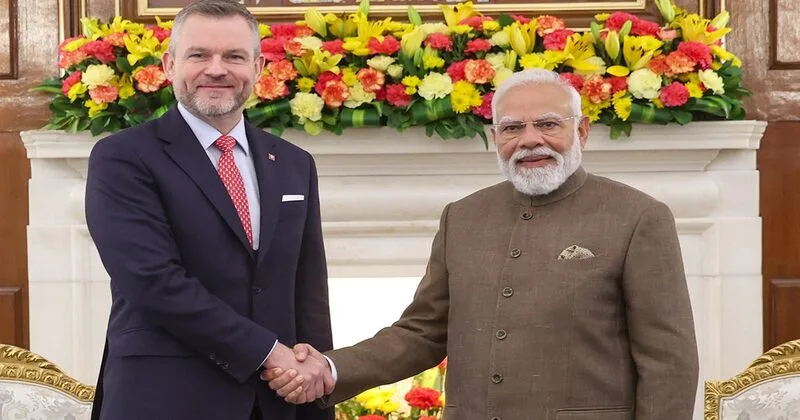
Prime Minister Narendra Modi is visiting the central European country of Slovakia on June 14 and 15. He is the maiden Prime Minister of India to visit Slovakia thus marking a watershed moment in bilateral relations and lending new momentum for one of the critical strategic partnerships of Europe. Being a landlocked country in Central Europe, Slovakia forms an immense footprint in New Delhi’s diplomatic playbook and Europe strategy. Slovakia is a key pillar to realise the defence, trade, business and energy goals of India.
Tracing the roots of India-Slovakia relations
Slovakia emerged as an independent sovereign republic in 1993, after the peaceful dissolution of Czechoslovakia. India and Slovakia had considerable bilateral partnership since then especially in the defence sector. Bratislava is a long-time supplier of defence technologies to India. However, the full potential of the bilateral relations was not completely harnessed. With the latest visit of Prime Minister Narendra Modi to the country, who is a key partner in Europe, India-Slovakia is set to commence a new chapter in strategic partnership with greater momentum.
Defence synergy: Cornerstone of India-Slovakia relations
Defence partnership is one of the most dynamic, critical and historical facets of India-Slovakia relations. Slovakia is a traditional arms, military hardware & defence technology supplier to India. Since 1993, Slovakia has been closely associated with defence public sector units of India. However, with evolving time and growing importance of strategic relations, the defence ties is shifting from mere supplier-consumer formula to a more broad and dynamic phase involving co-production and co-development. This is indeed in alliance with the defence indigenisation and Atmanirbharata vision of India. From a traditional arms supplier to Slovakia is emerging as a partner in manufacturing advanced military technologies.
Not just co-production and development, Slovakia is infact, purchasing arms and defence technologies from India, signifying the credibility of New Delhi as a key defence manufacturer and export hub. “There are a number of projects we are cooperating on jointly and a very interesting element of our cooperation in defence is that even Slovakia buys defence technologies from India”, Slovak Ambassador to India Robert Maxian stated.
Slovakia is also expert in the domain of artillery systems, armoured vehicle technologies, active protection systems and other state-of-the-art military technologies. For example, Slovakia has developed 155-mm self-propelled howitzers. Such capabilities are relevant for India as it modernises the country’s artillery and mechanised forces. New Delhi is also seeking for advanced technologies for future ready combat vehicles (FRCVs), future infantry combat vehicles (FICVs), light tanks, remote-controlled weapon systems and active protection systems.
Infact, during President Droupadi Murmu’s visit to Slovakia in April 2025, MoUs were signed to jointly develop technologies for light tanks, FRCVs and FICVs under the ‘Make in India’ initiative. The MoU also included manufacturing of advanced turret systems, remote-controlled weapon stations (RCWS), active protection systems (APS) and human-machine interface technologies. Slovakia is also renowned across the globe for wheeled artillery systems. Cooperation in this sector can help the artillery modernisation goal of the Indian Army.
Thus, Prime Minister Modi visit adds renewed zeal to India-Slovakia defence synergy for the defence diversification strategy of India and to seek new partners away from the conventional suppliers. Solid military technologies from Slovakia also helps accelerate offensive-defensive capabilities of India and strengthen the national security architecture song with fulfilling Make-in-India vision and transfer of critical technology.
Growing trade and business footprint of India
India-Slovakia trade today stands at 1.6 billion euros which has seen a 100 per cent rise over the span of the past three years. The recently inked India-EU FTA adds further fuel to the India-Slovakia trade credentials. Through India-EU FTA, New Delhi gets increased access to the central European market. Also, high-stake Indian automobile companies including Amara Raja Batteries, Jaguar Land Rover and Tata Auto Components have a significant footprint in Slovakia, signalling growing business ties.
Infact, during the 1990s Matador F307, a sturdy vehicle which was a common sight and comfortable, affordable mode of transportation for the Indian households was made in Slovakia. Thus, India-Slovakia automobile and business ties date back to decades.
Cooperation on civil nuclear energy expected
During the bilateral visit of Prime Minister Narendra Modi to Slovakia cooperation on civil nuclear energy is expected, as Slovakia is an expert in the sector. Interestingly, Slovakia generates 65 per cent of its electricity from nuclear energy signifying rich institutional expertise in the realm. This will indeed aid India in its transition towards clean energy sources. In an interview to a private media platform Ambassador Robert Maxian asserted, “We have vast experience from running nuclear plants, from decommissioning and from issues regarding nuclear waste storage”. He added that during PM Modi visit the existing MoU between India and Slovakia regarding nuclear energy is set to be strengthened.
Strong people-to-people ties
Not just defence, trade and business, but India and Slovakia have deep-rooted people-to-people ties who act as living bridges of bilateral relations and render soft power credentials to India. The Indian workforce is drastically growing in Slovakia with increasing Indian businesses and companies in the country. In fact, Indians have become the second largest foreign workforce in the country next to Ukrainians. “As of now, we are employing 11,000 Indian people in the Slovak industry. We need more than one lakh of the workforce from India”, reiterated Slovakia Ambassador thus signalling the importance of Indian skillpower in the central European country.
In this direction, Slovakian Embassy in India has doubled its consular capacity to swiftly process visa applications. Besides this yoga and other Indian cultural essence enjoys greater acceptance from the Slovakian community who cherish it. Also, during the outbreak of the Russia-Ukraine conflict, Slovakia aided India for the evacuation of Indian citizens from Kiev.
This stable, trusted and diplomatically cherished India-Slovakia partnership is thus set to gain greater impetus during Prime Minister Modi visit, which will further accelerate New Delhi’s footprint in Europe by leveraging greater trade, business and market access. It will consolidate India’s military capabilities in a hitherto fractured geopolitical landscape and volatile security architecture.