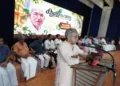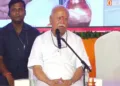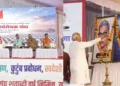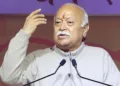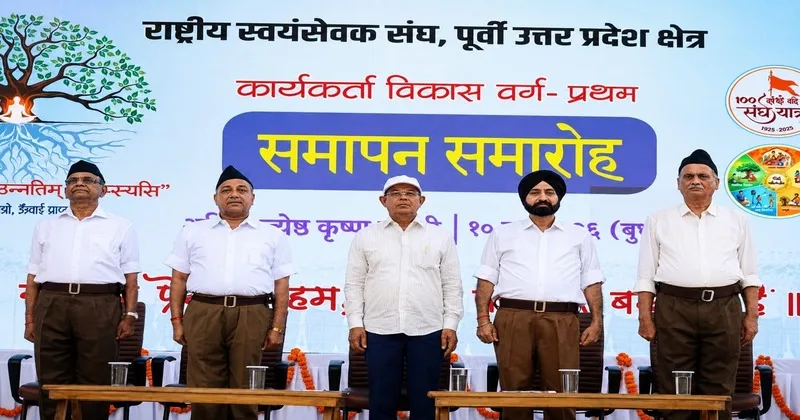
“2026 is an extremely significant year as it marks the 150th birth anniversary of Birsa Munda, who fought the British for Dharma and culture. It is also the 350th year of Guru Tegh Bahadur Ji’s martyrdom, the 150th year of the national song Vande Mataram, and the centenary year of the Rashtriya Swayamsevak Sangh”, said Sah Sarkaryavah Ramdatt Chakradhar while addressing the samapan samaroh Rashtriya Swayamsevak Sangh’s Karyakarta Vikas Varg–Pratham of Purvi Uttar Pradesh Kshetra on June 10.
He recalled that Dr Keshav Baliram Hedgewar decided to establish the RSS in 1925 and that today the organisation has several lakh swayamsevaks. From the first shakha at Mohite Wada, the number of daily shakhas has now crossed 83,000.
He said that every swayamsevak lives for the Sangh. Referring to poet Maithili Sharan Gupt, he noted that India has historically been a leader of the world and has contributed significantly in every sphere of human endeavour. During the early years of the Sangh, Dr Hedgewar’s efforts towards Hindu organisation were ridiculed and considered impractical. When people mockingly questioned who said India was a Hindu Rashtra, Dr Hedgewar firmly replied, “I, Keshav Baliram Hedgewar, say that Bharat is a Hindu Rashtra.”
Dr Hedgewar concluded that society had become self-centred. Through the shakha system, he sought to transform a self-centred Hindu into a society-centred individual. The daily shakha method was designed to cultivate disciplined and character-oriented Hindus. Illustrating the concept of self-realisation, he narrated the story of a lion cub raised among sheep that discovered its true identity only after being shown its reflection by a lion.
After the assassination of Mahatma Gandhi, the RSS was banned. The organisation maintained that if any involvement of the Sangh in the incident could be proven, it should be established. Lakhs of swayamsevaks participated in satyagraha against the ban, which was eventually lifted. Similarly, during the Emergency imposed by Indira Gandhi after her election was declared invalid, the RSS was again banned. Numerous swayamsevaks spent 18 months in prison before the ban was lifted following sustained resistance and public mobilisation.
He stated that nearly 38,000 people are joining the RSS every month through the Join RSS platform.
Describing the RSS as an ideological current, he said the organisation has consistently maintained that this nation belongs to Hindu society. A strong Hindu society strengthens the nation, while a weak Hindu society weakens it. RSS has played a vital role in awakening self-realisation within Hindu society, he said.
He recalled that former Tamil Nadu Chief Minister C.N. Annadurai, despite being a strong critic of the RSS, had stated that China’s attack on the Himalayas was an attack on Tamil Nadu as well. He also pointed out that the mottos of institutions such as the Supreme Court, Election Commission, Postal Department, Doordarshan, Army, Navy, and Air Force are derived from Bharat’s civilisational heritage.
Quoting Dr. A.P.J. Abdul Kalam, he said that only citizens who remove the veil of self-interest and work for the nation can make the country great. He also referred to Rabindranath Tagore’s view that every village should have sensitive and character-oriented leaders. Dr Hedgewar sought to realise this vision by taking shakhas to every village.
He cited Swami Vivekananda’s famous call, “Garv se kaho hum Hindu hai,” adding that one truly deserves to be called a Hindu when the very mention of the word inspires energy and when one feels the pain of every Hindu across the world as one’s own. He expressed concern over organised religious conversions through inducements and said such practices should stop. He called upon all constructive forces in society to work together for national progress.
Speaking about the erosion of family values, he narrated how Sir Ashutosh Mukherjee declined Lord Curzon’s invitation to travel abroad without his mother’s permission. Only after receiving her consent did he undertake the journey. He also referred to Dr Ram Manohar Lohia, who regarded service to his mother as more important than earning a PhD.
He said untouchability weakens and divides society. Bharat’s great sages became revered because of their knowledge and spiritual achievements, not merely because of their birth. Through the practice of Ek Sah-Sampat, the RSS has sought to bring together people of all castes on the basis of shared Hindu identity rather than birth. He noted that Mahatma Gandhi was deeply impressed during his visit to an RSS camp in Wardha, where swayamsevaks from all backgrounds lived together without caste distinctions.
He emphasised that plants sustain human life by providing oxygen and therefore environmental protection is essential. He remarked that even foreign scholars acknowledge that Bharat has much to teach the world regarding environmental stewardship.
He urged society to align its conduct with Bharatiya civilisational values, including the observance of festivals, birthdays, food habits, and personal development. He said all Bharatiyas are fortunate to have been born on this sacred land.
Concluding his address, he called upon the trained swayamsevaks to return to their respective areas and expand Sangh work with renewed enthusiasm and dedication while playing an active role in social life.
Chief guest Padma Shri Ramsaran Verma said that the programme was not merely the conclusion of a training camp but the manifestation of an offering in the grand yajna of nation-building. He urged the trained swayamsevaks to promote unity wherever social divisions exist and expressed confidence that they would fulfil their responsibility towards the nation, Dharma, and culture.
A total of 289 swayamsevaks from the Awadh, Kanpur, Kashi, and Gorakhpur Prants of Purvi Uttar Pradesh Kshetra completed the 20-day varg. The event also reinforced the spirit of Kutumb Prabodhan, one of the five transformational initiatives being undertaken by the RSS. Through interaction, dialogue, and participation among families, the programme strengthened social bonds and mutual understanding.
Among those present on the dais were Sardar Swarn Singh, Awadh Prant Sanghchalak and Sarvadhikari of the Varg, and Mithilesh Narayan, Kshetra Bauddhik Shikshan Pramukh and Varg Karyavah.