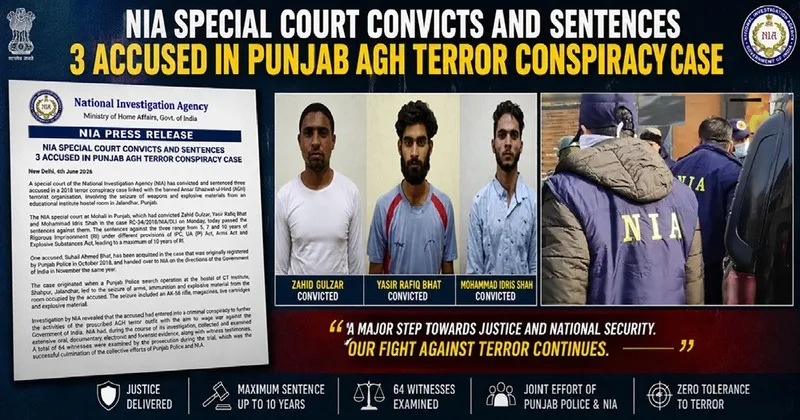
The special court of the National Investigation Agency (NIA) has sentenced three convicts to rigorous imprisonment in the high-profile 2018 terror conspiracy case linked to the banned terrorist organization Ansar Ghazwat-ul-Hind (AGH). The NIA special court in Mohali, Punjab, found Zahid Gulzar, Yasir Rafiq Bhat and Mohammad Idris Shah guilty under various sections and sentenced them to rigorous imprisonment (RI) for terms of five, seven, and ten years, respectively. This court verdict is considered significant, as it pertains to a serious conspiracy hatched against the country’s security.
According to information released by the NIA, the court had previously convicted the three accused on June 1, while the sentences were pronounced on June 4. Another accused in the case, Suhail Ahmed Bhat, was acquitted due to a lack of sufficient evidence.
3 accused have been convicted & sentenced by a NIA special court to 10 years of RI in a 2018 terror conspiracy case linked with the banned AGH terrorist outfit, involving the seizure of weapons & explosive materials from an institute hostel room in Jalandhar, Punjab. pic.twitter.com/xIVkkBXPi9
— NIA India (@NIA_India) June 5, 2026
Cache of Weapons Found in Hostel Room
It is noteworthy that this case came to light in October 2018 when the Punjab Police conducted a search operation at the hostel of CT Institute in Shahpur, Jalandhar. During the search, weapons, ammunition and explosive materials were recovered from a room occupied by the accused. The recovery shocked security agencies, as the presence of such a large quantity of lethal material in an educational institute’s hostel pointed towards the existence of a major terror network.
Investigations by the police and subsequently by the NIA, revealed that an AK-56 rifle, magazines, live cartridges, and explosive materials had been recovered from the room. It became evident during the preliminary investigation itself that the matter went beyond mere possession of weapons; a plot involving organised terrorist activities lay behind it.
Case Transferred from Punjab Police to NIA
Following the incident, the Punjab Police registered a case and initiated an investigation in October 2018. Given the case’s links to national security and a terrorist organization, it was handed over to the National Investigation Agency (NIA) in November 2018, following directives from the Government of India. Subsequently, the NIA conducted a thorough investigation, meticulously examining every aspect of the case.
NIA officials conducted raids across various states, examined digital devices and gathered electronic records linked to suspicious activities. Over several years, the agency continuously collected evidence to build a robust prosecution case for court.
Conspiracy to Promote Ansar Ghazwat-ul-Hind’s Activities
The NIA investigation revealed that the accused were influenced by the ideology and activities of the banned terrorist organization Ansar Ghazwat-ul-Hind and were working to advance the organization’s agenda. The probe also uncovered a criminal conspiracy aimed at waging war against the Government of India and inciting instability within the country.
According to the agency, the accused had prepared to carry out terrorist activities by stockpiling weapons and explosive materials. Evidence regarding their mutual contacts, digital communications and other activities surfaced during the investigation, strengthening the prosecution’s case before the court.
Conviction Based on Extensive Evidence
The NIA conducted a detailed analysis of oral, documentary, electronic, and forensic evidence in this case. The agency also employed technical and scientific investigative methods to gather sufficient evidence against the accused. According to an agency statement, the prosecution recorded the statements of 64 witnesses during the trial.
These witnesses included investigating officers, forensic experts and other key individuals. After examining all the evidence and testimonies, the court convicted all three accused. The NIA stated that this verdict is the result of effective coordination between the Punjab Police and the NIA, as well as a professional investigation. The agency described it as a significant achievement in the fight against terrorism.
Sentencing under various laws
The special court found the accused guilty under various sections of the Indian Penal Code (IPC), the Unlawful Activities (Prevention) Act (UAPA), the Arms Act and the Explosive Substances Act. Considering the gravity of the offenses, the court handed down sentences ranging from five to ten years of rigorous imprisonment.
Legal experts Advocate Ashutosh Kumar Jha and Dhananjay Singh jointly observe, “Convictions under the UAPA and other special laws indicate that the court found the evidence presented by the prosecution to be sufficient and credible. Securing convictions in terror-related cases is often challenging, as technical and forensic evidence plays a crucial role.”
Relief for Suhail Ahmed Bhat
The court acquitted Suhail Ahmed Bhat, who had been named as an accused in the case. Based on the available evidence, the court concluded that the charges against him could not be proven. Under the Indian justice system, an accused is not considered guilty until the charges against them are proven beyond reasonable doubt; it was on this principle that the court granted him relief.
There is a need to raise awareness against terrorism.
In this regard, psychologist Dr. Rajesh Sharma states, “There is a need to raise awareness to protect educational institutions and the youth from radical ideologies. This issue also serves as a reminder that terrorist organizations attempt to influence young people through social media and other channels; it is crucial to remain vigilant against this.”
Elaborating on his point, psychologist Dr. Sharma states, “There is a need to deeply investigate how Muslim youth in India are so easily made targets for recruitment into terrorist activities. If there are shortcomings in their general education, religious instruction in madrasas, or their social environment, identifying and addressing these issues is a critical necessity today, a matter requiring serious attention from both the central and state governments. Otherwise, this cycle will never end.”