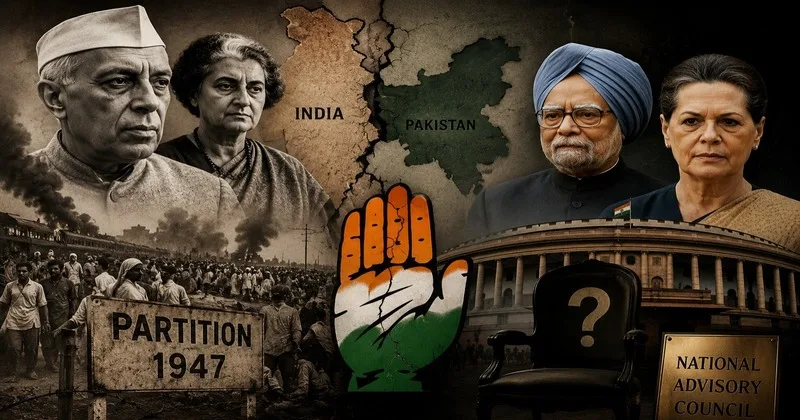
The history of modern India is deeply shaped by the Partition of 1947 and the political developments that followed in the decades of nation-building. Over time, different political interpretations have emerged regarding the role of early Congress leadership and later governments in shaping territorial, constitutional, and governance outcomes.
कांग्रेस का काला अध्याय
78. 2 जून 1939 को ही अंग्रेजों ने भारत विभाजन की नींव कॉंग्रेस के साथ यानि नेहरु जी के साथ मिलकर बनाई थी ।1947 में भारत पाकिस्तान दो देश धर्म के आधार पर बने,पाकिस्तान ने कश्मीर का हिस्सा अपने क़ब्ज़े में ले लिया,लड़ाई आज भी हम लड़ रहे है फिर भी नेहरु जी… pic.twitter.com/ACcrgaC4z9— Dr Nishikant Dubey (@nishikant_dubey) June 2, 2026
Partition and the End of Colonial Rule
The Partition of British India in 1947 was the result of complex negotiations involving the British government, the Indian National Congress, the Muslim League, and other stakeholders. The final boundary, drawn by the Radcliffe Commission, led to the creation of India and Pakistan.
This event triggered one of the largest migrations in human history and widespread communal violence. It also left unresolved territorial disputes, most notably over Jammu and Kashmir, which became a long-standing point of conflict between the two nations.
Over the years, various political narratives have attempted to assign responsibility for the Partition outcomes, but historical scholarship generally views it as a consequence of multiple interacting political and colonial factors rather than the actions of any single leader or party.
Territorial Realities After Independence
After 1947, the territorial map of India was shaped primarily by the Radcliffe Award and subsequent administrative integration of princely states. Regions such as Punjab, Bengal, Assam, and others were divided during Partition based on demographic, administrative, and strategic considerations at the time.
Some political arguments have questioned specific boundary outcomes, including the placement of certain districts and culturally significant regions. However, these decisions were largely part of the broader and immediate Partition settlement rather than later legislative actions in the 1960s.
Political Authority and Governance in 2004
A significant shift in Indian governance occurred in 2004 when the United Progressive Alliance came to power. Manmohan Singh assumed office as Prime Minister, while the Congress party leadership played a major role in coalition coordination.
During this period, the National Advisory Council was created as a consultative platform bringing together experts and civil society representatives to advise on policy formulation. It functioned in an advisory capacity rather than as a constitutional executive authority.
The presence of such a body generated debate in political circles regarding the balance between elected institutions and advisory mechanisms. Supporters viewed it as an innovation in participatory governance, while others questioned its influence on policy direction.
The narrative connecting Partition-era decisions with later governance structures reflects a broader political interpretation of Indian history. It frames early national decisions and later institutional developments as part of a continuous pattern shaping state power, territorial integrity, and governance models.
At the same time, mainstream historical accounts emphasise the complexity of these events, highlighting multiple actors, constrained decision-making environments, and evolving constitutional frameworks.
India’s political history remains deeply contested, particularly regarding Partition and post-independence governance. Different interpretations continue to shape public debate, reflecting the enduring significance of these events in understanding the nation’s past and present.