IIT Guwahati develops advanced anti-counterfeit nanotech system
September 20, 2026
  • Read Ecopy
  • Circulation
  • Advertise
  • Careers
  • About Us
  • Contact Us
Android AppiPhone AppArattai
Organiser
  • ‌
  • Bharat
    • Assam
    • Bihar
    • Chhattisgarh
    • Jharkhand
    • Maharashtra
    • View All States
  • World
    • Asia
    • Europe
    • North America
    • South America
    • Africa
    • Australia
  • Editorial
  • International
  • Opinion
  • RSS @ 100
  • More
    • World Hindu Congress 2026
    • Op Sindoor
    • Analysis
    • Sports
    • Defence
    • Politics
    • Business
    • Economy
    • Culture
    • Special Report
    • Sci & Tech
    • Entertainment
    • G20
    • Azadi Ka Amrit Mahotsav
    • Vocal4Local
    • Web Stories
    • Education
    • Employment
    • Books
    • Interviews
    • Travel
    • Law
    • Health
    • Obituary
  • Subscribe
    • Subscribe Print Edition
    • Subscribe Ecopy
    • Read Ecopy
  • ‌
  • Bharat
    • Assam
    • Bihar
    • Chhattisgarh
    • Jharkhand
    • Maharashtra
    • View All States
  • World
    • Asia
    • Europe
    • North America
    • South America
    • Africa
    • Australia
  • Editorial
  • International
  • Opinion
  • RSS @ 100
  • More
    • World Hindu Congress 2026
    • Op Sindoor
    • Analysis
    • Sports
    • Defence
    • Politics
    • Business
    • Economy
    • Culture
    • Special Report
    • Sci & Tech
    • Entertainment
    • G20
    • Azadi Ka Amrit Mahotsav
    • Vocal4Local
    • Web Stories
    • Education
    • Employment
    • Books
    • Interviews
    • Travel
    • Law
    • Health
    • Obituary
  • Subscribe
    • Subscribe Print Edition
    • Subscribe Ecopy
    • Read Ecopy
Organiser
  • Home
  • Bharat
  • World
  • Operation Sindoor
  • Editorial
  • Analysis
  • Opinion
  • Culture
  • Defence
  • International Edition
  • RSS @ 100
  • Magazine
  • Read Ecopy
Home Bharat

IIT Guwahati develops next-generation security technology to combat fake products and forged documents

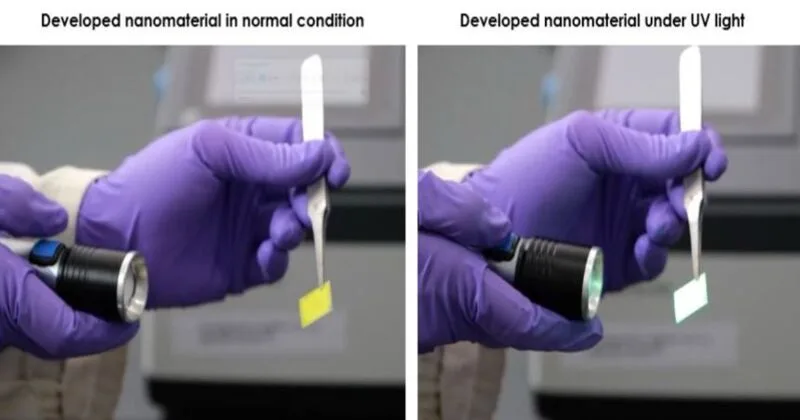
Researchers at IIT Guwahati have developed a next-generation perovskite nanomaterial-based security system that can help detect and prevent fake currency, forged documents, and counterfeit products using advanced light-emitting technology

WEBDESKWEBDESK
May 30, 2026, 07:00 pm IST
inBharat
Follow on Google News
Researchers at IIT Guwahati have developed an advanced perovskite nanomaterial-based system to detect and prevent fake currency

Researchers at IIT Guwahati have developed an advanced perovskite nanomaterial-based system to detect and prevent fake currency

Facebook
Twitter
WhatsAppTelegramEmail

Guwahati: Researchers at the Indian Institute of Technology Guwahati have developed an advanced light-emitting perovskite nanomaterial that could improve protection against fake currency, forged documents, and other counterfeit products. To achieve this, the research team has developed nanocrystals capable of producing light-based security patterns that cannot be replicated using traditional printing and imaging methods.

The findings of this research have been published in the prestigious Advanced Optical Materials journal, in a paper co-authored by Prof. Saikat Bhaumik, Assistant Professor, in collaboration with Prof. P.K. Giri, Professor, and their research scholars Latika Juneja and Garima Choudhary from the Department of Physics at IIT Guwahati.

Counterfeiting has become a global concern, affecting industries ranging from pharmaceuticals and electronics to banking and identity documentation. With the help of modern technologies, offenders have found ways to accurately copy conventional security measures such as barcodes, QR codes, holograms, and watermark labels. These challenges can also have implications for national security, as they can pose risks by enabling financial fraud, illegal activities, and security breaches. This has created increasing demand for smart, difficult-to-reverse-engineer anticounterfeiting systems.

To address this challenge, Prof. Bhaumik and Prof. Giri, along with their research team, have developed light-emitting perovskite nanocrystals, a group of crystalline materials known for their optical and electronic properties. These materials have sizes in the nanometer range (a hundred thousand times shorter than the width of a single human hair), and hold the capability to produce very pure and intense colours with very narrow emission ranges.

This property helps in providing accurate optical signatures and larger colour tunability than traditional fluorescent materials. These properties make it suitable for secure authentication technologies. However, one of the major challenges of these materials is their limitation when exposed to moisture, heat, and environmental conditions, under which they degrade easily.

To solve this problem, the research team developed a double-layer coating around the nanocrystals, making them heat- and chemical-resistant while maintaining their light-emitting properties. Then, with the use of a direct laser writing technique, the team created tiny patterns from these materials. The multi-layer coating enabled the developed nanocrystals to create these patterns without using conventional lithographic masks, which helped in achieving resolutions of 10–40 micrometres, allowing very complex patterns and encoding of information.

Also Read: Infiltrators should return to their countries, those who voluntarily go back will not face any legal action: Amit Shah

Speaking about the developed technology, Prof. Saikat Bhaumik, Lead author of the research, said A unique feature of this perovskite material is that, unlike normal security labels which always show the same mark, it exhibits very narrow emission spectra and the emission intensity changes depending on the environment. For example, an invisible fluorescent pattern can be erased by heating and regenerated by subjecting it to a chemical process. This means that the security label does not simply “glow” under UV light but rather acts in a very specific and predictable manner when subjected to certain treatments.

However, in the case of the developed materials, to produce a fake, a counterfeiter will need to copy the visible pattern along with the way in which the nanocrystals respond to heat and chemicals. This makes the security system much harder to copy using traditional techniques. It also has the potential to embed information into company products and banknotes for secure information storage and retrieval. The researchers have coined this approach as “4D anticounterfeiting”.

It is notable that the laser patterning technique developed by the IIT Guwahati research team can also be utilised in developing cutting-edge micro-LED displays for smartphones, wearables, and Augmented Reality (AR) systems, among others.

On a broader scale, the developed technology can be applied across several sectors where product authentication and security are critical. Ranging from protecting currency notes, passports, identity cards, and legal documents to industries such as luxury goods and consumer products, these advanced security labels can be integrated to verify product authenticity.

Topics: IIT GuwahatiNanotechnologyCounterfeiting TechnologyPerovskite NanomaterialsFake Currency PreventionDocument SecurityResearch Innovation
Share
Tweet
SendShareSend
✮ Subscribe Organiser YouTube Channel. ✮
✮ Join Organiser's WhatsApp channel for Nationalist views beyond the news. ✮
Previous News

Telangana Congress VP Alam Khan named by police in lawyer murder linked to Waqf disputes

Next News

ABVP National Executive Council Meeting: ABVP calls for industry-academia partnership to boost research ecosystem

Related News

Indian scientists have developed RK-251, a “smart” cancer drug designed to target cancer cells while sparing healthy tissue

India’s New Smart Cancer Drug: RK-25 targets tumour cells while leaving healthy cells unharmed

IIT Guwahati researchers have developed ‘E-Eye’, a low-cost portable device that rapidly detects toxic heavy metals and E. coli in water

IIT Guwahati develops ‘E-Eye’ device for rapid detection of cancer-causing heavy metals and toxicants in water

The Rs 200-crore MAHA Water Mission seeks to boost water security and democratise research funding in India

From Rigveda to Research Labs: How ANRF’s Rs 200 crore water mission is securing India’s future

Representative Image

Lighting Up Health Risks: Indigenous nanotech enables fast nicotine detection

RSS Sarkaryavah Dattatreya Hosabale ji at the IIT Guwahati Yuva Sammilan

RSS Centenary ‘Yuva Sammelan’ at IIT Guwahati: Sarkaryavah Hosabale urges youth to work towards nation-building

Representative image

IIT Guwahati & Skyroot Aerospace join forces in space research, additive manufacturing and student training in India

Load More

Latest News

BMS launches National Organisation for Digital Employees (NODE) for IT workforce; aims to strengthen employee welfare

GalaxEye’s US patent for OptoSAR marks a major boost for India’s private space sector, advancing its global Earth-observation ambitions

GalaxEye secures US patent for OptoSAR technology, boosting India’s private space and deep-tech ambitions

The arrested Bangladeshi national

Keralam: Series of Bangladeshi arrests raises questions over alleged support ecosystem of fake IDs, jobs and shelter

The Indian Army has launched AASHVAST to detect hidden software and electronic vulnerabilities in military drones

Indian Army strengthens drone security with AASHVAST lab to detect software vulnerabilities & Chinese components

Nileema Mishra’s grassroots work empowered women and helped transform more than 200 villages across Maharashtra

Nileema Mishra: The woman who transformed more than 200 villages across rural Maharashtra

Shree Stambheshwar Mahadev Mandir in Gujarat

Shiva Mandir that disappears into the sea and returns with the tide: The fascinating story of Stambheshwar Mahadev

Vishwa Hindu Parishad (VHP) spokesperson Surendra Jain (file photo0

VHP condemns Hamid Ansari over remarks citing Nehru on Hindu right-wing communalism

Ganesh murti visarjan incidents raise concerns over radical Islamic intolerance and law and order in Tamil Nadu

ABVP registers 3-0 win in Delhi University Students’ Union elections; wins president, secretary, joint secretary posts

Ganapati murti visarjan procession at T. Narasipura on September 18

Karnataka: Ganapati procession follows approved mosque route in T Narasipura amid allegations of police high-handedness

Load More
  • Privacy
  • Terms
  • Cookie Policy
  • Refund and Cancellation
  • Delivery and Shipping

© Bharat Prakashan (Delhi) Limited.
Tech-enabled by Ananthapuri Technologies

  • Home
  • Search Organiser
  • Bharat
    • Assam
    • Bihar
    • Chhattisgarh
    • Jharkhand
    • Maharashtra
    • View All States
  • World
    • Asia
    • Africa
    • North America
    • South America
    • Europe
    • Australia
  • Editorial
  • Operation Sindoor
  • Opinion
  • Analysis
  • Defence
  • Culture
  • Sports
  • Business
  • RSS @ 100
  • Entertainment
  • More ..
    • Sci & Tech
    • Vocal4Local
    • Special Report
    • Education
    • Employment
    • Books
    • Interviews
    • Travel
    • Health
    • Politics
    • Law
    • Economy
    • Obituary
  • Subscribe Magazine
  • Read Ecopy
  • Advertise
  • Circulation
  • Careers
  • About Us
  • Contact Us
  • Policies & Terms
    • Privacy Policy
    • Cookie Policy
    • Refund and Cancellation
    • Terms of Use

© Bharat Prakashan (Delhi) Limited.
Tech-enabled by Ananthapuri Technologies