Ambitame devitame naditame Saraswati
second Mandala in Rigveda (RV II.41.16)
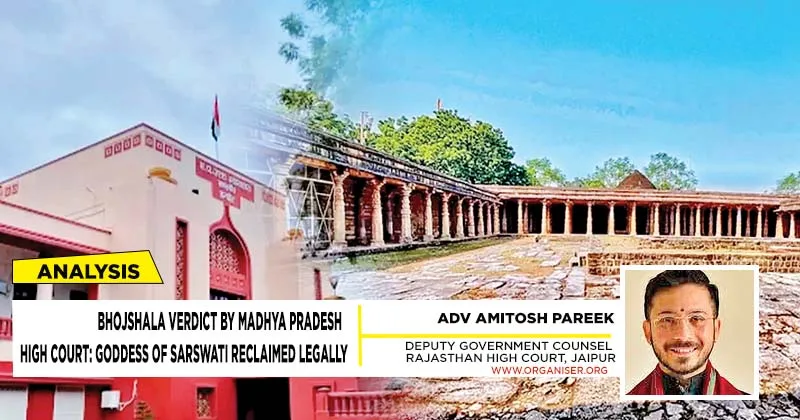
On May, 15, 2026, the Hon’ble Madhya Pradesh High Court pronounced a long awaited verdict subject to the centuries old Bhojshala complex declaring it to be a temple dedicated to Goddess Vagdevi, which was illegally being claimed to be Kamal Maulana Mosque by the Muslim community. While pronouncing the judgement, the hon’ble Court has taken into consideration the prolonged legal, archeological, historical references surrounding and subject to the most contested site in Central Bharat. It is pertinent to mention herein that the since long Hindu organisations, scholars, and petitioners to the concerned case were raising their voices time and again maintaining the sanctity of the religious structure which was once used to be the centre of learning and having temple of Goddess Saraswati duly established during the rule of Parmara king Bhoj.
Glimpse into Legal History
We should look into the legal history of the case and also the issues involved being decided by the Hon’ble Court of Madhya Pradesh.
Hon’ble Court: High Court Madhya Pradesh at Indore.
Case Title: Hindu Front For Justice Through Its President Ms. Ranjana Agnihotri & Ors. Vs. Union of India & Ors.
Case Title: Writ Petition No. 10497 of 2022
Bench: Hon’ble Justice Vijay Kumar Shukla and Justice Alok Awasthi
Date of Judgement: 15.05.2026
Relief Sought Under Art 226 of the constitution of India:
- Only the members of the Hindu community have Fundamental Right under Article 25 of the Constitution of India to perform pooja and rituals of Goddess Vagdevi/ Ma Saraswati within the premises of “Saraswati Sadan” commonly known as Bhojshala. Also members of Muslim community have no right to use any portion of the aforesaid property for any religious purpose.
- Quashing of the order dated 07.04.2003 passed by the Director Archeological Survey of India and also Para 3 to the extent it restricts the right of Hindus to worship within Bhojshala Complex.
- Government of India to undertake every effort to bring back the Pratima of Goddess Saraswati from London Museum in United Kingdom and re-establish the same within the Saraswati Sadan‘/ Bhojshala complex.
Point of Law Raised by Petitioner
- Whether the property once vested in the deity continues to be the deity‘s property?
- Whether any construction raised after demolishing any temple can be termed as mosque?
- Whether a mosque can be constructed on a non-wakf land?
- Whether Wakf should be the owner of the property and he must dedicate the property to the Almighty
- Whether the Bhojshala temple complex was existing since 1034 A.D. and Muslim rulers destroyed/damaged part of the building?
- Whether any right accrues in favour of Muslim community who have raised any construction at the site of Hindu temple after demolishing it?
- Whether the Bhojshala complex has all the trappings of a Hindu temple?
- Whether mutilated idols in a religious building offends the religious sentiments of members of Hindu community?
- Whether every citizen has inherent right to attain spiritual power according to tenets of his religion
- Whether the destruction of religious place is a trauma for the worshippers and continued attack on the spiritual life thereby violating their right to life guaranteed by Article 21 of the Constitution of India
- Whether all laws, practices, customs or trauma created or continued during pre-Independent era affecting the right of the citizens under Article 21, 25 and 29 have to be nullified following the constitutional injunction embodied in Article 13(1) of the Constitution of India?
Legal History of the Case
To reach the present conclusion of the case, we should be aware of the legal history. For the very first time the legal civil suit has been filed by Amiruddin S/o Waziruddin bearing number as 42 of 1962 impleading Union of India, Government of Madhya Pradesh and later Thakur Nihal Chandra, President Hindu Mahasabha Dhar and Boj Smriti Utsav Committee was also being impleaded as Defendants. The relief which has been sought in the civil suit by the plaintiff is to handover the possession of Kamal Maula mosque from defendants and also restraining them from interfering in offering namaz five times in Masjid kamal Maula. Thereafter the suit was renumbered as 40(A) of 1962 and sent to the Court of Additional District Judge, Dhar, whereby it was alleged by the plaintiff that there existed a mosque and the same was a protected monument under 1904 Act. The suit was dismissed in default vide order dated 27.09. 1969 by First Additional District Judge.
Thereafter Vimal Kumar had filed Writ Petition no. 1295 of 1997 challenged the order dated 12.05.1997, 13.06.1997 and 29.7.1997 which restricted the rights of Hindus. It was also prayed that direction be issued restraining respondents from prohibiting the devotees from entering into Bhojshala temple of Goddess Saraswati. Thereafter the Petitioner namely Vimal Kumar filed the application to withdraw the petition, which was duly being accepted vide order dated 29.01.1998 with liberty to approach the competent forum.
Meanwhile, Director General ASI passed an order on dated 07.04.2003 exercising his power under Rule 4 of The Ancient Monument and Archaeological Sites and Remains Rules, 1959 partially notifying order No.F No.11/5/97-MCH dated February 5, 1998 making provisions for the entry into the Bhojshala-Kamal Maula Mosque at Dhar. It is provided that Muslim community shall be allowed access to the premises for Friday Namaz between 1 to 3 pm and Hindus shall be permitted to hold traditional ceremonies on the occasion of Basant Panchami every year and shall be permitted access on every Tuesday from sunrise to sunset and the visitor could take a flower or two and a few granules of rice.
Thereafter Qazi Zakaullah filed another Writ Petition having number as 4216 of 2003 praying for setting aside order dated 07.04.2003 but no member of Hindu Community or any Hindu organisation were impleaded in the Writ Petition. It was dismissed by Learned Single Judge of Hon’ble High Court vide judgement dated 18.09.2003 by observing that the writ petition was not an appropriate forum to examine the facts and proper remedy was before Civil Court. Qazi Zakaullah later filed Letters Patent Appeal having number as 766 of 2003 at Principle seat Jabalpur which was being dismissed on dated 05.09.2005. Thereafter an Special Leave Petitioner was being filed against the order dated 05.06.2005 before the Hon’ble Supreme Court of India and the same was withdrawn with liberty to take steps before the Hon’ble High Court.
It is significant to mention herein that various others Public Interest Litigations have been filed by different petitioners sought similar or same relief as of the Writ petition bearing number as …..Details are being provided below for reference:
Kuldeep Tiwari Vs. Union of India & Ors. (WP No.10484/2022) relief claimed, pleading and material are almost similar to the petition filed by Hindu Front (WP No.10497/2022).
Salek Chand Jain Vs. Union of India & Ors (8986/2022): Petition filed by the Jain community challenging the order dated 07.04.2003 ignoring the Jain community‘s right to perform religious function on the pious occasions of different days of Jain religion.
Antar Singh & Ors. Vs. Union of India & Ors.( 6514/2013): Petition filed on behalf of the residents of Dhar by some of the members belonging to both Communities. It was also challenging the notifications issued by the ASI in regard to notifying disputed areas at Bhojshala cum Kamal Maula mosque. Relief claimed that the National Commission be appointed to frame a legislation to solve the problem of potential clashes at Bhojshala Kamal Maulas Masjid between Hindus and Muslims on Vasant Panchami days falling on Fridays and to completely restrain the entry of both the communities into the said disputed area.
Observations by MP Court
Whether the PIL is maintainable under Article 226 of the Constitution of India:
The Hon’ble Court while considering the petition concerned observed that the relief claimed in the concerned petitions are clearly concerned with the “Right to Worship” and the same has to be tested under Article 25, 26 Constitution of India. The Hon’ble Court stated that the petitions do not relate to the claim of “title of property” but with the fundamental right of worship. Extra ordinary jurisdiction of this Court under Article 226 is wide enough to be invoked where the matter concerns enforcement or protection of fundamental rights guaranteed under the Constitution of India.
Need to Dismiss PIL
Speaking of the res judicata, the respondents argued the petition is barred on the basis of order passed by the Single judge in the case of Qazi Zakaullah and Vimal Kumar on the ground that the said facts cannot be decided in writ jurisdiction but resort to civil remedy. The Hon’ble Court while denying the argument stated that the doctrine of res judicata applies to the same person and in respect of issue which has been raised and substantially decided by the court and therefore the orders passed in the case of Qazi Zakaullah and Vimal Kumar are not judgement in rem. Hon’ble Supreme Court of India on dated 22.1.2026 has ordered that these petitions cannot be dismissed on the ground of principle of res judicata or constructive res judicata.
Applicability of Places of Worship Act, 1991
The Hon’ble Court while addressing the issue raised by the Muslim community that the present petition is being barred by the Places of Worship Act and therefore need to be dismissed. While considering the same the Hon’ble High Court in Para 116 stated that sub section (3) of Section 4 makes it clear that the provision of sub-section (2) of Section 4 shall not apply to any place of worship which is an ancient and historical monument or an archaeological site or remains covered by Ancient Monument and Archaeological Sites and Remains Act, 1958 or any other law for the time being in force. It is subjective to understand that in the present case the issue is not related with the Title of the property but for the claim of Fundamental right of worship.
No mosque can be created on a land, which is not being waqf:
The Hon’ble Court in Para 192 stated that the property in dispute was neither dedicated nor could be dedicated to waqf. No part of Bhojshala was ever under the ownership of any Mahomedan and without creating waqf the maqbara/grave/dargah if constructed, considered to be illegal and encroachment on the property of Hindus. It was also stated that no material suggests that the part of the land is a waqf property. Historical material placed before us could not show that waqf has been created and therefore, there can be no presumption regarding existence of a mosque in the disputed area which is prima facie established to be constructed as Bhojshala and temple of goddess Vagdevi (Saraswati) a place of learning Sanskrit language in 1034 AD.
Existence of Mandir
It was also stated in Para 195 of the judgement subject to the idol of Gautam Buddha, no such idol was recovered by ASI. The Hon’ble Court in Para 208 stated that the Archeological evidence is admissible, relevant and can form a judicial conclusion. It was also stated that the scientific survey conclusively shows the existence of pre-existing temple structure, later conversion/modification. In substance, the ASI report establishes a pre-existing temple structure, whose remains form the base of the present monument. Placing on record the historical literature and thereafter the ASI survey (scientific) the Hindu community was claiming it to be Bhojshala and temple of Goddess Saraswati on which the Hon’ble Court in Para 210 stated that historical record places established that the character of the disputed area was Bhojshala as a Centre of Sanskrit learning associated with Raja Bhoj in substance, the ASI report establishes a pre-existing temple structure, whose remains form the base of the present monument.
Relief Granted
While allowing the Writ Petition in Para 211, the Hon’ble Court granted relief by firmly mentioning that the religious character of disputed area of the Bhojshala Complex and Kamal Maula Mosque is held to be a Bhojshala with a temple of goddess Vagdevi (Saraswati). And quashed the impugned order of ASI dated 7.04.2003 to the extent restricting right of Hindus to worship within the Bhojshala complex, in the property in question at land No.604 (Old No.313) and also permitting the prayer by the Muslim community.