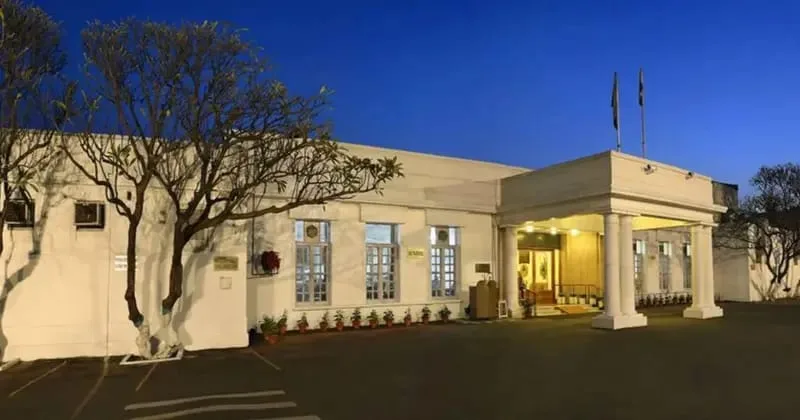
Originally named the Imperial Delhi Gymkhana Club, the institution was founded on 3 July 1913, at the Coronation Grounds in Delhi. Its first president was Spencer Harcourt Butler, the first governor of the United Provinces of Agra and Oudh, a senior British colonial administrator. The name alone tells you everything about its intentions. This was not a sports club. It was a statement of power.
Founded as one of dozens of clubs set up by British colonists across the subcontinent, many of which had explicit “whites-only” policies, the Imperial Delhi Gymkhana was designed as a social fortress for the colonial ruling class. Indians, the overwhelming majority of people in their own land, were largely excluded or admitted only on the most marginal of terms. In its early decades, westernised Indian Civil Service officers, among the few Indians admitted into elite colonial circles, reportedly learned ballroom dancing and British social etiquette at the club as they navigated the codes of imperial society. The club was, in effect, a finishing school in subservience to the Crown.
In 1928, the club was allotted 27.3 acres of land in the new imperial capital of New Delhi on a perpetual lease. That lease, breathtaking in its generosity, has allowed a private members’ club to occupy some of the most valuable real estate in Asia, essentially for free, for nearly a century. The land sits in Lutyens’ Delhi, beside the current residence of the Prime Minister. On a continent where hundreds of millions live in poverty, the sheer audacity of this arrangement deserves far more outrage than it has received.
Independence Changed the Name, Not the Spirit
When India won independence in 1947, the word “Imperial” was quietly dropped from the club’s name. But the soul of the institution remained intact. After independence, the Delhi Gymkhana dropped “imperial” from its name and became the preserve of a new cadre of young Indian army officers and civil servants. For many who’d risen up the ranks of the colonial military and administrative services, joining the club at which they had long been marginalised allowed them to reclaim India’s institutions of power.
What looked like decolonisation was in reality a transfer of gatekeeping. The British sahibs handed the keys to Indian bureaucrats, generals, and industrialists, who in turn reproduced the same hierarchies, the same exclusions, and the same rituals of belonging that had defined the colonial era. For more than a century, the Delhi Gymkhana Club existed as far more than just a sports or social club. Hidden behind manicured lawns and colonial architecture, the club became a symbol of power, privilege, and old-world influence, a place where bureaucrats, generals, diplomats, politicians, and industrialists quietly shaped networks over drinks, bridge games, and tennis matches.
The leather-upholstered sofas, the dress code, the slow ceiling fans, the bridge rooms, the stately bungalows with teakwood interiors and walls hung with large paintings, these were not merely aesthetic choices. They were a deliberate continuity with imperial culture, preserved in aspic while the country outside changed dramatically.
The Architecture of Nepotism
The most damning aspect of the Gymkhana’s modern existence is not its colonial origins but its post-independence behaviour. Rather than evolving into a democratic institution, it doubled down on exclusivity and dynastic privilege.
One of the most striking aspects of the Delhi Gymkhana Club has been its notoriously long membership waiting period, which at one point stretched to nearly 37 years. Thirty-seven years. A child born on the day their parent applied for membership might themselves have children by the time the application was processed. But of course, the children of existing members did not have to wait nearly as long. Various workarounds for the waiting list were created, including one that granted members’ children a so-called “green card” that allowed them to use the club while on the waiting list if they applied for membership at 21.
Critics pointed to nepotism, including easier pathways for children of existing members through these “green card” privileges. The system was designed not to reward merit or public service, but to perpetuate bloodlines of privilege. If your father sat in the leather chair, so could you. If he didn’t, you could wait four decades.
The club’s managing committee, made up of about 16 members elected every year, were in effect the gatekeepers of one of the country’s most coveted institutions. The power this conferred was not trivial. As one former member noted, once elected to the managing committee, you had connections across 15,000 members and could “pick up a telephone and get things done.” The club was not separate from Delhi’s power structures; it was one of the primary mechanisms through which those structures reproduced themselves.
Financial Rot and Institutional Mismanagement
Beyond the philosophical objections lies a more prosaic scandal: the club was, by multiple official accounts, simply being run badly and corruptly.
Following a multiyear government investigation, authorities filed a nearly 5,000-page report in 2020. Another report detailed a litany of alleged wrongdoing and “random, arbitrary policymaking” by successive committees that had cost the club nearly ₹3 billion. The list of alleged abuses ranged widely: overcharging some would-be members while facilitating “potential backdoor entries” for others.
The National Company Law Tribunal found the club was being run in a manner prejudicial to the public interest, noting violations of its memorandum of association and articles of association, as well as financial irregularities and mismanagement. The tribunal also found substance in the government’s allegations that the club was being run on the lines of parivarvaad , nepotism. The NCLT did not mince words: “Privilege and privileged are misconceived notions and they are nothing but a reminiscence of earlier legacy, which is a vanity in a democratic society.”
Allegations of financial irregularities, nepotism, and governance failures led to intervention by government agencies and the NCLAT. In 2021, the tribunal suspended the club’s General Committee and ordered government-appointed administrators to oversee its functioning. The club was described in one proceeding as a “relic of the imperial past.” Environmental violations compounded the picture: in August 2014, it was reported that the club had been using unauthorised bore wells and violating environmental rules. The same year, the government launched a crackdown on the club for its failure to pay luxury tax dues amounting to ₹2.92 crore for the past three years.
A private club that uses public land, violates environmental regulations, dodges taxes, and racks up billions in losses through mismanagement does not deserve protection under heritage sentiment.
27.3 Acres That Belong to Everyone
The most fundamental argument for the Gymkhana’s closure is also the simplest: the land does not belong to the club. It never did. Supporters of the eviction order argue that prime public land should not be used indefinitely for an ultra-exclusive private club. This is not an ideological position; it is a legal and moral one. In a city of over 32 million people, where vast numbers lack adequate public green space, recreational facilities, or affordable housing, the idea that 27.3 acres in the heart of Lutyens’ Delhi should remain cordoned off for fewer than 15,000 elite members is indefensible.
The Gymkhana debate is not really just about a club. It is about how India negotiates its relationship with colonial-era institutions that survived independence and adapted into symbols of postcolonial power. For some, it represents heritage. But heritage is not a moral blank cheque. The question is not whether the Gymkhana has history — it clearly does. The question is whose history it represents, and at whose expense that history is being preserved.
The Nostalgia Trap
The club’s defenders invoke heritage, sporting tradition, and institutional memory. These are not entirely dishonest arguments — the possible closure of the Gymkhana feels emotional to many in Delhi. Hundreds of staff members face unemployment. Decades of social memory are tied to its lawns and corridors.
But nostalgia is a poor basis for policy. The emotional pull of colonial architecture and old-world rituals should not override the democratic imperative that public land serve the public. If the Gymkhana’s tennis courts, swimming pool, and lawns were opened to ordinary citizens — students, athletes, working families — the land would finally begin to justify its public subsidy. As things stand, it does not.
India has spent the decades since independence dismantling, with varying degrees of success, the legal and economic structures of colonial rule. The Delhi Gymkhana Club is one of the last standing monuments to the social structures of that era — the idea that certain people, by virtue of birth, title, or connection, are simply entitled to more: more space, more comfort, more access, more influence.
That idea has no place in a republic. The eviction notice of May 2026 is not the end of Delhi’s history. It may, at last, be the beginning of its democratic future.