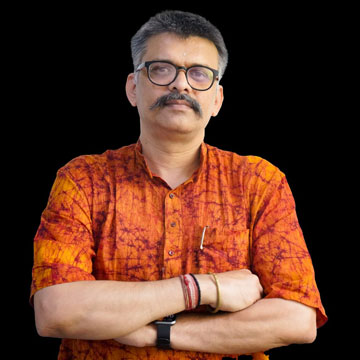

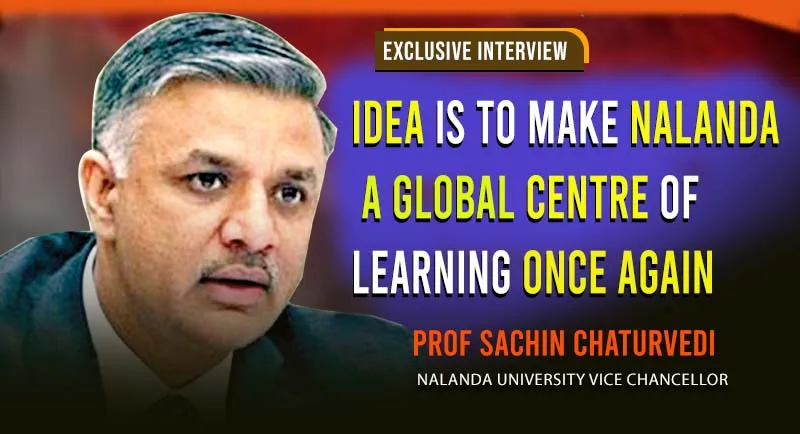
At a time when education across the world is being reshaped by technology, Artificial Intelligence and new global challenges, Bharat is also rediscovering the strength of its own ancient knowledge traditions. In this context, few institutions carry as much historical and intellectual significance as Nalanda University – the ancient seat of learning that once attracted scholars from across the world and is now being reimagined for the 21st century. Organiser Editor Prafulla Ketkar speaks to Nalanda University Vice Chancellor Prof Sachin Chaturvedi, an eminent economist and academician who has played a significant role in India’s engagement with the Global South and international academic cooperation. Excerpts:
On one hand, due to your efforts and the Government’s initiatives, Vesak Day has now been celebrated on the United Nations platform. At the same time, Nalanda University is also witnessing a new kind of global recognition and revival. As India moves forward with the National Education Policy and broader reforms in the education sector, how do you see this transformation — especially in the context of reconnecting with our ancient knowledge traditions while preparing for the future?
I think the National Education Policy (NEP) 2020 has manifested a much larger civilisational shift in the way India sees its past and connects it with its future. The NEP reflects the idea of looking back to build the future. This broader idea of rediscovering our intellectual traditions is now getting reflected in several national initiatives, and Nalanda University’s revival is one of the clearest examples of that effort.
Former President Dr APJ Abdul Kalam had given a clarion call for the revival of Nalanda in 2007 at the East Asia Summit. Parliament passed the Nalanda University Act in 2010, but for several years, things did not move in the desired direction. However, after 2014, and particularly from 2016 onwards, there was a consistent commitment from the Government of India. A long-term vision was created, substantial funding was sanctioned, and the university was put back on track.
“The NEP reflects the idea of looking back to build the future, and Nalanda’s revival is one of the clearest examples of that effort”
The attempt has been to revive not just a historical institution, but the spirit of the world’s first residential university. Today, the idea of decolonisation, backed by NEP 2020, is providing new scope and opportunities. The recent Vesak Day celebrations at the United Nations were also part of this broader effort to reconnect the world with Buddhist philosophy, global peace and the intellectual traditions that emerged from Bharat.
Nalanda is often perceived as a religious institution meant only for Buddhist monks. But historically, it was also a centre for mathematics, astronomy, astrophysics, science and literature. How is modern Nalanda reconnecting with that broader legacy?
When Nalanda was burned down in the 12th century, we lost a massive amount of manuscripts and intellectual heritage. Fortunately, many manuscripts were carried away by scholars to different countries, particularly Tibet and Mongolia, and many of them were translated into Chinese, Mandarin and other scripts. Later, when the Dalai Lama returned to India, some manuscripts also came back.
But the real problem began during the colonial period. The British encouraged a very narrow interpretation of Buddhist studies by focusing only on Pali traditions. They created the impression that Buddhist literature existed only in Pali, whereas the vast Sanskrit tradition connected to Buddhist philosophy was deliberately ignored. This intellectual distortion continued even after Independence.
Buddhist studies became confined largely to Pali teachings associated with Sri Lanka and Myanmar. A false divide was gradually created where Buddhism was projected as something entirely separate from the broader Sanatan civilisational framework. The foundational cultural and philosophical continuity between Buddhist traditions and the larger Indic ethos was weakened.
Today, at Nalanda, we are trying to bring back the Sanskrit foundations of Buddhist philosophy and reconnect Buddhist thought with the larger Indic intellectual tradition from which it emerged. We are also working on a major language project.
Historically, Nalanda functioned through multiple languages, but language was a medium for sharing knowledge. Unfortunately, over time language became politicised and turned into an instrument of identity politics. So today, we are trying to reconnect with that original Nalanda spirit where knowledge moved freely across traditions and languages.
We are also trying to revive the integrated intellectual culture of ancient Nalanda. Figures like Acharya Nagarjuna were not just Buddhist philosophers — they were also scientists and chemists.
Nalanda is also introducing very different kinds of contemporary courses. We hear about initiatives like the Chanakya School of Capacity Building, new programmes in data sciences and interdisciplinary studies. So how are you bridging the ancient and the modern?
We are trying to revive Nalanda in its complete spirit. Historically, there were five foundational disciplines that every student at Nalanda had to study in some form: philosophy, logic, mathematics, astronomy and social connect.
We are now introducing a foundational programme called the “Nalanda Spirit” course. This will not only be compulsory for Nalanda students but will also be made available online for anyone interested.
Academically, we have significantly diversified. Buddhist Studies already existed, but we launched Hindu Studies last year. This year, we are introducing courses on Jain philosophy, and next year we plan to introduce Sikh philosophy as well. Guru Nanak had spent time in the Nalanda region, and we believe these philosophical traditions should be studied together within a larger Indic framework.
One important initiative we are working on is inspired by Indian civilisational models of governance and administration. We are studying ancient Indian thinkers and governance traditions and trying to integrate those insights into modern capacity-building frameworks. In collaboration with institutions, international agencies and policy bodies, we are trying to contribute to a new discourse on governance rooted in Indian experiences and knowledge systems.
So Nalanda today is trying to revive an ancient civilisational spirit while simultaneously engaging with the most contemporary global challenges — from sustainability and governance to Artificial Intelligence and technological transformation.
Nalanda is also expanding its international collaborations. What kind of global engagement is taking place?
Nalanda is rapidly expanding its international academic partnerships. During Prime Minister Narendra Modi’s visit to the Netherlands, Nalanda was included among the institutions involved in bilateral agreements. We signed a partnership with Groningen University for research on green hydrogen energy.
We have also signed agreements with universities in Japan, Indonesia and the United States. During my recent visit to the Vesak celebrations in New York, I travelled to Boston and signed additional academic collaborations with several institutions. The idea is to make Nalanda once again a global centre of learning where international students and scholars come to India in pursuit of knowledge.