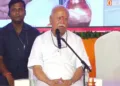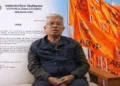
Bhubaneswar: Rashtriya Swayamsevak Sangh’s Purva Kshetra Kshetriya Karyavah Durga Prasad Sahu said that the core objective of the RSS is to unite Hindu society, remove the sense of inferiority prevailing within it, and build a supremely glorious Bharat through character-building and social awakening. He stated that the organization has been continuously working toward this goal for the last hundred years.
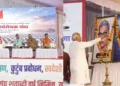
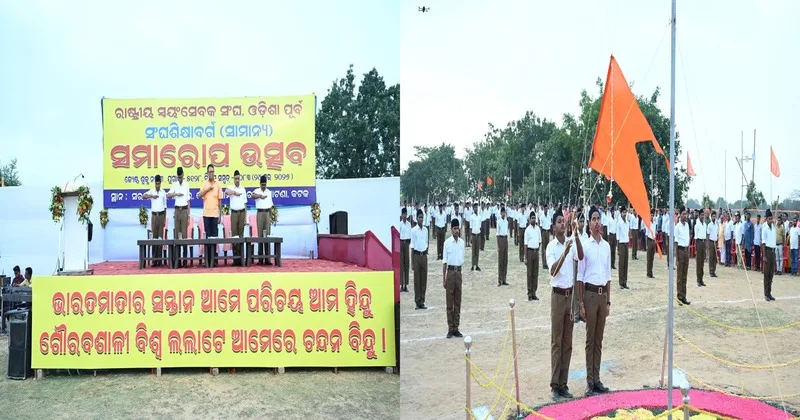
Addressing the concluding ceremony of the Odisha (Purv) Prant Sangh Shiksha Varg (Samanya), held at Saraswati Shishu Vidya Mandir in Keshav Dham, Gatirout Patna, Cuttack, Sahu called for large-scale social transformation through the concept of “Panch Parivartan” (Five Transformations).
He said the time has come for the “virtuous and responsible section” of society to stand with the RSS and actively support swayamsevaks in social transformation initiatives. He also urged RSS swayamsevak to work in villages and local communities to strengthen national consciousness, social harmony, and cultural awakening.
RSS is a continuous mission of Hindu national awakening
Durga Prasad Sahu emphasized that the RSS is not merely an organization but a continuous mission dedicated to the life-purpose and awakening of the Hindu nation.
He explained that Hindutva is not simply a mode of worship, but a comprehensive way of life rooted in humanity, values, duty-consciousness, and universal welfare. According to him, the RSS functions on the principle of “nation-building through individual character-building,” asserting that only nation-oriented individuals can create a strong and prosperous country.
He further stated that Bharat’s soul lies in spirituality and that Bharat’s resurgence is essential for global welfare. Every individual, he said, must participate in this larger civilizational awakening.
Commemorating 150 years of “Vande Mataram” and the idea of Bharat Mata
Sahu noted the 150th anniversary of “Vande Mataram” and underscored the literary and philosophical significance of Bankim Chandra Chattopadhyay’s novel Anandamath.
He described a symbolic episode from the novel where Brahmachari Bhavananda introduces Mahendra to three forms of Bharat Mata (Mother India ). The first represents Bharat’s glorious past, the second reflects the condition of colonized and subjugated Bharat, and the third presents the vision of a future Bharat Mata. In this depiction, Bharat Mata is shown with ten arms raised, her glory celebrated in all ten directions.
At this point, Mahendra asks Bhavananda when this third form of Bharat Mata, whose glory is celebrated in all directions, will be visible to them. In response, Bhavananda states that this vision will be realized only when all the children of Bharat begin to address and revere her as “Mother.” Only then will they be able to witness this divine form.
According to Sahu, this vision remains relevant today and continues to inspire nationalist thought and social organization.
Dr. Hedgewar’s vision and the founding philosophy of RSS
Referring to RSS founder Keshav Baliram Hedgewar, Sahu said Dr. Hedgewar had deeply reflected during his student years on whether merely driving the British out of Bharat would automatically restore Bharat’s greatness.
He said Hedgewar concluded that colonial rule alone was not responsible for Bharat’s decline. Rather, weaknesses that had developed within Putra rupi Hindu society—such as the loss of historical consciousness, selfishness, indiscipline, lack of unity and social fragmentation—were equally responsible.
According to Sahu, RSS was founded with the objective of removing these weaknesses and reorganizing Hindu society so that Bharat could once again emerge as a powerful and glorious nation.
RSS introduced new organizational paradigms
Sahu stated that from its inception, the RSS introduced new social and organizational paradigms. He noted that while most organizations focus initially on posts, structures, and financial systems, RSS prioritized character-building and nation-building above all else.
He said RSS daily shakhas instill discipline, patriotism, and character formation while nurturing a “nation first” outlook among participants. Referring to the Bharatiya Mazdoor Sangh, he said earlier Left-oriented trade unions often raised slogans centered solely around demands and confrontation like.. In contrast, Bharatiya Mazdoor Sangh introduced a different approach with the slogan: “We will work in national interest and receive fair wages for our work.”
He described this as a “paradigm shift” in labor philosophy that balanced workers’ rights with national responsibility.
RSS swayamsevaks are the first to reach disaster zones
Highlighting the service activities of RSS swayamsevaks , Sahu said that whenever any disaster strikes the country, RSS swayamsevaks are often among the first to reach affected areas and participate in relief work.
He added that beyond emergency response, RSS swayamsevaks are engaged in thousands of daily service initiatives across the country. According to him, more than 150,000 service projects are currently being run nationwide under RSS-inspired initiatives in areas such as education, healthcare, rural development and social welfare.
Hindu philosophy and the idea of universal harmony
Sahu elaborated on the philosophical foundation of Hindu thought, saying that according to Hindu philosophy there is no distinction between the byashti (individual), samashti(society), shrishti(creation) and the parameshti (divine).
He said the same consciousness exists in all beings and that this spiritual understanding is the reason why Bharatiya civilization reveres nature as sacred. Rivers such as the Ganga and even plants like Tulsi are accorded the status of “mother” in Bharatiya culture. He asserted that such a worldview promotes equality and harmony rather than division.
However, he acknowledged that despite the greatness of this philosophy, social distortions such as untouchability and caste discrimination entered society over time. He stressed the need to eradicate these social evils.
Sahu also warned against attempts to divide society on the basis of language, caste or region, saying that true Hindutva lies in uniting society beyond such divisions.
“Panch Parivartan” as the basis of social transformation
Durga Prasad Sahu described “Panch Parivartan” as the foundation for comprehensive social transformation. According to him, the five broad themes include Paryavaran Surakshya (environmental protection), Samajik Samarasata (social harmony) , Swa Bodh, Nagarik Kartavya (civic responsibility) and Kutumb Prabodhan (family awakening).
He said environmental degradation has become one of the greatest global challenges due to uncontrolled exploitation of nature. Therefore, environmental protection has been given major importance under Panch Parivartan.
Reducing the use of plastic, conserving water, preventing deforestation and promoting plantation drives are, according to him, forms of “practical Hindutva”. On Samajik Samarasata, Sahu said efforts must be made to remove caste discrimination and untouchability while fostering equality and mutual affection in society.
He emphasized that every individual should be treated with dignity and respect irrespective of social background.
Emphasis on Swa Bodh
Sahu said that for Bharat to become a truly prosperous and self-confident nation, Bharatiyas must develop awareness of their “Swabhav” and “Swatva” — a sense of selfhood rooted in Bharatiya civilization.
He urged people to abandon the colonial mindset and take pride in Bharat’s culture, traditions, and indigenous systems. He encouraged the use of native languages, traditional attire, and indigenous products in everyday life and called upon people to inspire others to do the same.
Civic responsibility and nation-building
He identified nagarik kartavya ( civic responsibility) as another important aspect of Panch Parivartan.According to Sahu, responsible citizenship includes respecting the Constitution, following traffic rules, participating in voting, and protecting public property.
He said efforts should be made at every level to cultivate such civic consciousness among citizens.
Family as the foundation of Bharatiya society
Sahu said the family is the fundamental unit of Bharatiya society and the first institution where values and culture are imparted. He expressed concern that family systems are facing increasing challenges in modern times. Therefore, “Kutumb Prabodhan” (family awakening) has been included as a key component of Panch Parivartan.
He stressed the importance of strengthening the joint family tradition and imparting patriotism, ethics, and moral values to children. He urged all trainees and members of society present at the event to adopt the principles of Panch Parivartan in their personal lives and spread awareness about them in society.
Sahu concluded by reiterating that Bharat’s soul lies in spirituality and that Bharat’s resurgence is essential for the welfare of the world. He called upon citizens to participate actively in this larger mission of national and civilizational awakening.
Chief guest praises the activities of RSS
The chief guest at the event, former Deputy Director of the Odisha Directorate of Secondary Education, Dr. Mihir Das, praised the role of RSS in shaping disciplined and responsible citizens over the past century. He said the organization instills patriotism and dedication toward the nation among swayamsevaks . This, he noted, is why RSS swayamsevaks are often visible first during times of crisis and public emergencies.
308 participants from 19 districts attended the training camp
It is noteworthy that RSS organizes annual training camps during summer vacations to improve the quality, efficiency, and organizational capacity of its workers. This year’s Odisha (Purv) Prant Sangh Shiksha Varg (Samanya) began on May 9, 2026, and concluded on the evening of May 24.
A total of 308 shikshyarthis from 183 locations across 19 districts of Odisha Purva Prant participated in the camp. The participants included 208 students, 15 teachers and lecturers, and 70 doctors, engineers, and professionals from various fields.Additionally, 29 shikshyak and 58 prabandhaks were involved in organizing and managing the camp.All participants bore their own expenses, including uniforms, food charges, travel expenses, and other costs.
Rigorous daily training schedule
The camp followed a strict daily schedule beginning at 4AM with wake-up activities and concluding at 10 p.m. with ceremonial closure rituals.Physical training included danda, danda-yuddha, niyuddha jashthi, yoga and drills focused on coordination and discipline.
In addition to physical activities, intellectual sessions and group discussions were conducted to develop ideological clarity and provide training related to service, outreach and communication activities.
Senior functionaries guided the camp
Several senior RSS functionaries and trainers guided the camp at different stages. These included Akhil Bharatiya Sadbhavana Pramukh Dr. Gopal Prasad Mahapatra, Sah Kshetra Pracharak Jagadish Prasad Khadanga, Prant Karyavah Dr. Anil Kumar Mishra, Sah Prant Karyavah Ravi Narayan Panda, Sudarshan Das, Prant Pracharak Bipin Prasad Nanda, Sarvadhikari Bishwambhar Pani, Karyavah Sharat Chandra Sen, camp guardian Asit Kumar Sahu, chief instructor Rajesh Jena and intellectual head Satya Ranjan Mahakud. Their guidance and participation, organizers said, played an important role in the smooth and successful completion of the training camp.