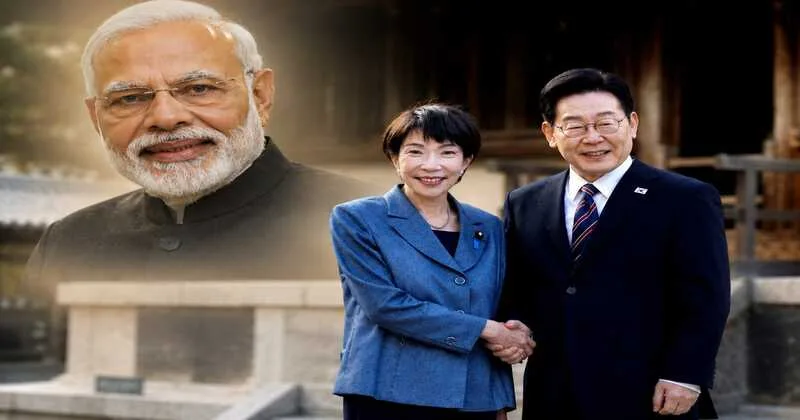
It is heartening to note that Japanese diplomacy toward South Korea is increasingly being focused on striking a strategic convergence with it. Tokyo has prioritised bolstering its intelligence sharing, supply chain resilience, and regional stability with Seoul. The other day, Japanese Prime Minister Sanae Takaichi met South Korean President Lee Jae Myung for a summit at Andong, the latter’s hometown. Earlier, in January this year, the two leaders met at Nara, Premier Takachi’s hometown. It is believed that the two leaders reviewed the documents hereat to enhance their energy security and supply chains. They signed an agreement to establish a mutual swap arrangement for crude oil, petroleum products, and liquefied natural gas. The two nations will now provide gasoline, diesel and other refined petroleum products to each other, cooperate in procuring crude oil and refrain from unnecessary export controls in case of any threat to their imports from the Middle East.
It is immensely clear from the Andong agreement that the two East Asian nations are fully aware that they are heavily export-driven and almost entirely dependent on imported energy. They must stand together to defend their supply chains and energy markets and neutralize the threats North Korea, China and Russia pose to them. They are aware that together they can neutralize better any ill-effects of the growing possibilities of the United States and China, the two strongest states in the contemporary world, coming together .
Pertinently, the Taiwan issue seems to have offered Tokyo a “strong strategic incentive” to pursue closer engagement with Seoul. History bears out Japan has been committed to the defence of Taiwan. As late as in November last year, Japanese Prime Minister Takaichi even declared that her country might become militarily involved in a potential Taiwan Strait conflict. But Tokyo cannot be sure how Washington would behave in case of any threat to Taiwan from China. Recently, United States President Donald J Trump declined to offer an unambiguous commitment to defend Taiwan.
One is sure Premier Takaichi would stay her new course in diplomacy towards South Korea. Hopefully, she is well aware she must keep South Korea in loop so that Japan can focus on modernising the country’s military attaining its long Indo-Pacific Vision and creating an appropriate security architecture for this .
One would, however, suggest Premier Takaichi to do whatever she can to resolve Japan’s historical friction with South Korea . Relations between the two nations have long been strained on account of their historical disputes. South Korea has raised demands, from time to time , for Japanese reparations over the issue of wartime Korean forced labour and comfort women. Seoul has also raised the issue of Japan’s sovereignty claim over the territory currently under the South Korean control.
One thinks that in resolving Japan’s historical frictions with South Korea, Premier Takaichi could learn from former German Chancellor Konrad Adenauer’s famous “Strategy of Humility” towards the Jews in the post- Nazi landscape and reach out to the Koreans.
In this noble enterprise, Premier Takaichi could turn also to Indian Prime Minister Narendra Modi. One thinks he is well placed to help herein. India has had warm relations with both Japan and South Korea . Prime Minister Modi has been close to both Premier Takaichi and South Korean President Lee Jae-myung . If approached, New Delhi may use its existing mechanisms with Tokyo and Seoul and help Premier Takaichi in the proposed mission .