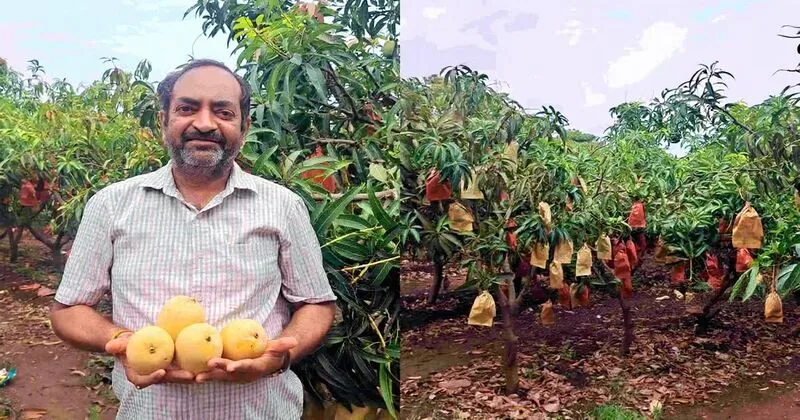
Belagavi: While most doctors spend their lives between hospitals and patients, an Ayurveda specialist from Karnataka has created a unique success story by combining medicine with modern agriculture. Dr Sameer Nayik from Belagavi has successfully adopted the Israel model of high-density mango farming and is now earning lakhs of rupees through premium Kesar mango cultivation.
Dr Sameer Nayik, an Ayurveda doctor with postgraduate and PhD qualifications in Kayachikitsa, has been practising medicine for the last 28 years. Hailing from a farming family in Sadalaga of Chikkodi taluk, he always had a strong interest in agriculture and wanted to experiment with modern farming techniques.
Instead of following conventional mango cultivation methods, Dr Nayik closely studied Israel’s advanced agricultural practices, particularly the high-density plantation model that enables farmers to achieve maximum yield from limited land. Inspired by the success of Israeli farmers, he decided to implement the same system in Karnataka.
In 2019, he purchased around five-and-a-half acres of land at Nandihalli village in Belagavi district. Out of this, four acres were developed into a high-density Kesar mango orchard. He planted nearly 2,800 saplings sourced from the horticulture centre near Hidkal Dam.
Unlike traditional mango farming, where only 35 to 40 trees are planted per acre, Dr Nayik adopted the Israeli spacing model and planted around 700 saplings per acre. The saplings were planted with a distance of seven feet between plants and 12 feet between rows.
The Israel model proved highly successful. In conventional farming, mango trees usually begin commercial fruiting after eight to ten years. However, with the high-density Israeli method, the plants started yielding fruit within just three years. The orchard has now completed seven years and entered its fourth productive harvest season.
This year, Dr. Nayik expects a yield of nearly 30 tonnes of Kesar mangoes. Harvesting has already begun, and the fruits are being packed and sold under his own brand name, “Vaishali Farm Kesar Mango,” named after his mother.
The mangoes are sold in specially packed boxes priced between Rs 350 and Rs 700, depending on quality and quantity. The fruits have gained popularity among customers because of their natural ripening process, sweetness, and quality.
Dr. Nayik said the orchard follows nearly 95 per cent organic farming practices. The farm maintains seven cows, and the manure generated from them is converted into organic fertiliser. Agricultural waste is also recycled and used in the orchard. Only minimal chemical inputs are used. According to him, maintaining soil health is one of the biggest reasons behind the healthy growth of the trees and the excellent quality of the fruit.
Another unique feature of the farm is the use of fruit bagging technology, a method widely followed in Israel and advanced horticulture countries. Once the mango reaches around 90 grams in weight, each fruit is covered using eco-friendly protective bags.
These bags protect the fruit from heat, insects, birds, rain, fungal infections, and direct sunlight. The process also improves the colour, texture, and taste of the mangoes while reducing pesticide use. Dr. Nayik said he never harvests raw fruits before they naturally mature on the tree. He criticised the widespread practice of chemically ripening immature mangoes in the market.
“As a doctor, I meet many patients who complain of health issues after consuming artificially ripened fruits. Our objective is not just to grow attractive fruits but to provide healthy and naturally ripened mangoes,” he said. The farm is fully equipped with drip irrigation facilities, a farm pond, borewell system, and solar-powered motor pumps. Solar energy is used to generate the electricity required for irrigation, reducing operational costs and making the farm environmentally sustainable.
Apart from mangoes, Dr. Nayik also grows guava and jackfruit. He expects a revenue of nearly Rs 30 lakh this season, while the total cultivation expenditure stands at around Rs 8 lakh. The success of the orchard has attracted farmers, students, and agriculture enthusiasts from different districts who regularly visit the farm to study the Israeli model cultivation techniques.
Officials from the Horticulture Department have praised the initiative and stated that Dr. Nayik’s orchard is an example of how farmers can achieve better profits through modern technology, branding, and scientific farming practices.
For Dr. Sameer Nayik, farming is not merely a business venture but a passion. “Agriculture gives me peace, happiness, and satisfaction. Farmers can earn much more if they think differently and adopt modern technology,” he says.