
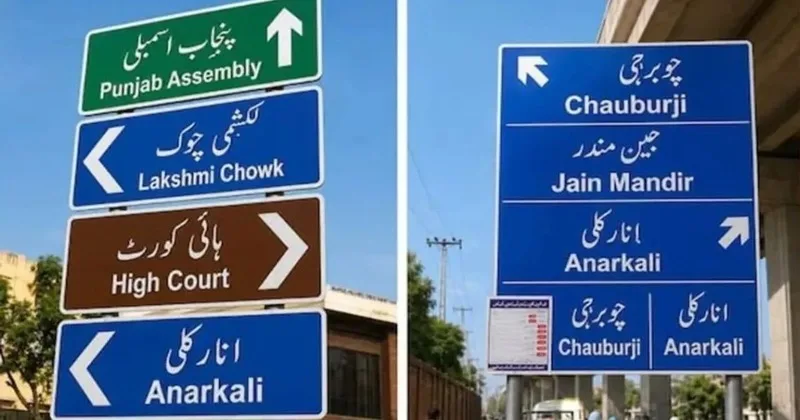
A recent news report has surely surprised everyone, saying that Pakistan has restored the pre-Partition names of Lahore streets. Islampura is once again Krishan Nagar. Babri Masjid Chowk has been reverted to Jain Mandir Chowk. Sunnat Nagar is now Sant Nagar. Mustafaabad has become Dharampura. So, the question arises: has Pakistan really changed? The truth is that Pakistan and minorities cannot co-exist. A country which came into existence in the name of religion can never ever tolerate the existence of another faith. We all know that Pakistan has been committing genocide against Hindus, Christian and other minorities. In Pakistan, Hindus are persecuted, and Dalit Hindu women are forcibly converted and raped. Also, Christians are burnt alive in the name of blasphemy.
According to a UN analysis, about 75 per cent of women and girls subjected to forced conversion through marriage in Pakistan are Hindu. The data does not lie. When Pakistan was created in 1947, Hindus constituted about 15 per cent of the population of West Pakistan, who are now limited to 1.6 per cent. According to the data, the Hindu population in Karachi has gone from nearly 50 per cent to just 1.12 per cent in 82 years. The same has happened across the region in Pakistan with the minority population.
Therefore, Pakistan cannot fool the world. Since when did Pakistan suddenly become a lover of minorities? It is difficult for anyone to even imagine that. As long as Pakistan exists in its present form, “Pakistan” and “minority inclusiveness” cannot coexist.
You may remember that before the Pahalgam incident last year in April, Pakistan army chief Asim Munir, while addressing Pakistan Military Academy (PMA) parade in Khyber-Pakhtunkhwa province, said, “The two-nation theory was based on the fundamental belief that Muslims and Hindus are two separate nations, not one. Muslims are distinct from Hindus in all aspects of life – religion, customs, traditions, thinking and aspirations. Our forefathers made immense sacrifices for the creation of Pakistan. We know how to defend it”. The point is that this decision is merely Pakistan’s political posturing.
Though, here it is important to mention that all the establishment in Pakistan have taught their children history in such a distorted manner that even rational-minded Pakistani youth have started questioning what their real history actually is. Pakistani youth who try to take an interest in their history. They find themselves lost in the world. One question always arises in their mind. Are they truly an Islamic nation? Because their ancestors themselves were not originally Muslim. Even the political and military establishment, whoever comes to power, tries to give a different ancestry during their tenure. Imran Khan claims Turkish ancestry, while at other times, other leaders speak of Arab or Saudi ancestry. These are all done to claim Pakistan’s history.
The Dawn, which is a Pakistani newspaper, in its article titled, “What is the most blatant lie taught through Pakistani Textbooks?” published on August 15, 2014, writes, “The most blatant lie in textbook accounts of Pakistan’s history is by virtue of omission, which is in effect the denial of our multicultural, multi-ethnic and multi-religious past. It is a common complaint that Pakistan’s history is taught as if it began with the conquest of Sindh by the Umayyad army, led by the young General Muhammad bin Qasim in 711 AD.
Most textbooks in Sindh at least mention Mohenjo-Daro and the Indus Valley civilisation, but they do not discuss them meaningfully, nor do they address their extent and culture. Important periods and events during subsequent centuries are also skimmed over, like the Aryan civilisation, which introduced its powerful social system and epic poetry (the Mahabharata, in which Sindh and Khyber Pakhtunkhwa play important roles), the Brahmin religion, a thousand years of Buddhism with its universities and the Gandharan civilisation, which was spread throughout present-day Pakistan.”
The fact is that the Islamisation of Pakistan started under General Muhammad Zia-ul-Haq, who instituted a program of Islamisation of the country. He designed a policy in 1979. According to that policy, the highest priority was given to revising the curriculum to reorganise the entire content around Islamic thought.
Having said this, the idea of Pakistan and its Hindu past, whose evidence can be clearly found across the region, cannot coexist together. On one hand, Pakistan is trying to mislead the world by restoring the pre-Partition Hindu names of its streets; on the other hand, it has been glorifying invaders like Muhammad ibn Qasim, Mahmud Ghaznavi, Muhammad Ghori, Babur, Abdali, Aurangzeb and Tipu, who are known for their brutality against Hindus. Also, now that religious bigot General Asim Munir is at the helm in Pakistan, who is controlling the country while appointing puppet Prime Minister Shehbaz Sharif, it would be utterly foolish to assume any change in Pakistani’s psyche towards religious minority in the country.