
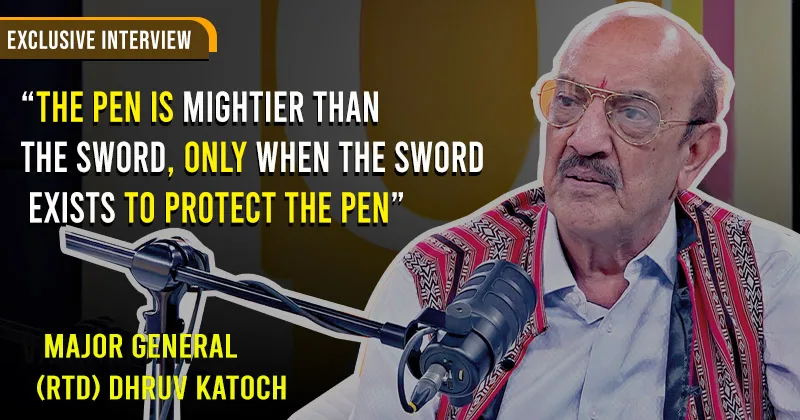
One year after Operation Sindoor reshaped India’s counter-terror doctrine, Organiser Weekly Editor Prafulla Ketkar spoke to Major General (Rtd) Dhruv Katoch about his new book ‘Operation Sindoor: 88 Hours That Redefined Deterrence’, co-authored with Lieutenant General Raj Shukla. In this detailed conversation, General Katoch discussed how India’s military strategy evolved from “strategic restraint” to “compellence,” the role of political leadership, the transformation of warfare through precision technology, Pakistan’s structural instability, defence indigenisation, and why the “mind” has now become the primary battlefield of modern war. Excerpts:
n One year after Operation Sindoor, how do you see it redefining India’s deterrence doctrine?
I think this has been one of the most significant military operations carried out by India after Independence. We have fought many wars, 1947-48, 1965, 1971, and Kargil, but this operation was fundamentally different because warfare itself has changed. Technology has changed. Precision targeting has changed the very character of conflict.
India, over the last decade, has made enormous progress in ISR capabilities, surveillance systems, information technology and kinetic capabilities. But military capability alone means very little unless it is matched with political will. Unless the leadership is prepared to use that capability decisively, you do not achieve strategic effect.
We first saw this convergence in 2016 after the Uri attack. India carried out multiple surgical strikes across the Line of Control. People say India crossed the border earlier, too, and yes, small tactical actions had happened before. But those were limited and localised. In 2016, India struck across multiple points over a 100-kilometre stretch and then publicly announced it to the world through the DGMO. That was a strategic shift.
Then came Balakot in 2019 after the Pulwama attack. India used air power deep inside Pakistan for the first time since 1971. That too had a major impact.
But after the Pahalgam massacre, everybody knew there would be action. Personally, I consider Pahalgam one of the most despicable terror attacks India has ever faced because people were segregated based on religion and shot dead in front of their families. No civilised nation can accept that. So when Operation Sindoor happened, there were several important differences. For the first time, all three services were planned together in complete synchronisation. There was total civil-military fusion. Political leadership gave full operational freedom.
Your book begins with the history of Jammu & Kashmir and Pakistan. Why was that important?
Without understanding the historical roots, you cannot understand the present conflict.
Pakistan’s identity itself was built as the “other” of India. If India stood for something, Pakistan stood for the opposite. One of Pakistan’s former leaders openly admitted this contradiction when he said that if they wanted friendship with India, why did they separate? There is an ideological conflict built into Pakistan’s existence. Radicalisation in Kashmir did not happen overnight. It began slowly in the 1960s, intensified after the 1970s and eventually culminated in the genocide of Kashmiri Hindus. Political leadership in Kashmir knew what was happening but chose silence. Now, after the abrogation of Article 370, structural transformation has become possible. If 370 had remained, none of the present changes could have happened. The process started in August 2019 and has progressed steadily since then.
I believe that within the next few years, Kashmiri society itself will transform to a point where Pakistan will find it increasingly difficult to sustain terrorism through local support networks. Infiltration attempts may continue, but societal acceptance of terrorism is declining.
How exactly did Operation Sindoor establish deterrence against Pakistan?
The most important thing is that India controlled the escalation ladder throughout the conflict. Initially, India intended to stop after delivering the message. But Pakistan escalated further. So India did accordingly. This continued until May 10, when India launched devastating precision strikes that rendered 11 Pakistani airfields non-operational. The most important among them were Nur Khan and Sargodha. Near Sargodha lies the Kirana Hills region, which is strategically extremely sensitive. One precision strike fundamentally changed the situation. Suddenly, the Americans panicked. What is interesting is that just hours earlier, the US Vice President JD Vance had publicly stated that this was India and Pakistan’s issue, and America would stay out. But after that strike, Washington intervened because Pakistan had effectively lost control over its airspace. Pakistan approached the Americans. America contacted India. India made it very clear that this was a bilateral issue and that if Pakistan wanted peace, it should directly ask for it. That is when Pakistan’s DGMO called India. This is why I say, India controlled escalation throughout the conflict. We escalated when required and stopped when required. That itself is deterrence.
One of the most discussed aspects of Operation Sindoor was the integrated functioning of the Armed Forces. How significant was the CDS structure?
Extremely significant. The Army, Navy and Air Force planned together in complete synchronisation because the CDS structure existed. Even the Navy, though it did not fire weapons, played a crucial role. The carrier battle group was fully deployed and prepared for immediate action. The next step is integrated theatre commands. Once that happens, synergy between services will improve even further – logistics, procurement, planning and execution. Wars today are no longer fought by armies alone. Wars are fought by nations. Which means the civil bureaucracy, strategic communication systems, economy and technology ecosystems all become part of warfare.
How much did Operation Sindoor showcase India’s indigenous capabilities?
India’s defence ecosystem has changed dramatically after 2014. For decades, India imported almost 70 per cent of its defence requirements. That dependency is now steadily reducing.
Defence corridors in Tamil Nadu and Uttar Pradesh, reforms in ordnance factories, private sector participation and export-oriented production have all changed the landscape. Look at BrahMos. Very few countries can strike targets hundreds of kilometres away with an error margin of barely one metre. When India struck Bahawalpur, the central dome of the target structure was destroyed while surrounding sections remained intact. That is precision warfare.Drone technologies, ISR systems, loitering munitions, communication networks, satellite systems – India is rapidly progressing in all these areas. But much more private sector participation is still needed. The public sector should focus on high-end technologies like AI, quantum systems and advanced propulsion, while routine systems can increasingly shift to private manufacturing. The progress India has made in the last ten years, in my view, is greater than what was achieved in the previous sixty years.
Do you think the terror groups themselves understood the message after Bahawalpur and Muridke?
Absolutely. Earlier, these terror headquarters believed they were safe because they operated within civilian localities. But India demonstrated extraordinary precision targeting capability. The message now is very simple: India can hit terrorists anywhere inside Pakistan. They may sleep at night, but they will never know whether a missile will arrive before morning. That psychological fear did not exist earlier. It exists now, and I think it is important that it exists.
Pakistan still managed to project victory domestically through its information system. How do you assess the information warfare dimension?
Pakistan’s ISPR controls the entire narrative ecosystem. The Army controls the Government, media and information structure. India, being a democracy, faces different challenges. I have argued for years that India needs something like a National Information Adviser functioning alongside the National Security Adviser so that there is strategic coherence in communication. We also face a domestic political challenge where even military operations become politically contested internally.
But one important change has happened. India now openly declares its actions. Surgical strikes were declared publicly. Balakot was declared publicly. Operation Sindoor was declared publicly. That itself is a strategic communication shift. Another major doctrinal change is the suspension of the Indus Waters Treaty. Prime Minister Modi made it clear: blood and water cannot flow together. Similarly, India’s declaratory intent has changed. Earlier, India targeted terror camps. Now India has openly declared that it will also target the sponsors of terrorism. That means the Pakistani military establishment itself can become a target. This marks the transition from “strategic restraint” to “compellence.”
Pakistan repeatedly invokes nuclear threats. How should India view this?
Pakistan uses nuclear rhetoric because it assumes India will get scared. India should respond calmly and firmly. India follows a No First Use doctrine. But if nuclear weapons are used against India, our response will not be proportional; it will be total. That message has already been conveyed. Pakistan understands this very well. They are rational actors despite their rhetoric. The era of nuclear blackmail against India is over.
What message would you give to ordinary Indians one year after Operation Sindoor?
Today, wars are not fought only on battlefields. The battlefield is now the mind. Cyber systems are battlefields. Financial systems are battlefields. Communication networks, railways, airlines – everything becomes part of modern warfare. That means the whole nation fights, not just the military.
Political differences are natural in a democracy. But national security must remain above political divisions. Remember one thing: “The pen is mightier than the sword, only when the sword exists to protect the pen.” History has repeatedly taught India that lesson. If the sword disappears, invaders return. That is why, a strong economy and a strong military must always go together.