
The recent spike in petrol and diesel prices amid the escalating West Asia crisis has once again triggered a predictable political chorus from the Congress party. As tensions in the Gulf intensify and the blockade of the Strait of Hormuz threatens nearly a quarter of the world’s seaborne oil trade, the Congress has chosen to weaponise public frustration over fuel prices rather than confront the uncomfortable truths of its own economic legacy.
After the Modi government approved a Rs3 per litre increase in petrol and diesel prices, Congress leader Rahul Gandhi accused the government of making ordinary citizens pay for its “mistakes.” Congress President Mallikarjun Kharge described the situation as a “Modi-govt-made crisis” born of incompetence and lack of vision. Other Congress leaders quickly followed suit, alleging that the government deliberately postponed the fuel hike until the assembly elections concluded.
Such rhetoric may serve immediate political interests, but it ignores a far more inconvenient reality: the Congress party itself created one of the biggest hidden fiscal liabilities in India’s economic history through the infamous oil bond regime of the United Progressive Alliance era.
The current fuel price pressures are not occurring in isolation. Brent crude prices have surged beyond 100 dollars per barrel due to geopolitical instability in West Asia. Shipping insurance premiums have soared, freight costs have climbed sharply, and uncertainty over energy supply routes has rattled global markets. Every major oil-importing nation is facing the same challenge. India, which imports more than 85 per cent of its crude oil requirement, cannot magically insulate itself from these global disruptions.
Yet instead of acknowledging the international context, Congress has reverted to selective memory and populist accusations.
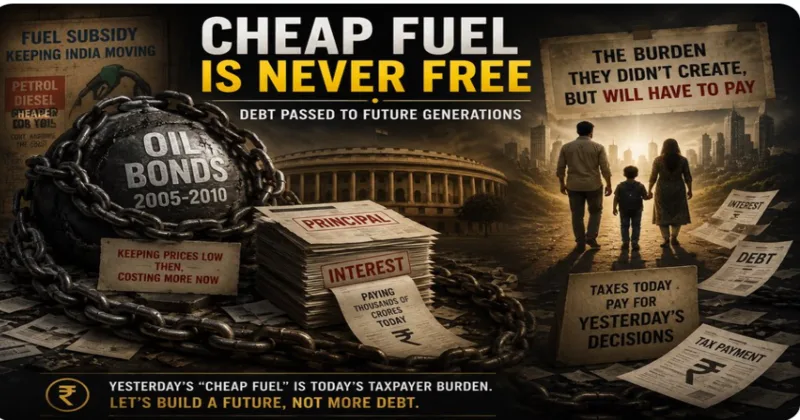
What the party conveniently omits is that when it faced a similar global oil shock during the UPA years, it resorted to a dangerous exercise in fiscal camouflage through oil bonds. Between 2005 and 2010, the UPA government issued oil bonds worth approximately Rs1.48 lakh crore to public sector oil marketing companies. These bonds were presented as a mechanism to cushion consumers from rising fuel prices. In reality, they were a sophisticated accounting trick designed to hide subsidies and suppress the fiscal deficit on paper.
Rather than directly paying subsidies from the Union Budget, the government handed over long-term sovereign securities to oil companies that were selling fuel below market cost. The bonds carried maturities of 15 to 20 years and interest rates ranging from 7 to 8.4 per cent. This allowed the UPA government to temporarily avoid showing the true subsidy burden in official fiscal deficit calculations under the Fiscal Responsibility and Budget Management framework.
The result was a textbook case of deferred liability.
The subsidy bill disappeared from the books temporarily, but the burden did not vanish. It was merely transferred to future governments and future taxpayers. Interest payments alone eventually ballooned to nearly Rs1.71 lakh crore. By the time the principal and accumulated interest were fully accounted for, the total obligation crossed Rs3.20 lakh crore.
This was not economic prudence. It was fiscal procrastination masquerading as welfare.
Worse, the oil bond strategy failed even in its stated objective of protecting consumers from rising fuel prices. During the UPA decade, petrol and diesel prices still rose dramatically. Petrol prices in Delhi increased from roughly Rs34 per litre in 2004 to more than Rs72 per litre by 2014, a rise exceeding 118 per cent. Diesel prices climbed from around Rs22 per litre to nearly Rs55 per litre during the same period.
There were multiple steep hikes during those years, including the infamous Rs8 per litre petrol hike in 2012. Global crude prices undoubtedly played a role, but the central point remains unchanged: despite massive hidden subsidies financed through oil bonds, consumers still paid sharply higher prices at fuel stations.
The economy, meanwhile, absorbed a double blow.
First, the government burdened future budgets with massive repayment obligations. Second, the oil marketing companies were saddled with illiquid government paper instead of actual cash compensation, weakening their balance sheets and constraining investment in refining, infrastructure, and energy expansion.
The long-term economic cost of such policies was enormous.
Every year, thousands of crores had to be allocated merely to service interest payments on these bonds. Money that could have funded highways, hospitals, schools, irrigation projects, or defence modernisation instead went toward paying interest on politically convenient borrowing undertaken years earlier.
This is the historical context that Congress deliberately avoids discussing today.
The bulk of the oil bond repayments matured after 2014, meaning the National Democratic Alliance government inherited the real burden. While the UPA issued bonds worth Rs1.48 lakh crore, it repaid only a fraction of the principal before leaving office. The overwhelming majority of the repayment responsibility fell upon the Modi government between 2014 and 2026.
The numbers are staggering.
Of the total oil bonds issued, bonds amounting to nearly Rs1.34 lakh crore matured during the NDA period. Alongside this, more than Rs1 lakh crore in interest payments had to be serviced. By March this year, the Modi government completed repayment of the final instalments, closing an obligation that ultimately cost the exchequer around Rs3.20 lakh crore.
This repayment did not happen through fresh accounting gimmicks or off-budget manipulation. It required disciplined budgeting, prudent fiscal management, and the political willingness to prioritise long-term economic stability over short-term populism.
The irony therefore is impossible to miss.
The same government now facing criticism over a Rs3 fuel price increase quietly spent years paying the deferred fuel subsidy bill created by Congress governments. The Congress party consumed the political benefits of subsidised fuel while leaving the financial consequences for its successors.
Today’s global energy crisis only reinforces why the Modi government’s approach is economically sound.
Unlike the UPA era, the present government has largely avoided blanket fuel subsidies and maintained market-linked pricing for petrol and diesel. Petrol pricing was deregulated in 2014 and diesel followed in 2016. This system ensures that domestic fuel prices reflect international crude realities rather than being artificially suppressed through hidden borrowing.
Critics argue that market-linked pricing exposes citizens to painful price increases. That criticism is understandable. Rising fuel prices undeniably hurt middle-class families, transport operators, farmers, and small businesses. Inflationary pressures ripple across the economy through higher logistics and production costs.
However, the alternative is not painless relief. The alternative is hidden debt.
Blanket subsidies financed through borrowing distort energy consumption, reward inefficiency, weaken public finances, and disproportionately benefit wealthier fuel consumers who consume more petrol and diesel. The UPA experience demonstrated that such policies ultimately fail to shield consumers while creating enormous long-term fiscal liabilities.
In contrast, targeted welfare mechanisms such as direct benefit transfers and LPG support for vulnerable households are far more sustainable than universal fuel subsidies.
The Congress party’s current criticism therefore reflects a deeper political problem: selective amnesia. It wants the public to remember today’s fuel hike but forget yesterday’s deferred liabilities. It wants voters to focus on immediate discomfort while ignoring the hidden debt that accumulated under its own rule.
Had a similar geopolitical crisis unfolded under a Congress government today, there is little doubt that it would once again resort to off-budget financing, disguised subsidies, and deferred liabilities to manufacture temporary political comfort.
The Modi government has consciously chosen a more difficult path accepting short-term political criticism in order to preserve long-term fiscal credibility.
That distinction matters enormously for India’s economic future.
In an era of volatile global energy markets, geopolitical instability, and uncertain supply chains, fiscal discipline is not merely an accounting principle. It is a strategic necessity. Nations burdened by uncontrolled subsidies and hidden liabilities become vulnerable to inflation, debt crises, and currency instability.
India cannot afford that vulnerability.
The current fuel price increase may be unpopular, but unpopular decisions are not automatically wrong decisions. Sometimes economic realism demands confronting immediate pain rather than postponing it through borrowed money and political deception.
The Congress party may continue attacking the government for rising fuel prices. But the historical record remains clear.
The UPA deferred the bill.
The Modi government paid it.
And India must not repeat the same mistakes again.