
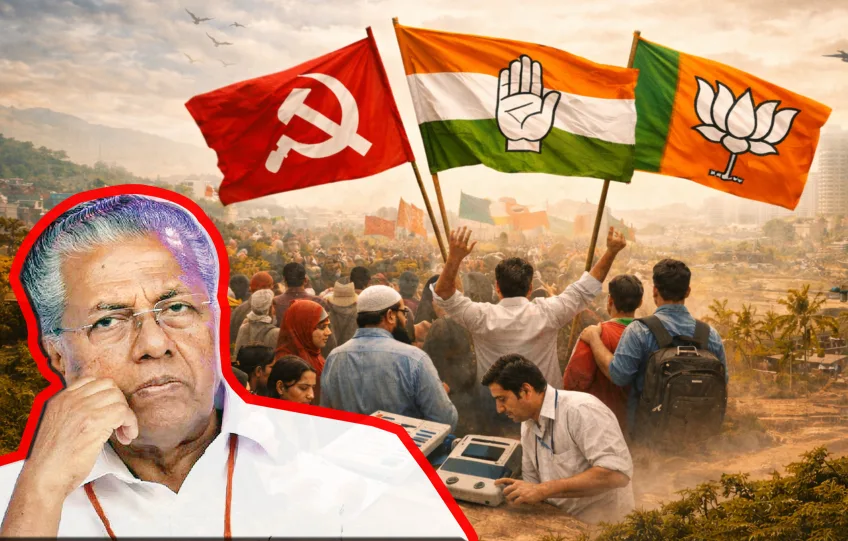
The results that came in on May 4, 2026, were nothing short of tectonic in Keralam, as the UDF stormed to power with 102 seats — its highest mandate since 1977. The LDF, which had defied Keralam’s alternating-government tradition by winning consecutively in 2016 and 2021, crashed to just 35 seats. Pinarayi Vijayan, who resigned on the day after the results without even travelling to Thiruvananthapuram — submitting his resignation through a special envoy to the Raj Bhavan from his Kannur residence — looked like a man who already knew this reckoning was coming.
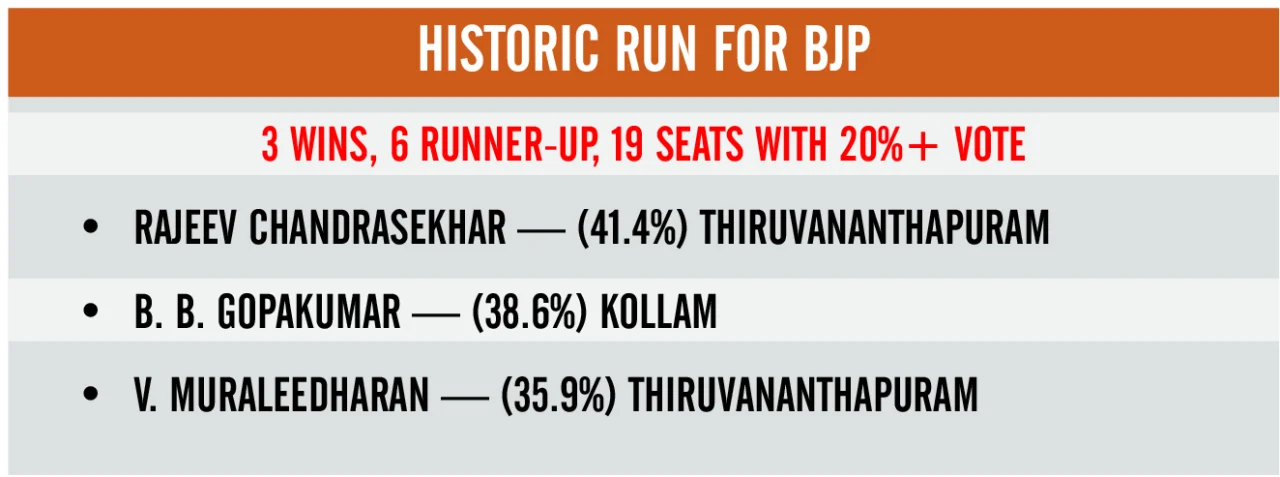
For the BJP, the result is historically significant. The party won three seats — Nemom and Kazhakoottam in Thiruvananthapuram district where the party has swept the Corporation in 2025, and Chathannoor in Kollam district— ending its complete shutout from the Keralam Assembly since 2021. In 2016 former Railway Minister O.Rajagopal has won from the Nemom, which was lost to LDF in 2021. BJP was able to reclaim the Nemom constituency with additional seats.
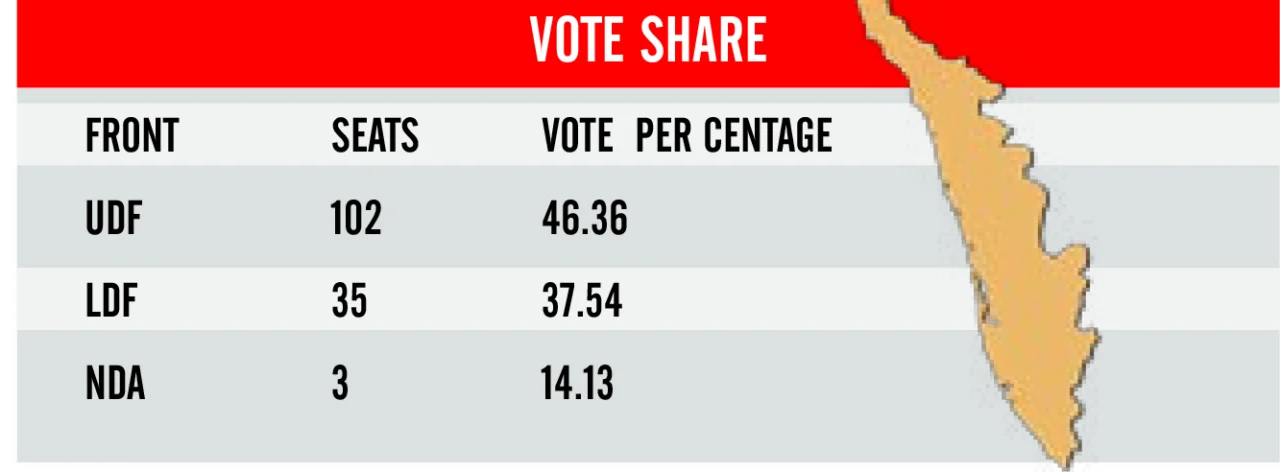
More importantly, the BJP now counts 29 constituencies where it crossed the 20 per cent vote share mark. Its overall vote share nudged up from 11.30 per cent and 23,54,468 votes in 2021. It went to 11.42 per cent in 2026 with 24,66,178 votes. The national trajectory is clear: from 5.02 per cent in 2001 to 10.53 per cent in 2016 to 11.42 per cent in 2026. That is two decades of consistent, patient, ideological groundwork now bearing fruit for the party.
But here is the number that should make every thinking Indian stop: For the first time in 50 years, there is not a single Communist-ruled state government in India. Keralam was the last domino. Bengal fell. Tripura fell. Now Keralam has fallen. The land that gave the world its first democratically elected Communist government in 1957 under E.M.S. Namboodiripad has now democratically voted that experiment to its probable end.
BJP’s Three Wins
Those who treated BJP’s Keralam ambitions as a joke for decades — will say that three seats out of 140 is a modest return. They are missing the architecture of what was built.
Nemom, Chathannoor and Kazhakoottam
Those who mocked the BJP’s Keralam ambitions are missing the larger political shift behind its three-seat victory. Rajeev Chandrasekhar’s win in Nemom with 41.44 per cent votes signalled the party’s long-term commitment to Keralam politics. In Kazhakoottam, V. Muraleedharan defeated former Devaswom Minister Kadakampally Surendran by just 428 votes, reflecting growing anger over issues like Sabarimala and the gold theft controversy.
In Chathannoor, B.B. Gopakumar’s victory capped years of steady BJP growth. The NDA’s vote share rose sharply from 30.6 per cent in 2021 to 38.6 per cent. Beyond these wins, the BJP finished second in six constituencies, building momentum for future expansion in Keralam.
This verdict is not just a change of government. It is an electoral funeral for an ideology that never reconciled itself with the aspirations of a modern, Hindu-rooted India.
The Collapse of Red Citadel
Of all the stories from this election, Kannur’s is the most symbolically devastating for the CPI(M). This was the district where Pinarayi Vijayan built his political career — his personal fiefdom, his power base, his identity. In Dharmadam, his own constituency, he trailed multiple times during 6 rounds of counting, a man who had won by over 50,000 votes in 2021 now clinging to victory by fewer than 20,000. The margin collapse alone tells you everything about how far the Communist centralised idol has fallen.
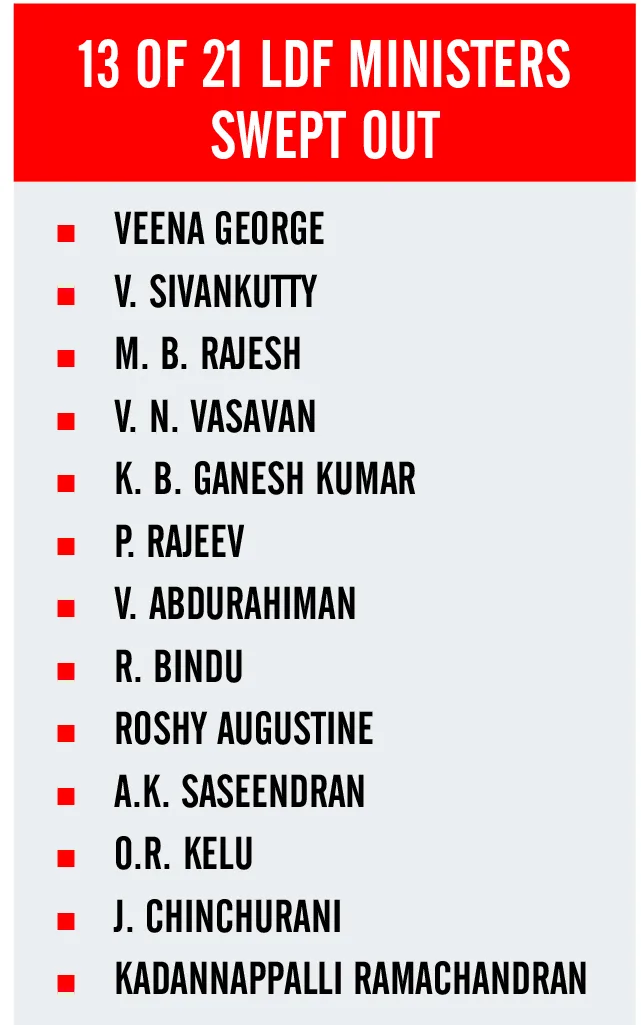
The 2026 Keralam Assembly election results have exposed a profound ideological rot within the CPI(M), where the foundational identity of a “workers’ party” was shattered by pervasive nepotism and the perceived emergence of a new “communist royalty.”
The decision to field State Secretary M.V. Govindan’s wife P.K. Shyamala in Taliparambu became a lightning rod for public anger, symbolising a shift from the erasure of privilege to the institutionalisation of family connections.
This internal decay was further highlighted by the expulsion of workers who blew the whistle on the diversion of “martyr’s funds” and the rebellion of veterans like G. Sudhakaran, who exposed the leadership’s hypocrisy regarding age limits.
In Taliparamba and Payyannur — constituencies where party loyalists used to boast that the CPI(M) was woven into the very fabric of the earth — rebel candidates who had openly questioned corruption and family nepotism won decisively. These were not outsiders. They were men who had given decades to the party, who knew its internal functioning intimately, and who finally chose conscience over compliance. When the ‘masses and the general public’ rally behind rebels in Kannur, you know the rot has gone all the way to the root.
The rebels were former loyalists —V. Kunhikrishnan and T.K. Govindan — who had been systematically sidelined by Pinarayi’s centralised inner circle.
Privately, even committed cadres now describe the party as a soulless “corporate entity” rather than a mass movement. The 2021 aura of invincibility has been replaced by a grim reality: the party has lost its ideological moorings, and the voters—once its greatest strength—have finally demanded a reckoning. A decade of Pinarayi Vijayan’s rule had left a residue of exhaustion — even among people who had voted Left twice in a row.
The CPI(M) leadership’s response to dissent within Kannur was not dialogue — it was intimidation. Vehicles were threatened with burning. Crops were threatened with destruction. A wall painted for a rebel candidate’s campaign was demolished. This is the ‘democratic centralism’ of the CPI(M) laid bare: iron discipline enforced through fear, dressed up as ideological unity. Keralam’s voters saw through it.
Party cadres speaking privately admitted what the leadership would never say publicly: the CPI(M) had ‘degenerated into a structure resembling a corporate entity rather than a mass political movement,’ having ‘lost its ideological soul.’
Sabarimala: Left Alienated Hindus
No honest account of the CPI(M)’s 2026 collapse can ignore Sabarimala. When the Pinarayi government chose to implement the Supreme Court’s women entry order with what felt like relish — sending police to escort non-devotees and activists up the hill, deploying force against those who had come to protect a centuries-old tradition — it created a wound in the Hindu psyche of Keralam that has never fully healed.
Former Devaswom ministers Kadakampally Surendran and V.N. Vasavan were photographed at major temples in postures that devotees found deeply disrespectful — standing with folded hands in ways that allegedly obscured the deity. It became viral symbols of a government that treated Hindu sentiment as an inconvenience to be managed rather than a living tradition to be respected.
The Guruvayur temple controversies compounded the perception. CPI(M) developed a remarkable ability to antagonise the Hindu majority while simultaneously being seen as soft on or deferential to minority religious institutions. This double standard — which BJP leaders including Rajeev Chandrasekhar hammered relentlessly during the campaign — resonated in rural and semi-urban constituencies with significant Hindu populations.
The result was a consolidation of Hindu votes — not just to the BJP, but also to the UDF in many constituencies — that fundamentally altered the electoral arithmetic. The CPI(M)’s assumption that it could indefinitely leverage minority votes while taking Hindu voters for granted proved to be its electoral death warrant.
In Thiruvananthapuram, visible demoralisation among CPI(M) ground workers happened. In Kannur — from Payyannur to Dharmadam — the rebel sentiment was palpable.
End of Communism in India?
The historical markers are unambiguous. West Bengal, where the Left ruled for 34 uninterrupted years — the longest democratically elected Communist rule in world history — fell in 2011. Tripura fell in 2018. Keralam, the last domino, fell in 2026. India today has, for the first time since 1977, no state governed by a Communist party. Keralam was the last place on earth outside Cuba, China, Vietnam and North Korea where a Communist party had genuine governing legitimacy. That governing legitimacy has now been revoked by the people. This is a civilisational moment. The ideology that was imported wholesale from European Marxist frameworks, that was built on the denial of India’s Hindu cultural roots, that aligned itself repeatedly with forces hostile to the national interest, that suppressed internal dissent through cadre intimidation, and that confused ‘secular’ governance with the active marginalisation of Hindu sentiment has been handed its verdict by the very people it claimed to represent.
CPI(M) developed a remarkable ability to antagonise the Hindu majority while simultaneously being
seen as soft on or deferential to minority religious institutions
The CPI(M) was founded in 1964. It formed the world’s first democratically elected Communist government in Keralam in 1957 (through its predecessor CPI). In 2026, with no Communist party in power anywhere in democratic India, the experiment has reached its democratic conclusion.
Road Ahead for BJP
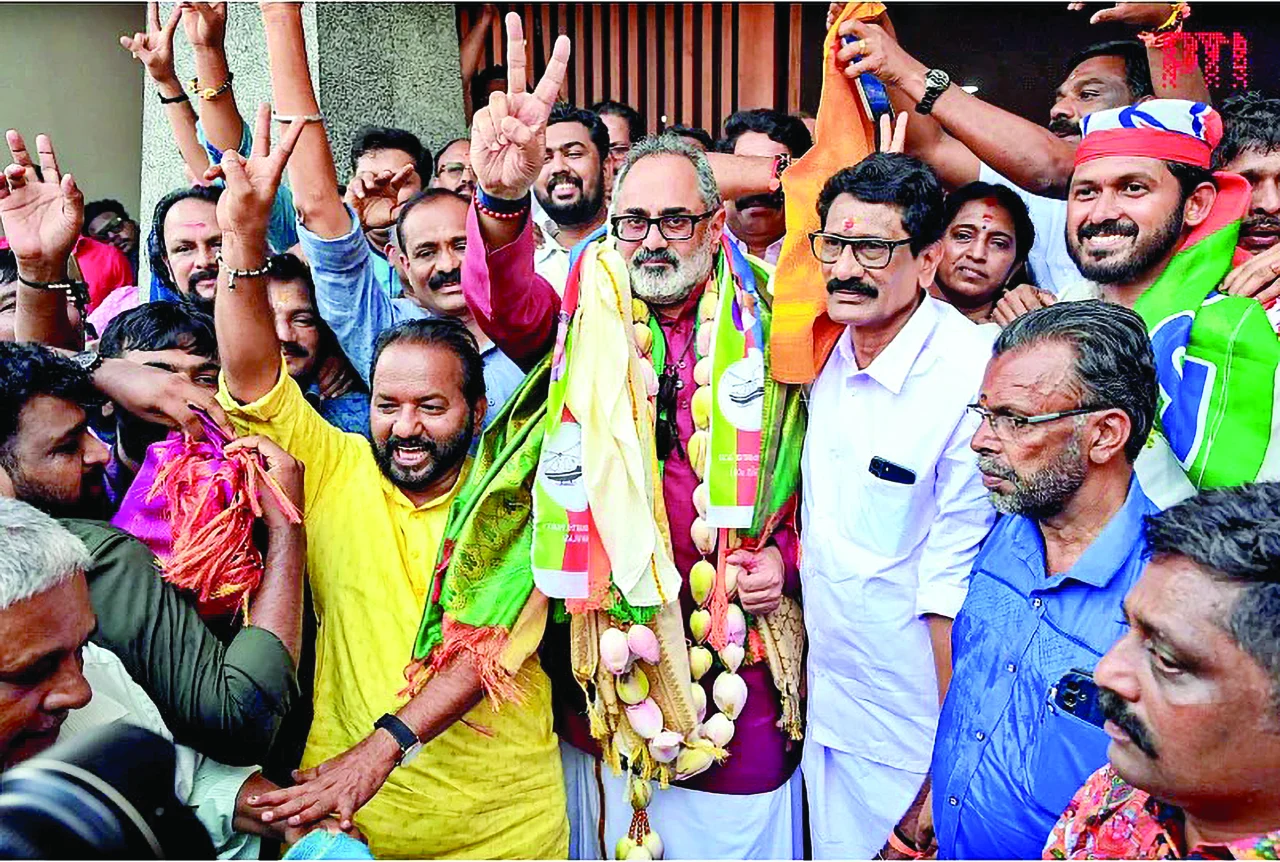
The BJP’s three-seat victory in the 2026 Keralam Assembly election marks not an endpoint, but the beginning of a deeper political shift in the state. With senior leaders Rajeev Chandrasekhar, V. Muraleedharan, and B.B. Gopakumar winning has established a credible and experienced legislative presence in Keralam for the first time since 2016. These leaders are expected to emerge as vocal and visible opposition figures in the Assembly, making it difficult for the new UDF government to ignore the BJP’s growing influence.