Savarkar, 1857 and national war for independence
June 23, 2026
  • Read Ecopy
  • Circulation
  • Advertise
  • Careers
  • About Us
  • Contact Us
Android AppiPhone AppArattai
Organiser
  • ‌
  • Bharat
    • Assam
    • Bihar
    • Chhattisgarh
    • Jharkhand
    • Maharashtra
    • View All States
  • World
    • Asia
    • Europe
    • North America
    • South America
    • Africa
    • Australia
  • Editorial
  • International
  • Opinion
  • RSS @ 100
  • More
    • Op Sindoor
    • Analysis
    • Sports
    • Defence
    • Politics
    • Business
    • Economy
    • Culture
    • Special Report
    • Sci & Tech
    • Entertainment
    • G20
    • Azadi Ka Amrit Mahotsav
    • Vocal4Local
    • Web Stories
    • Education
    • Employment
    • Books
    • Interviews
    • Travel
    • Law
    • Health
    • Obituary
  • Subscribe
    • Subscribe Print Edition
    • Subscribe Ecopy
    • Read Ecopy
  • ‌
  • Bharat
    • Assam
    • Bihar
    • Chhattisgarh
    • Jharkhand
    • Maharashtra
    • View All States
  • World
    • Asia
    • Europe
    • North America
    • South America
    • Africa
    • Australia
  • Editorial
  • International
  • Opinion
  • RSS @ 100
  • More
    • Op Sindoor
    • Analysis
    • Sports
    • Defence
    • Politics
    • Business
    • Economy
    • Culture
    • Special Report
    • Sci & Tech
    • Entertainment
    • G20
    • Azadi Ka Amrit Mahotsav
    • Vocal4Local
    • Web Stories
    • Education
    • Employment
    • Books
    • Interviews
    • Travel
    • Law
    • Health
    • Obituary
  • Subscribe
    • Subscribe Print Edition
    • Subscribe Ecopy
    • Read Ecopy
Organiser
  • Home
  • Bharat
  • World
  • Operation Sindoor
  • Editorial
  • Analysis
  • Opinion
  • Culture
  • Defence
  • International Edition
  • RSS @ 100
  • Magazine
  • Read Ecopy
Home Bharat

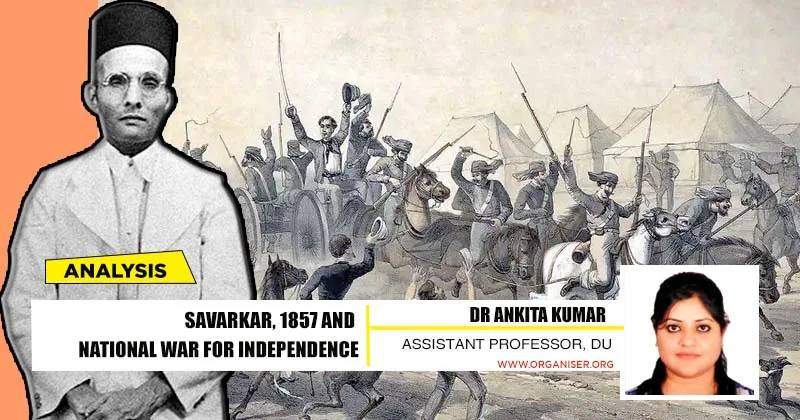
Savarkar, 1857 and national war for independence

To create awareness of exploitative British rule, Veer Savarkar took regional acts of defiance & wove them into a coherent narrative of resistance. Titled ‘The Indian War of Independence, 1857’, this seminal book was aimed at creating asmita (pride) among Bharatiyas. Importantly, the 169th anniversary of this historic revolt falls on May 10, 2026

Dr Ankita KumarDr Ankita Kumar
May 10, 2026, 06:30 am IST
in Bharat, Analysis
Follow on Google News
FacebookTwitterWhatsAppTelegramEmail

History is not merely what happened. It is what is remembered, how it is told, and who tells it. For most of the 19th and early 20th centuries, the story of 1857 was told by the British in dispatches of generals, memoirs of colonial administrators, and academic volumes by historians like John William Kaye and George Bruce Malleson. In their telling, the uprising was a mutiny: localised, irrational, driven by superstition about greased cartridges, and mercifully suppressed by the forces of order and civilisation. It was a story designed to justify an empire, and it was told with the authority that only victors possess.

Vinayak Damodar Savarkar refused to accept that story. When he wrote The Indian War of Independence, 1857, completing it in 1908 at just twenty-four years of age while studying in London, he was not merely offering a different interpretation of the same events. He was performing something more fundamental: an act of memory-making. He understood that a people deprived of their history are deprived of their identity, and that colonial rule operated not only through taxation and law but through the systematic erasure of the colonised people’s capacity to see themselves as agents of their own story. Savarkar set out to restore that capacity. He took scattered events, regional uprisings, disconnected acts of defiance, and wove them into a single, coherent narrative of collective resistance, a narrative that future generations could inhabit, draw strength from, and build upon.

The centrepiece of that narrative, its most powerful and enduring image, is the march from Meerut to Delhi. On the evening of May 10, 1857, soldiers of the Bengal Army at Meerut broke from their barracks, turned their weapons against their British officers, and rode through the night toward Delhi. The immediate provocation, the imprisonment of eighty-five sepoys who had refused to use the new Enfield rifle cartridges, rumoured to be greased with animal fat, offensive to both Hindu and Muslim soldiers, was real enough. But Savarkar understood that explaining the march solely through the cartridge controversy would miss its deeper significance entirely.

What made the march to Delhi the defining act of 1857 was the choice of destination itself. The soldiers did not scatter. They did not retreat to their home villages or melt into the countryside. They marched to Delhi, to the Red Fort, to Bahadur Shah Zafar, the last Mughal emperor, and they declared it the centre of their resistance. This was an act of profound political intelligence. Delhi was not merely a city. It was the historic seat of Indian sovereignty, the symbolic heart of a civilisation that had governed itself for millennia before the British arrived. By converging on Delhi, the rebels announced that they were not merely protesting a policy; they were challenging the very legitimacy of foreign rule and asserting the continuity of an older political order.

Savarkar recognised in this march the germ of national consciousness. This is precisely what Savarkar sought to document and preserve. The genius of his project was not simply that he renamed the mutiny a War of Independence, though that renaming was itself a significant intellectual intervention. The deeper achievement was his insistence that these scattered events added up to something coherent, that they were linked not merely by chronology but by a shared impulse: the refusal of a civilisation to accept the permanent domination of a foreign power. He gave the revolt a narrative spine, and the Meerut-to-Delhi march was that spine’s most vivid expression.

The personalities who emerged from 1857, Rani Lakshmibai, Tantia Tope, Kunwar Singh, and Nana Sahib, became, in Savarkar’s telling, not regional actors defined by their particular circumstances but national heroes defined by their shared defiance. Lakshmibai was not merely the queen of Jhansi resisting annexation through the Doctrine of Lapse, she was the embodiment of a nation that refused dispossession. Tantia Tope was not merely a military commander extending a losing campaign, he was the personification of a resistance that would not concede even when concession seemed inevitable. By placing these figures within a single national narrative, Savarkar gave future generations a gallery of ancestors they could claim regardless of their own region, religion, or community.

The British had understood the power of narrative very clearly. They had spent decades producing histories, gazetteers, and official accounts that told the story of India as a story of British achievement, of order brought to chaos, of civilisation brought to savagery. The implicit message was that Indians had no coherent history of their own, no tradition of self-governance worth recovering, and therefore no legitimate claim to self-determination. Savarkar’s book was a direct assault on this project. By 1909, the British banned it, a measure of how seriously they took the danger of a counter-memory reaching Indian hands.

That ban was itself a kind of tribute. You do not suppress a book that poses no threat. The colonial authorities understood that memory is a form of power, and that Savarkar had produced a text capable of converting 1857 from a closed chapter of failure into an open inheritance of resistance.

The revolt ultimately did not succeed in expelling the British. Delhi fell in September 1857 after months of bitter siege. Yet the memory Savarkar built from these events proved more durable than the military outcome. Generations of freedom fighters drew on the imagery of 1857, the ride from Meerut, the red walls of Delhi, the figures of those who fought and fell, as evidence that resistance was possible, that it had a tradition, that they were not beginning something new but continuing something old.

This is the enduring significance of Savarkar’s project. He did not merely document 1857. He transformed it from a suppressed and misrepresented episode into a founding moment of national memory. The soldiers who rode from Meerut to Delhi on the night of May 10, 1857, could not have known what they were beginning. Savarkar made sure that those who came after them would know, would remember, and would find in that ride a reason to continue.

Topics: Bengal Army at MeerutHindu and Muslim soldiersIndian War of Independence 1857Vinayak Damodar SavarkarMughal Emperor
Dr Ankita Kumar
Dr Ankita Kumar
The writer is Independent Researcher [Read more]
ShareTweetSendShareSend
✮ Subscribe Organiser YouTube Channel. ✮
✮ Join Organiser's WhatsApp channel for Nationalist views beyond the news. ✮
Previous News

Terror threat to Delhi: Security beefed up near BJP HQ, key govt buildings, amid fears of coordinated terror strike

Next News

Democracy for Sale: How prediction markets turned US power into a profitable commodity

Related News

Veer Savarkar (File Image)

Death Anniversary of Veer Savarkar: A great revolutionary and nationalist thinker of the Indian independence movement

Karyakartas of the Rashtriya Swayamsevak sangh

RSS at 100 | Cultural Nationalism in Action: Understanding the RSS’s founding purpose and enduring relevance

Contemporary global scenario is concerning for peace-loving nations: VP Jagdeep Dhankhar at launch of ‘The New World’

Vinayak Damodar Savarkar: A revolutionary icon of India’s freedom struggle

Rahul’s historic blunder! If Savarkar ‘begged to remain obedient servant’ of British, what about Gandhi & Nehru?

BJP MLA T Raja Singh

“Kab tutegi Aurangzeb ki kabr?”: BJP MLA T Raja Singh resolves to make India “Hindu Rashtra”

Load More

Latest News

(Left) Petrol bomb hurled at BJP leader’s clinic opposite newly inaugurated RSS office in Bhatinda (Right) BJP leader Dr Tarsem Garg

Punjab: Petrol bomb hurled at BJP leader’s clinic opposite newly inaugurated RSS office in Bhatinda

Functionaries of Akhil Bharatiya Rashtriya Seva Bharati on the stage release Rashtriya Seva Sadhana–2026

Tamil Nadu: Seva Bharati reviews service initiatives, charts roadmap for future expansion

PM Modi Pays Homage to Jan Sangh Founder Syama Prasad Mookerjee

Balidan Diwas: PM Modi pays tribute to Jan Sangh founder Syama Prasad Mookerjee, hails his nationalist legacy

Odisha Legislative Assembly Speaker Surama Padhy conducting proceedings of the State Assembly in Bhubaneswar. (File Photo)

Odisha Speaker rejects BJD and Congress petitions seeking disqualification of 11 MLAs over Rajya Sabha cross-voting

Bastar Yatra 2026: Inside Chhattisgarh’s unique Goncha festival celebrating Bhagwan Jagannath and tribal traditions

(Left) Dr. Shyama Prasad Mookerjee (Right) of Dr Keshav Baliram Hedgewar

Bengal and the Sangh: The historical bond forged by Dr Keshav Baliram Hedgewar and Shyama Prasad Mookerjee

French President Emmanuel Macron welcomes India's Prime Minister Narendra Modi during the G7 summit, in Evian-les-Bains, France, June 16, 2026.

From Global South to Global Power: Why G7 continues to seek India’s presence and partnership

Remembering Dr Shyama Prasad Mookerjee on his death anniversary – A great Nationalist and architect of political vision

Quetta court awards life imprisonment to Dr Mahrang

Balochistan: Quetta court awards life imprisonment to Dr Mahrang; BYC calls it Pakistan’s hatred towards Baloch masses

(Left) Site of fire at the coaching centre in Lucknow (Right) Trishank Krishna and Virdendra Shukla arrested

Lucknow Coaching Centre Fire: 4 officials suspended, building owners arrested; Regulatory lapses exposed

Load More
  • Privacy
  • Terms
  • Cookie Policy
  • Refund and Cancellation
  • Delivery and Shipping

© Bharat Prakashan (Delhi) Limited.
Tech-enabled by Ananthapuri Technologies

  • Home
  • Search Organiser
  • Bharat
    • Assam
    • Bihar
    • Chhattisgarh
    • Jharkhand
    • Maharashtra
    • View All States
  • World
    • Asia
    • Africa
    • North America
    • South America
    • Europe
    • Australia
  • Editorial
  • Operation Sindoor
  • Opinion
  • Analysis
  • Defence
  • Culture
  • Sports
  • Business
  • RSS @ 100
  • Entertainment
  • More ..
    • Sci & Tech
    • Vocal4Local
    • Special Report
    • Education
    • Employment
    • Books
    • Interviews
    • Travel
    • Health
    • Politics
    • Law
    • Economy
    • Obituary
  • Subscribe Magazine
  • Read Ecopy
  • Advertise
  • Circulation
  • Careers
  • About Us
  • Contact Us
  • Policies & Terms
    • Privacy Policy
    • Cookie Policy
    • Refund and Cancellation
    • Terms of Use

© Bharat Prakashan (Delhi) Limited.
Tech-enabled by Ananthapuri Technologies