In the political imagination of West Bengal, the story of the Rashtriya Swayamsevak Sangh is often narrated as if it were a relatively recent phenomenon—an organization that entered the state only in the shadow of contemporary electoral churn. That telling, however, misses a much longer and deeper historical arc. The relationship between Bengal and the RSS is not new. It stretches back to the 1930s, when the first shakhas, discussions, and ideological activities began to take root in a province that had already long been one of India’s most vibrant centres of intellectual, cultural, and nationalist ferment.
To understand the contemporary expansion of the RSS in Bengal, it is necessary to begin with this older history. Bengal was not merely another province in the organizational map of the Sangh. It was viewed as a region of immense civilizational importance. Leaders such as Madhav Sadashiv Golwalkar, Dattopant Thengadi, and Eknath Ranade understood Bengal not simply as a political geography, but as an intellectual and cultural arena whose influence extended far beyond its borders.
That emphasis has endured. Even during the tenure of the present Sarsanghchalak, Dr Mohan Bhagwat, Bengal has remained a region of special attention. Yet for decades, the RSS remained an organization of limited visible influence in the state. There were reasons for this. First, Bengal’s political landscape was shaped for a long period by the dominance of Left politics. Later, governments that were politically and ideologically opposed to the Sangh ecosystem further constrained its expansion. As a result, for many years the RSS in Bengal was perceived less as a mass social force and more as a small, persistent ideological presence.
But history often changes not through sudden rupture, but through quiet cultural shifts. A particularly important turning point came in 2012–13, during the 150th birth anniversary of Swami Vivekananda. Across Bengal, commemorative programs, lectures, youth gatherings, and cultural initiatives generated a renewed interest in questions of identity, civilizational memory, and national selfhood. For many younger Bengalis, Vivekananda became not merely a spiritual figure but a bridge between cultural pride and public life. It was in that moment that the language of “cultural nationalism” found renewed social energy. This is an important point. The rise of the Sangh in Bengal cannot be understood purely through electoral arithmetic. It must also be seen through the lens of cultural psychology. Bengal’s politics has always involved deeper questions—Who speaks the language of Bengali civilizational confidence? Who engages with its memory, symbols, and intellectual inheritance? Which institutions are able to translate cultural discourse into social organization? The RSS gradually found a wider audience because it began engaging precisely at that intersection.
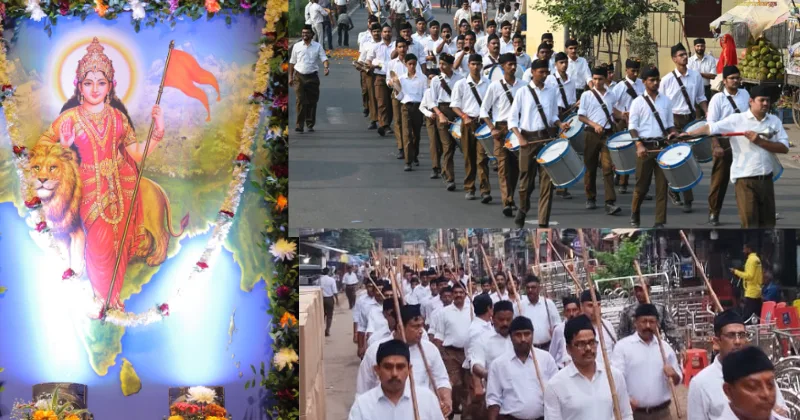
The most visible expression of this change has been organizational growth. Before 2026, the Sangh’s work in Bengal was broadly divided into three major prants—Uttar Banga, Madhya Banga, and Dakshin Banga. Between 2023 and 2025, the organizational structure expanded rapidly, accompanied by a notable increase in the number of shakhas.
In Uttar Banga, the rise was especially striking. This region, with its distinctive social composition and changing political currents, emerged as a particularly dynamic zone of growth. Madhya Banga, which includes districts such as Purba Bardhaman, Paschim Bardhaman, Birbhum, Bankura, Murshidabad, Hooghly and Purulia—also witnessed a steady rise in shakha activity. Dakshin Banga saw equally significant expansion. Here, the number of shakhas reportedly rose from 1,206 to 1,564 over the same period.
In March 2026, the Sangh undertook another important organizational step. The earlier three-prant structure in West Bengal was reorganized into five sambhags. On the surface, this may appear like an internal administrative adjustment. In practice, however, it represents something much more significant. A more decentralized structure allows faster local decision-making, sharper strategic planning, and better micro-level organizational management. In a state as socially layered and regionally diverse as Bengal, such decentralization matters. Yet the Sangh’s expansion in Bengal cannot be measured by shakha numbers alone.
Its organizational method has always rested on a wider ecosystem of affiliated and ideologically aligned bodies. Through this broader network, the Sangh has gradually extended its social presence among youth, students, workers, farmers, women, and cultural groups. This is crucial because institutions endure when they become socially embedded rather than merely politically visible. Over time, this multi-layered expansion has produced not only an ideological base but also emotional and social linkages. That is one of the principal reasons why the Sangh’s presence has become more visible across regions and social segments of Bengal.
No account of the Sangh’s relationship with Bengal is complete without recalling one of the most evocative physical spaces in that history; ‘26 Bidhan Sarani’ in Kolkata. This building, today the RSS Kolkata Mahanagar Karyalay and Prajna Pravah Bengal Karyalay, occupies a remarkable location. On one side stands the revered Thanthania Kalibari. On the other lies the ancestral home of Swami Vivekananda. Long before contemporary political observers began debating the RSS in Bengal, this address had already become an important centre of organizational and ideological activity in eastern Bharat. By around the 1940s, it had emerged as one of the region’s significant karyalays.
Its importance is not merely symbolic. It is said that the name of the Bharatiya Jana Sangh itself was finalized after discussions held there. If one visits the building today, history feels almost tactile. The old wooden staircase still stands. Those steps are not ordinary architectural remnants; they are witnesses to political memory. One can imagine the footsteps of Madhav Sadashiv Golwalkar ascending them. One can think of Atal Bihari Vajpayee, Deendayal Upadhyaya, Eknath Ranade, Dr. Shyamaprasad Mookerjee and other eminent figures who passed through the same corridor of history.
There is another story associated with this address that deepens its place in national memory. When the idea of the Vivekananda Rock Memorial at Kanyakumari was taking shape—built in memory of the sacred visit of Swami Vivekananda—the planning discussions, too, are remembered as having been held at 26 Bidhan Sarani. Recently, in a conversation with a senior sannyasi of Belur Math, this historical memory found a living voice. He recalled: “I visited that karyalay a few times and met Eknath ji. At that time, I was a brahmachari.”
That remark is brief, but it carries the weight of continuity. It reminds us that institutions are not sustained only by documents and archives. They are preserved through memory, lived encounters, and places where ideas were once debated, shaped, and carried forward. The contemporary rise of the RSS in Bengal, therefore, should not be interpreted merely as a recent organizational expansion or as a by-product of immediate political competition. It is better understood as the resurfacing of a longer historical current—one rooted in Bengal’s own intellectual and civilizational landscape.
Whether one agrees with the Sangh ideologically or not, it is difficult to deny that its journey in Bengal has entered a new phase. What was once peripheral is now more socially visible. What was once organizationally limited has become structurally deeper. What was once treated as an external force has increasingly sought to speak through local memory, cultural idiom, and historical rootedness. And perhaps that is where the real story lies. Not only in the rise of shakhas. Not only in organizational charts. But in the quiet way Bengal’s past, memory, and cultural self-awareness continue to shape its political future.