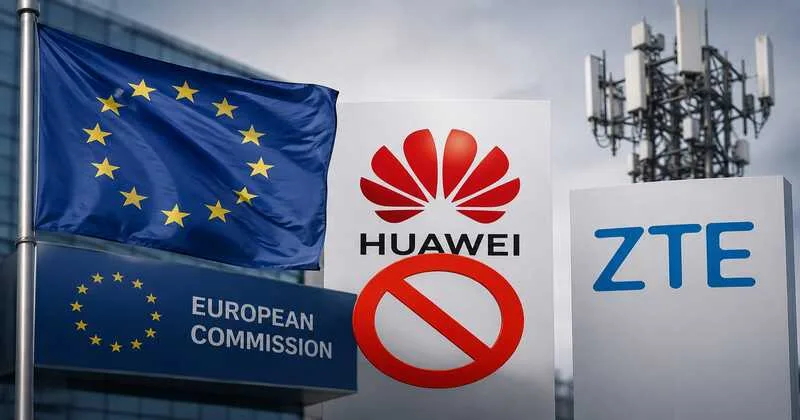
Brussels: The European Commission has renewed pressure on European Union member states to remove Huawei and ZTE equipment from telecom infrastructure, arguing that the Chinese firms pose significant cybersecurity risks to the bloc’s digital networks. During a briefing in Brussels on Monday, a Commission spokesperson recommended that all 27 EU nations exclude equipment made by Huawei and ZTE from operators’ connectivity infrastructure. The recommendation comes as the EU discusses new cybersecurity legislation that could allow authorities to ban equipment supplied by what it describes as “high-risk suppliers” across the European market.
The move marks the latest stage in a years-long effort by the EU to tighten security around 5G and telecommunications networks. Concerns have centred on the possibility that foreign-linked suppliers could expose sensitive infrastructure to cyberattacks, espionage, or outside political influence.
The European Union first adopted its 5G cybersecurity toolbox in January 2020. That framework offered guidance to governments and telecom operators on assessing security threats and restricting high-risk vendors from both core and accessible parts of telecom networks. In June 2023, the European Commission stated that restrictions imposed by some member states on Huawei and ZTE were justified.
The Commission argued that the two Chinese companies presented “materially higher risks” compared with other 5G suppliers because of their links to third-country legislation concerning intelligence gathering and data security.
Revised cybersecurity rules advance
The EU’s push has since moved toward binding legislation. On Jan. 20, the Commission proposed revisions to the Cybersecurity Act aimed at converting many earlier recommendations into enforceable rules. Among the measures included were plans to phase out critical components supplied by high-risk vendors from mobile networks. Telecom operators could be given roughly 36 months to comply with the proposed requirements. China has reacted sharply to the plans. Last week, Beijing warned it could take countermeasures if the EU implemented the rules in what Chinese authorities called a discriminatory manner. China’s commerce ministry said possible responses could include investigations into European firms and reciprocal actions against EU businesses. EU officials, however, insist that the measures are based on objective security evaluations rather than geopolitical targeting of a specific country.
Several EU member states have already taken steps against Huawei and ZTE equipment, though implementation differs across the bloc. Sweden and the Baltic states have imposed full bans on the Chinese suppliers, while Germany is gradually removing their equipment from national telecom infrastructure. In some countries, the high cost of replacing existing systems has slowed the process. The proposed cybersecurity rules still require approval from EU governments and the European Parliament before they can become law. Meanwhile, the Commission continues to stress that telecom networks handle sensitive information and support essential services, including emergency communications and financial transactions.