
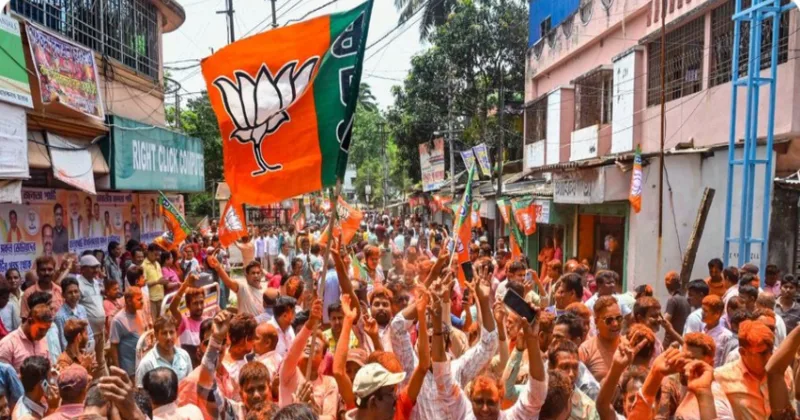
The present political moment in Bengal carries an uncommon historical resonance. It is not confined to the transactional domain of elections, nor does it rest merely on the calculus of seats and margins. Rather, it reflects a deeper churn within society, a quiet yet firm assertion that Bengal seeks to rediscover its equilibrium between governance, culture, and progress. What is unfolding is best understood as a civilizational correction, a conscious effort by the people to align the state’s political direction with its enduring intellectual and cultural inheritance.
Bengal has, for centuries, occupied a distinctive position in India’s national life. It has been a cradle of reformist thought, a theatre of resistance, and a fountainhead of artistic and literary excellence. The Bengal Renaissance was not a singular event but a continuum of awakening that influenced the trajectory of the entire nation. That legacy, shaped and articulated by visionaries such as Sri Aurobindo, continues to define the moral and philosophical foundations of the region. His articulation of India as a living Shakti, a dynamic and spiritual force, offers a framework through which Bengal’s present aspirations can be understood.
In the political realm, the legacy of Syama Prasad Mukherjee remains equally instructive. His insistence on unity, institutional integrity, and national coherence was not merely a response to the exigencies of his time but a forward looking doctrine. His words, advocating a united Bengal within a united India, resonate today as a reminder that political consolidation must always be accompanied by social harmony and administrative clarity. The contemporary mandate, therefore, is not an isolated phenomenon but part of a longer historical arc that seeks to restore these foundational principles.
The emerging public sentiment appears to reflect a desire for stability and accountability. It suggests that citizens are increasingly unwilling to accept governance structures that are perceived as opaque or inefficient. Instead, there is a clear preference for systems that are transparent, predictable, and oriented towards public welfare. This shift in expectations is significant because it redefines the relationship between the state and the citizen. Governance is no longer seen as a distant authority but as a responsive mechanism that must deliver measurable outcomes.
At the same time, it is essential to recognise that such a mandate carries with it a profound responsibility. Electoral success, while important, is only the initial step in a much larger process of institutional transformation. The real challenge lies in translating political intent into administrative action. This requires not only policy innovation but also the capacity to implement those policies effectively across diverse and often complex socio economic contexts.
One of the most critical areas demanding attention is the issue of structural distortions within the economy and administration. Over time, informal networks of influence have come to exert a disproportionate impact on sectors such as construction, local commerce, and public service delivery. These networks, often described as syndicates, operate outside the formal regulatory framework, thereby undermining both efficiency and fairness. Addressing this challenge necessitates a comprehensive approach that combines legal enforcement with systemic reform. Digital governance, transparent procurement processes, and robust oversight mechanisms can play a pivotal role in dismantling such structures and restoring public confidence.
Equally significant is the question of border management and internal security. Bengal’s geographical location, particularly its proximity to Bangladesh, presents both opportunities and challenges. While cross border interactions can facilitate trade and cultural exchange, they also require vigilant monitoring to prevent illicit activities such as trafficking and smuggling. Strengthening border infrastructure, enhancing coordination among security agencies, and leveraging technology for surveillance are essential components of an effective response. At the same time, these measures must be implemented in a manner that respects human rights and maintains the delicate balance between security and openness.
Another dimension that warrants careful consideration is the demographic evolution of the state over the past several decades. Changes in population patterns have implications for resource allocation, urban planning, and social cohesion. Addressing these issues requires a nuanced understanding of local contexts and a commitment to inclusive development. Policies must be designed to ensure that growth benefits all sections of society, thereby reducing disparities and fostering a sense of shared progress.
Economic revitalisation is, without doubt, central to Bengal’s future trajectory. The state possesses significant advantages, including a strategic location, a skilled workforce, and a rich tradition of entrepreneurship. However, unlocking this potential requires a clear and coherent development strategy. Investment in infrastructure, particularly in transport and digital connectivity, can create the foundation for sustained growth. Simultaneously, fostering innovation through start up ecosystems, research institutions, and skill development programmes can position Bengal as a hub of knowledge driven industries.
In this context, the role of technology assumes critical importance. The integration of digital tools into governance and economic activity can enhance efficiency, reduce corruption, and improve service delivery. From e governance platforms to data driven decision making, technology offers the means to bridge gaps between policy and practice. However, its success depends on careful implementation and continuous adaptation to evolving needs.
Cultural renewal, too, must form an integral part of this broader transformation. Bengal’s identity is deeply intertwined with its artistic and intellectual traditions. Preserving and promoting this heritage is not merely a matter of nostalgia but a strategic imperative. Cultural industries, including literature, music, and tourism, have the potential to contribute significantly to the economy while also reinforcing social cohesion. A balanced approach that integrates cultural preservation with modern development can create a distinctive model of progress.
For the Bharatiya Janata Party, the current moment represents both an opportunity and a test. The opportunity lies in the possibility of shaping a new governance paradigm, one that aligns with the aspirations of the people and the imperatives of the time. The test lies in the ability to deliver on these expectations in a consistent and credible manner. Success will depend not only on policy choices but also on the quality of leadership and the strength of institutions.
It is important, therefore, to approach this phase with a sense of humility and purpose. Political transitions, while significant, do not automatically translate into systemic change. They must be accompanied by sustained effort, continuous evaluation, and a willingness to adapt. The focus must remain on outcomes rather than rhetoric, on long term impact rather than short term gains.
Ultimately, the story of Bengal at this juncture is one of possibility. It is a narrative that combines memory with aspiration, tradition with innovation, and mandate with responsibility. If guided by wisdom and executed with integrity, the present moment can indeed mark the beginning of a genuine renaissance. Such a renaissance would not only restore Bengal’s historic stature but also contribute meaningfully to the broader trajectory of national development.
In this sense, the mandate is more than a political endorsement. It is an invitation to rebuild, to reform, and to reimagine. It calls for a collective effort to transform challenges into opportunities and aspirations into achievements. The path ahead may be complex, but it is also rich with promise. Bengal, once again, stands ready to lead, provided its energies are harnessed with clarity, courage, and conviction.