Representative Image
The verdict in West Bengal has done more than alter the arithmetic of seats. It has opened a larger debate about identity, political memory, and the meaning of Bengali ashmita in contemporary public life. For years, Bengal’s politics was framed around the argument that cultural identity belonged exclusively to one political camp. The slogan “Bangla nijer meyekei chay” and repeated invocations of “Joy Bangla” were presented as the authentic voice of Bengali pride. Yet the recent electoral verdict suggests that voters have drawn a distinction between political branding and civilizational belonging. The rise of the Bharatiya Janata Party in Bengal, culminating in a decisive mandate, is therefore not merely an electoral event. It reflects the emergence of a more rooted and historically conscious Bengali identity.
For nearly a decade, the ruling establishment attempted to construct a political narrative in which Bengali identity was portrayed as something fragile, perpetually under threat from external forces. That narrative was deliberately designed to create a binary: one side supposedly stood for Bengal, the other against it. The emotional appeal was obvious. Bengal has a deep literary, intellectual, and cultural inheritance, and any political formation that successfully claims to be its custodian can gain enormous symbolic legitimacy. But slogans alone cannot sustain cultural ownership. The problem with this manufactured version of ashmita was that it often reduced Bengal’s vast civilizational inheritance into a narrow electoral instrument. “Joy Bangla” may carry emotional resonance in parts of the Bengali-speaking world, but its political deployment in recent years often invited uncomfortable associations beyond Bengal’s own historic experience. Many ordinary Bengalis began to feel that a slogan, however energetic, could not by itself represent the depth of their heritage—a heritage shaped by reformers, philosophers, nationalists, poets, spiritual leaders, and freedom fighters.
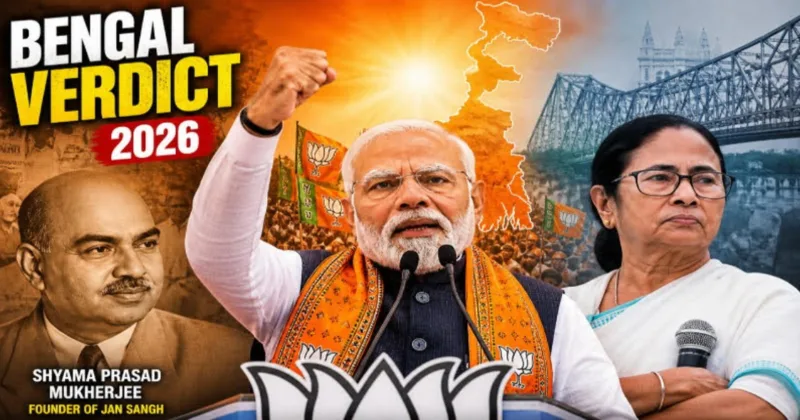
Political identity becomes fragile when it is reduced to immediate electoral symbolism. Bengal’s cultural memory is far richer, deeper, and more layered than the vocabulary of campaign rallies. Bengali ashmita cannot be constructed merely through performative rhetoric. It must emerge from historical continuity, intellectual inheritance, and civilizational contribution. That is where the legacy of Shyama Prasad Mukherjee becomes central. He was not an outsider to Bengal; he was one of modern Bengal’s most significant political and intellectual figures. Son of the celebrated educationist Ashutosh Mukherjee, Shyama Prasad belonged to a tradition that linked scholarship, public life, and civilizational self-confidence. His political career was rooted in Bengal’s intellectual world, not imported from elsewhere. Most importantly, the political tradition that later evolved into today’s BJP begins with him. On 21 October 1951, Shyama Prasad Mukherjee founded the Bharatiya Jana Sangh, which later became the BJP in 1980. That is not merely a partisan talking point; it is a historical fact.
This fact matters because it directly challenges one of the most repeated political narratives in Bengal—that the BJP is somehow an “outsider” force imposed upon the state. How can a political stream founded by one of Bengal’s own foremost sons be reduced to an external phenomenon? The roots of the party’s ideological lineage are intertwined with Bengal’s own political history. To ignore that is to simplify history for electoral convenience. The argument is larger than party genealogy. It also concerns the meaning of cultural authenticity.
Real Bengali ashmita has never been narrow. Bengal’s selfhood was shaped by figures who combined cultural rootedness with national imagination—Bankim Chandra Chattopadhyay, Swami Vivekananda, Rabindranath Tagore, Subhas Chandra Bose, and Shyama Prasad Mukherjee. Their Bengal was intellectually confident, civilizationally aware, and deeply connected to the larger Indian national project. That tradition did not see Bengali Identity and Indian identity as rivals. It saw them as complementary. This is precisely why contemporary political discourse in Bengal often feels inadequate. Too often, cultural pride has been reduced to theatrical symbolism, selective historical invocation, and short-term political messaging. But a society with Bengal’s civilizational depth eventually asks a more serious question: who genuinely carries forward Bengal’s intellectual and political inheritance?
A landslide electoral verdict, especially one marked by large victory margins across constituencies, would therefore carry significance beyond party competition. Margins matter in politics because they indicate more than numerical success. Narrow victories may reflect temporary coalition-building or fragmented opposition. Large margins often suggest something deeper—a shift in public mood, a consolidation of confidence, and a broader legitimacy granted by voters. If such a verdict emerges in Bengal, it would reflect not merely anti-incumbency but a positive mandate. It would indicate that a substantial section of the electorate sees political change as culturally legitimate, historically rooted, and politically necessary. That would also tell us something important about generational political change in Bengal.
A new generation of voters is participating in politics with different instincts. They are more exposed to national political currents, more connected to digital political debate, and often less willing to accept inherited narratives without scrutiny. They increasingly ask historical questions, compare ideological claims, and evaluate political symbolism more critically than previous generations. In that sense, a decisive shift toward the BJP would not simply mean support for a party. It would also suggest a reconsideration of the stories Bengal tells itself about identity, belonging, and political ownership.
For decades, one political habit in Bengal held that cultural authenticity belonged permanently to one ideological camp. But no democracy can sustain monopolies over identity forever. Sooner or later, citizens reclaim the right to reinterpret their own history. That process appears increasingly visible. To say this is not to deny that Bengal’s identity remains plural, layered, and internally contested. It has always been so. Nor does electoral victory settle every historical debate. It does not. But politics often reveals which historical memory resonates most strongly at a given moment. And if the political current rooted in Shyama Prasad Mukherjee receives a powerful popular endorsement in Bengal, that will carry undeniable symbolic force. It will mean that a significant number of Bengalis do not see the BJP as an alien arrival. They see it as part of a political inheritance that, in important ways, began in Bengal itself. That would be a remarkable political moment.
For then the story would no longer be framed as an outside force entering Bengal. Rather, it would be understood as a political tradition returning to one of its original homes. In that sense, the meaning of such a verdict would extend beyond the immediate contest for power. It would speak to history. It would speak to memory. And above all, it would speak to a renewed argument over what real ‘Bengali ashmita’ truly means.
