Vote counting for the 2026 Assembly elections is revealing a striking early pattern across states, with three sitting Chief Ministers trailing in their respective strongholds, pointing to a strong wave of anti-incumbency and a volatile political mood among voters.
Three Chief Ministers trail in early trends
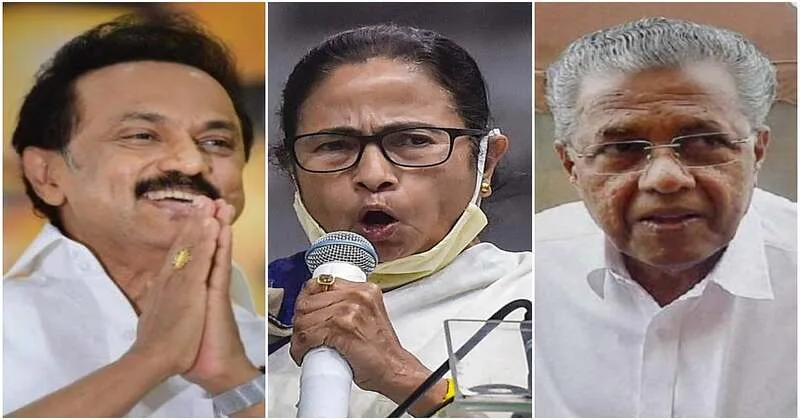
In a major political development, Keralam Chief Minister Pinarayi Vijayan has slipped to the second position in the Dharmadam constituency after the second round of counting. The United Democratic Front (UDF) candidate V.P. Abdul Rasheed has surged ahead with a lead of 2,523 votes, overturning the early advantage held by the Left Democratic Front (LDF). Dharmadam, long seen as Vijayan’s stronghold, had delivered him a victory margin of over 50,000 votes in 2021, making the current trend particularly significant.
In Tamil Nadu, Chief Minister M.K. Stalin is also trailing from his bastion, the Kolathur seat. He is currently behind Tamilaga Vettri Kazhagam (TVK) candidate VS Babu by more than 1,200 votes in early rounds. Stalin, who has held Kolathur since 2011 and won by a massive margin in 2021, now faces an unexpectedly tight contest.
Meanwhile, in West Bengal, Chief Minister Mamata Banerjee is trailing in the high-profile Bhabanipur constituency. Suvendu Adhikari of the BJP has taken an early lead with 6,380 votes, maintaining a margin of 1,558 votes over Banerjee, who has secured 4,822 votes so far. The constituency, considered a prestige battle, is witnessing a closely fought contest as counting progresses.
Anti-incumbency wave across states
The early trends across Keralam, Tamil Nadu, and West Bengal suggest a broader pattern of anti-incumbency sentiment among voters. In Keralam, apart from Vijayan, as many as 14 ministers from the 19-member cabinet are reportedly trailing in their constituencies, signalling widespread dissatisfaction with the ruling dispensation.
In Tamil Nadu, the challenge to the incumbent government appears to be coming from new political forces. The Tamilaga Vettri Kazhagam, led by C. Joseph Vijay, has emerged as a major player, leading in 98 out of 234 constituencies. This has significantly altered the traditional contest between the DMK and AIADMK alliances.
Similarly, in West Bengal, the Trinamool Congress is facing stiff resistance from the BJP, which is leading in over 150 seats according to early trends. The scale of the BJP’s lead indicates a strong anti-incumbency push against the ruling party.
Tight races and shifting political landscape
Despite the early leads, several constituencies remain tightly contested, and the final outcomes are yet to be determined. In Bhabanipur, Suvendu Adhikari has expressed confidence that his lead will widen as more rounds of counting are completed, even as Mamata Banerjee remains within striking distance. In Tamil Nadu, the Kolathur seat continues to witness a close fight, with Stalin expected to gain ground in later rounds. At the same time, Udhayanidhi Stalin is trailing in Chepauk-Thiruvallikeni, another key constituency for the DMK. As counting continues, the early trends point to a potentially transformative electoral verdict, with anti-incumbency emerging as a decisive factor and established political strongholds facing unprecedented challenges.